
Comparisons
Pushups vs Bench Press: Kinematics and Activation
Explore pushups vs bench press: a rigorous comparison of kinematics, muscle activation, and loading for training guidance.


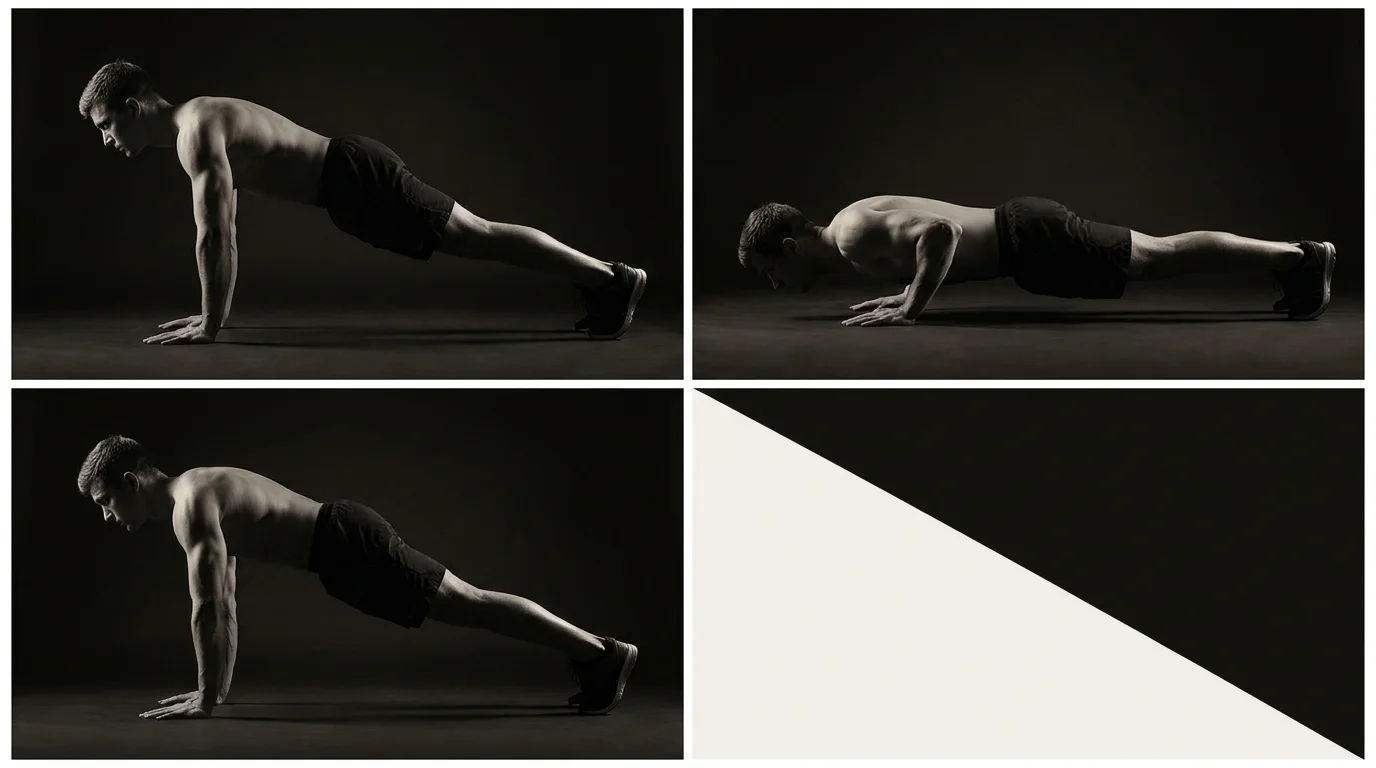
Kinematics and Range of Motion Across Loads
Kinematic profiles at representative loads (50%, 65%, 80% 1RM)
- 50% 1RM: Pushups are closed-chain, so floor contact helps stabilize the trunk as the shoulder and elbow move through a broader, smoother arc; the bench-press version at light load uses a controlled bar path with hips braced and feet planted.
- 65% 1RM: Depth and speed taper in both, but push-ups retain more scapular movement due to floor contact, while the bench press emphasizes a steady bar path and consistent elbow draw-in.
- 80% 1RM: ROM shortens in both. Push-ups may limit depth to protect the chest and shoulders; bench press often touches the chest with a braced, rigid torso and a tighter elbow angle.
Shoulder and elbow ROM across push-ups and bench presses
Pushups tend to show more variation in scapular motion and a larger shoulder arc; bench presses favor a more consistent elbow angle and closer shoulder adduction, especially as load rises.
Influence of hand position and bench height on joint angles
Narrow hand spacing reduces elbow flare and shifts load toward triceps; wide spacing increases chest involvement. Lower bench height or higher feet shift start angles, nudging shoulder flexion and elbow range differently between the two lifts.
Muscle Activation and EMG Across Loads
EMG patterns shift as loads rise, even though the same trio—pectoralis major, anterior deltoid, and triceps—drives the movement in both push-ups and the bench press. When we express work as loads as percentage of 1RM, you often see stronger activation in the pectorals and deltoids with heavier loads, while stabilizers step up in demand, especially in push-ups.
EMG normalization: MVC vs peak across loads
- MVC (MVIC) normalization uses a maximal voluntary contraction as the reference. Pros: stable baseline and easier cross-study comparison. Cons: hard to sustain max effort, may not reflect dynamic task demand.
- Peak across loads normalization uses the highest EMG within each load condition. Pros: mirrors actual task demand. Cons: more variable across sessions.
- Practical takeaway: when comparing push-up muscle activation to bench press muscle activation, note which method was used, and treat high-load comparisons with that context in mind.
Muscle-specific activation patterns (pectoralis major, anterior deltoid, triceps)
- Pectoralis major tends to rise with heavier loads in both tasks; spread of hand spacing subtly shifts emphasis.
- Anterior deltoid is more sensitive to bench angle and grip, showing variable activation as loads climb.
- Triceps often increase activation with heavier loads, especially in the bench press.
Open-chain vs closed-chain activation differences and hand spacing effects
- Open-chain (bench press) isolates elbow extension more, with robust triceps and chest involvement; stabilization demands are less from the trunk.
- Closed-chain (push-up) recruits more scapular/thoracic stabilizers; hand spacing matters: wider grip boosts chest activation, narrower grip shifts toward triceps.
- Bench height/angle also shifts emphasis: incline targets upper pectoralis and anterior deltoid; flat favors overall chest engagement.
Practical Training Implications, Protocols, and Limitations
Translating EMG and kinematics into training protocols
- EMG push-up bench press data provide directional cues for strength and hypertrophy. Pushups can reach substantial chest activation with proper form; bench press muscle activation remains high when angles favor pressing.
- Blend both moves: begin cycles with bench press–style loading (using %1RM equivalents) and finish with pushup progressions (weighted pushups) to accumulate volume. Use controlled tempos to extend time under tension, aligning with observed activation patterns.
Practical adjustments: bench height, hand spacing, and progressive loading
- Bench height: incline pushups (hands higher) reduce ROM and load; lower height increases chest engagement.
- Hand spacing: wide grip favors chest; narrow grip favors triceps; keep wrists neutral.
- Progressive loading: add reps, then load (weighted vest) or tempo variation; translate bench loads to pushups using loads as percentage of 1RM and percent bodyweight equivalents for progression.
Limitations, population considerations, and future directions
- Note limitations of sample size and methods; apply findings as guidelines.
- Consider populations (novices, athletes, shoulder risk) and tailor progressions; future work should examine fatigue and long-term adaptations.
Frequently asked questions
Is a push-up as effective as a bench press for chest muscle development?
Both exercises recruit the pectoralis major, but the bench press loads the chest more directly with a steadier torso, while push-ups rely more on scapular stabilizers and the core. For focused chest development, heavier bench pressing is typically more efficient, though push-ups contribute with progression and variations.
Do push-ups activate the same muscles as the bench press, and by how much?
Both target the pectoralis major, anterior deltoid, and triceps, but push-ups recruit more scapular stabilizers and core due to fixed hand placement, whereas the bench press emphasizes a steadier bar path and elbow-driven load.
How does the load percentage (e.g., 50–80% of 1RM) affect muscle activation in both exercises?
As load increases from 50% to 80% 1RM, activation of the chest and front deltoids tends to rise in both exercises, and trunk/stabilizer demand increases more for push-ups. At the same time, range of motion generally shortens at higher loads.
Which exercise is better for shoulder health and joint stability?
Push-ups promote shoulder stability by strengthening scapular stabilizers and the core; bench presses load the chest and deltoids with a steadier torso, so both can be safe with proper form, but push-ups may offer greater joint-stabilization benefits.
About the authors

Goran Huskić
Co-founder · Professional basketball player
Goran Huskić is a Serbian professional basketball player — a 6'11" center currently playing for Monbus Obradoiro in Spain's Primera FEB. He won the 2019–20 Basketball Champions League with San Pablo Burgos and has competed professionally across Spain, Germany, Lithuania, Serbia and the United States. He co-founded PUSHapp to bring pro-level training discipline to everyday workouts.

Nikola Janković
Co-founder · Former professional basketball player
Nikola Janković is a former professional basketball player — a 6'9" forward and the 2016–17 ABA League MVP — who played for Partizan, Union Olimpija and Mega, among others. Today he runs a pilates studio and gym focused on strength, mobility and overall wellbeing. He co-founded PUSHapp to make consistent, measurable training simple for everyone.