
Comparisons
Pushups vs Dips: Which Activates More Muscle
Compare pushups vs dips to understand muscle activation, biomechanics, and safety. Learn which options best support chest, triceps, and shoulder health.


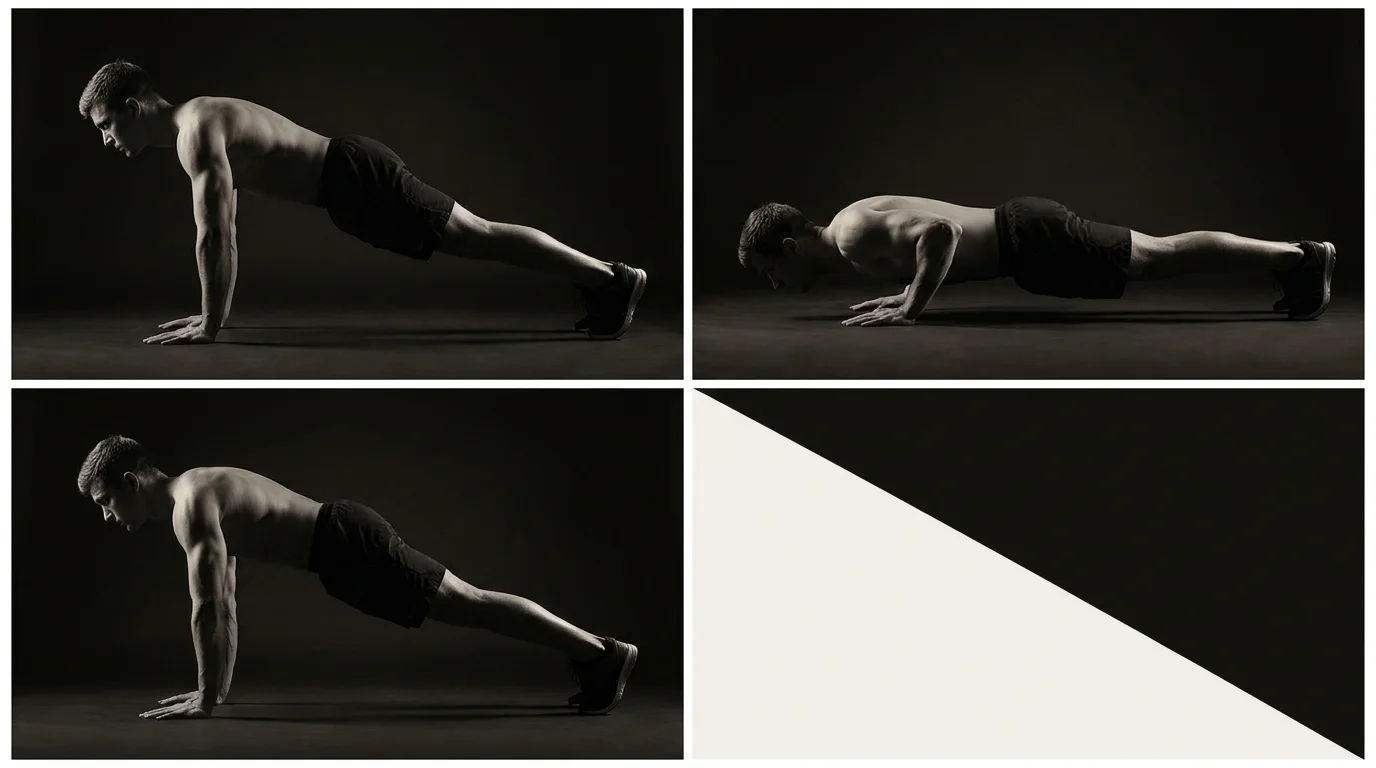
Biomechanics and Muscle Activation: Pushups vs Dips Across Variations
Joint angles and kinematics across dip variations (bench, bar, ring)
- Bench dips keep the torso relatively upright; bottom elbow flexion is around 90–100 degrees, loading more on the triceps with less stretch on the pectorals.
- Bar dips allow a deeper elbow bend and more forward lean, shifting work toward the pectoralis major and increasing scapular protraction at the bottom.
- Ring dips introduce instability, demanding greater scapular control and trunk bracing; this tends to elevate serratus anterior involvement and core activation, with pectoral engagement depending on ring height and depth.
EMG expectations: pecs, delts, serratus anterior, and trunk muscles
- Pushups vs dips both recruit pectoralis major, but dips—especially ring or bar variations—often raise anterior deltoid and serratus anterior activation due to shoulder extension and protraction.
- Ring dips increase trunk and serratus activation because stabilizing the rings requires more core work.
- EMG results vary with depth, tempo, and form, so use them as a guide, not a rule.
Effect of trunk position on activation during push-ups
- A neutral spine with braced core promotes steady pectoralis major and serratus anterior engagement.
- Excessive arch or sag shifts load toward the spine and shoulders, reducing chest emphasis and increasing compensatory trunk effort.
Safety, Shoulder Health, and EMG Evidence: Who Should Do Pushups or Dips
Shoulder safety signals: pain, impingement risk, and depth control
- Stop if you feel sharp shoulder pain, numbness, or weakness during a pushup or dip.
- Watch for impingement signs: pain at the front of the shoulder or with overhead reach; reduce depth if it appears.
- Use shallow ranges and keep the scapula and spine stable; progress depth only as your control allows.
Dips vs push-ups for shoulder health: safety considerations and when to avoid
- Are dips safe for shoulder health compared to push-ups? Pushups generally place less anterior load on the shoulder; dips can compress and strain the front of the joint if depth is excessive.
- When to avoid: existing shoulder pain, rotator cuff tendinopathy, or a history of impingement. If pain worsens with dipping, switch to pushups or incline versions.
Protection cues: scapular control, elbow alignment, and progressive loading
- Scapular control: keep blades down and stable; avoid shrugging.
- Elbow alignment: hug elbows in about 45–60 degrees from the body.
- Progressive loading: start with incline pushups or shallow dips, then gradually increase depth as technique and tolerance improve; EMG evidence (pushups vs dips EMG study) supports similar chest/triceps activation but warns of greater anterior shoulder load with deeper dips.
Practical Progressions and Program Design: Integrating Pushups and Dips for Chest, Triceps, and Core
Beginner pathways: from wall push-ups to bench dips and progressing to bar or ring dips
- Start with wall push-ups or incline push-ups to build scapular control and core engagement.
- Progress to knee push-ups, then standard push-ups on the floor as form improves.
- For dips, begin with bench dips, focusing on controlled descent and elbow tracking.
- Progress to bar dips or ring dips as strength grows; use bands for assistance if needed.
Choosing for chest vs triceps vs core: tailoring push-up and dip variants
- Chest: decline push-ups, wide push-ups, ring push-ups with a forward lean; dips with a forward lean.
- Triceps: close-grip push-ups or bench dips with hips supported; bar dips with elbows close to the body.
- Core engagement: maintain a solid plank through push-ups; ring push-ups require a stable torso; control tempo.
Integrated routines: balancing pushups and dips for shoulder health and overall development
- Alternate days: pushups-focused session, then dips-focused session, integrating pushups and dips across the week; finish with a core set.
- Balance total weekly volume; avoid deep dips on consecutive days; scale depth and tempo.
- Include scapular resets and light rotator cuff work as part of warm-ups.
Frequently asked questions
Which is better for chest development: push-ups or dips?
Both can develop the chest, but dips tend to load the chest more when you lean and descend deep, whereas push-ups are a safer, shoulder-friendlier option with solid chest engagement when you keep elbows at a moderate angle.
Do dips activate the triceps more than push-ups?
Yes, dips typically bias the triceps more, especially with a closer grip and controlled descent, though push-ups still recruit the triceps—particularly near lockout.
Are dips safe for people with shoulder pain?
Dips can aggravate shoulder pain; avoid deep dips, excessive elbow flare, and use incline or bench variations, stopping if pain worsens.
How should beginners progress from push-ups to dips?
Start with incline push-ups to build strength, then move to shallow bench or assisted dips while maintaining scapular control and a safe elbow angle; deepen the dip only as control and pain-free ROM improve.
About the authors

Goran Huskić
Co-founder · Professional basketball player
Goran Huskić is a Serbian professional basketball player — a 6'11" center currently playing for Monbus Obradoiro in Spain's Primera FEB. He won the 2019–20 Basketball Champions League with San Pablo Burgos and has competed professionally across Spain, Germany, Lithuania, Serbia and the United States. He co-founded PUSHapp to bring pro-level training discipline to everyday workouts.

Nikola Janković
Co-founder · Former professional basketball player
Nikola Janković is a former professional basketball player — a 6'9" forward and the 2016–17 ABA League MVP — who played for Partizan, Union Olimpija and Mega, among others. Today he runs a pilates studio and gym focused on strength, mobility and overall wellbeing. He co-founded PUSHapp to make consistent, measurable training simple for everyone.