
Muscles & Benefits
Spiderman Pushups Muscles Worked: Chest & Core
Discover spiderman pushups muscles worked and how this variation targets chest, core, hips, and upper body for stronger push-ups.


Muscles Worked: Chest, Core, and Hip Mobility in Spiderman Pushups
Primary movers and stabilizers
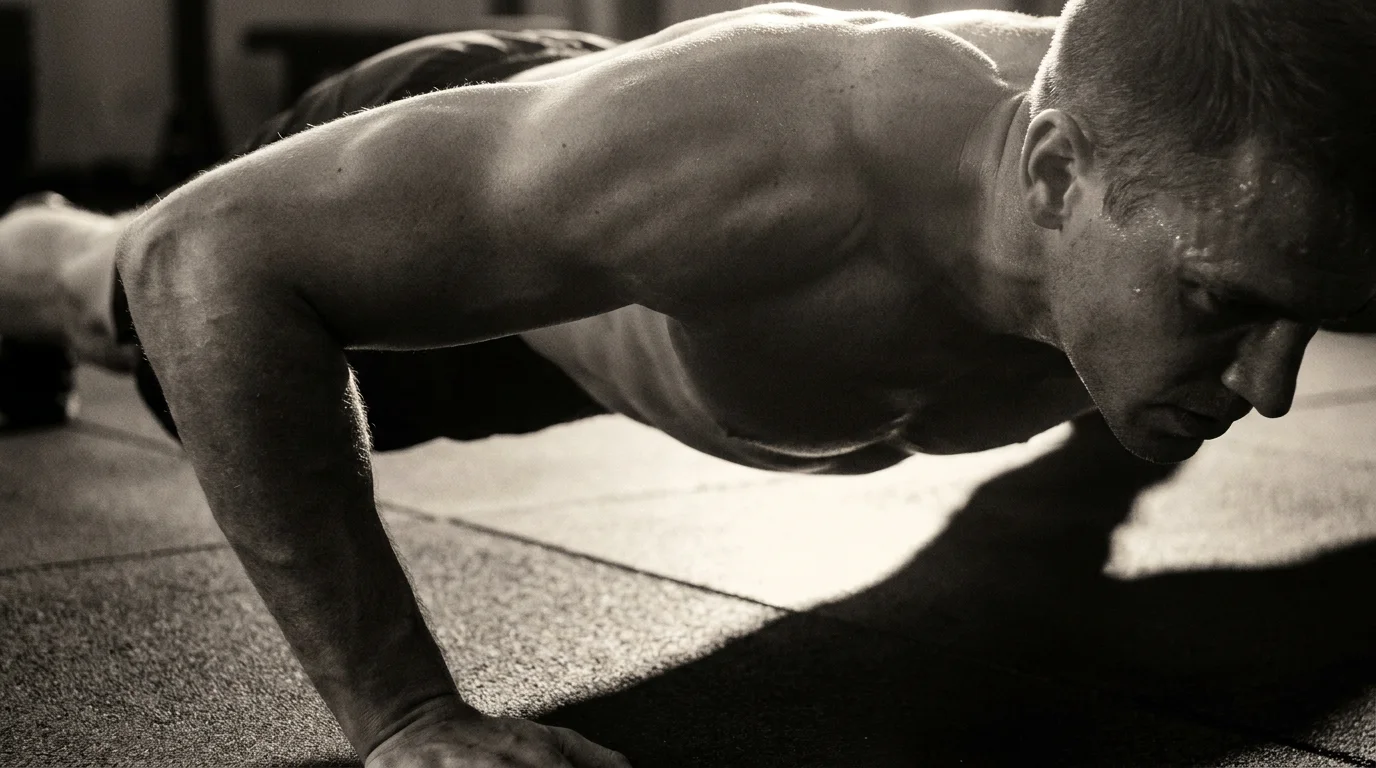
Spiderman pushups muscles worked extend beyond a standard pushup. What muscles do spiderman pushups work? The chest leads with the pectoralis major, assisted by the anterior deltoids and triceps. The core drives stability—the rectus abdominis and obliques resist twisting during the knee-to-elbow path, supporting spiderman pushups core engagement. Hip flexors (iliopsoas, rectus femoris) and glutes (gluteus maximus) power and control the leg drive, while hip external rotators in push-ups (piriformis, obturators, gemelli, quadratus femoris) guide knee alignment. Upper back work comes from rhomboids and trapezius to keep the thoracic spine steady. This movement doubles as hip mobility push-up, challenging hip stability as you move.
Hip mobility and ROM during reps (approximate degrees)
- Hip flexion: roughly 40–60°
- Hip external rotation: about 15–25°
- hip ROM degrees in Spiderman pushups: ~40–60° flexion with 15–25° external rotation
Scapular and upper-back engagement to support thoracic stability
Serratus anterior and upper-back muscles coordinate scapular control to maintain a tall, stable spine throughout the rep.
Form, Cues, Variations, and Core-Stability Demands
Key technique cues for solid form
- Start in a solid high plank: hands under shoulders, body in one line, core braced, hips level. This is your spiderman push-up form guide on how to do spiderman pushups correctly.
- Lower with a knee driving toward the same-side elbow; keep the spine neutral and the core braced. The knee-to-elbow action highlights spiderman pushups muscles worked obliques.
- Keep shoulder blades stable with a light downward press; avoid excessive elbow flare.
- Exhale on the push back to start; eyes forward, neck in a neutral line.
Common mistakes and fixes
- Hips sag or twist: brace harder, tighten glutes, shorten the range as needed.
- Knee misses elbow: guide the knee straight to the elbow; mirror with the other knee.
- Shoulders collapse: maintain scapular stability; avoid letting ribs flare.
Variations to challenge core stability and progression paths
- Anti-rotation push-up: add a light torso band or pad to resist rotation; keep hips square.
- Hip mobility push-up: pause at bottom with a mild hip hinge to feel a hip-mobility cue, progress with tempo.
- Spiderman push-ups knee to elbow variation: drive knee to elbow, pause, then press; progress by reps and tempo.
Progression, Programming, and Injury Considerations
4–6 week progression ladder
- Level 1 (Weeks 1–2): Spiderman pushups. 4x6–8 reps; tempo 3s down, 0s bottom pause, 2s up; rest 60–90s.
- Level 2 (Weeks 3–4): Spiderman pushups knee-to-elbow variation. 4x4–6 reps per side; tempo 3s down, 0s bottom pause, 2s up; rest 60–75s.
- Level 3 (Weeks 5–6): Spiderman pushups knee-to-elbow variation with a 1s bottom pause. 4x5–7 reps per side; tempo 2s down, 1s hold, 2s up; rest 60–75s.
Sample programming templates (sets/reps/tempo)
- Template A: 3 days/week across 6 weeks. Weeks 1–2: 4x6–8; Weeks 3–4: 4x4–6 per side; Weeks 5–6: 4x5–7 per side.
- Template B: 2 days/week option with incline regressions as needed; progressions stay within knee-to-elbow variation.
Injury considerations, regressions, and alternatives
- Shoulder irritation: drop ROM, use incline/board pushups, or return to Level 1; avoid knee-to-elbow reps if painful.
- Knee or loading issues: perform standard Spiderman pushups on knees or from an elevated surface.
Quantified hip mobility benefits and ROM impact in programming
- Track depth of knee toward elbow and bottom ROM; improved hip flexion ROM supports faster progression and steadier form. Use hip‑mobility drills to maintain symmetry as you progress.
Frequently asked questions
What muscles do Spiderman pushups work?
Spiderman pushups drive the chest and triceps, with the serratus anterior and shoulder stabilizers guarding the joint. The core (especially the obliques and transverse abdominis) resists rotation during the knee-to-elbow path, while the hip flexors and glutes power and control the leg drive; upper back muscles help maintain a stable thoracic spine.
How do you perform Spiderman pushups correctly and safely?
Start in a solid high plank, then lower by driving your knee toward the same-side elbow while keeping your spine neutral and hips level; press back up with a steady 2-second descent and 2-second ascent. Use safe progressions (incline or wall) and 2–3 sets of 6–10 reps, stopping if you wobble or feel pain.
Do Spiderman pushups improve hip mobility as claimed by trainers?
Yes—the move challenges hip mobility by loading hip flexors and glutes and requires hip flexion around 40–60° plus external rotation around 15–25°, effectively training hip stability during the knee-to-elbow path.
How many reps and sets are recommended for Spiderman pushups to build chest and core?
Aim for 2–3 sets of 6–10 reps, 2–3 sessions per week, starting with adjustable incline progressions and progressing as control improves.
About the authors

Goran Huskić
Co-founder · Professional basketball player
Goran Huskić is a Serbian professional basketball player — a 6'11" center currently playing for Monbus Obradoiro in Spain's Primera FEB. He won the 2019–20 Basketball Champions League with San Pablo Burgos and has competed professionally across Spain, Germany, Lithuania, Serbia and the United States. He co-founded PUSHapp to bring pro-level training discipline to everyday workouts.

Nikola Janković
Co-founder · Former professional basketball player
Nikola Janković is a former professional basketball player — a 6'9" forward and the 2016–17 ABA League MVP — who played for Partizan, Union Olimpija and Mega, among others. Today he runs a pilates studio and gym focused on strength, mobility and overall wellbeing. He co-founded PUSHapp to make consistent, measurable training simple for everyone.