
Muscles & Benefits
Slow Pushups Benefits: Strength, Stability & Safety
Explore slow pushups benefits and how slow tempo improves strength, hypertrophy, core stability, and joint health with safe progressions.


Slow Pushups 101: What They Are and Why They Benefit Strength, Stability, and Tendon Health
Tempo defined: eccentric-focused reps, tempo ranges, and common notations
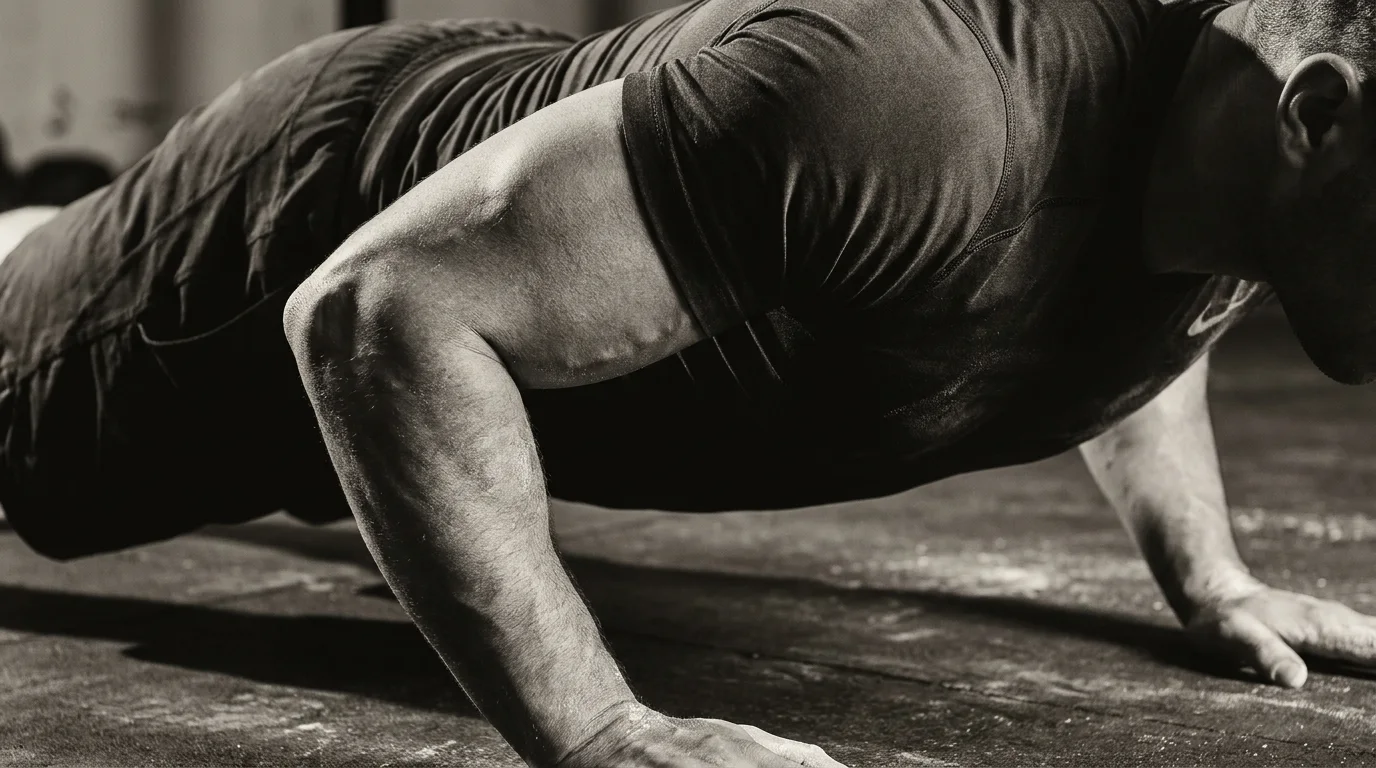
Slow pushups lean on the eccentric (lowering) phase. Tempo is the speed of each phase: eccentric, bottom pause, concentric, and top pause. Notation is usually four digits: Eccentric-Pause-Concentric-Pause. For example, 3-0-2-0 means a 3-second descent, no bottom pause, a 2-second ascent, and no top pause. A slower 4-0-3-0 increases time under tension; 2-0-2-0 is gentler. Prioritize control, a neutral spine, and elbows tracking close to the torso.
What slow pushups train: neuromuscular control, stabilization endurance, and tendon health
- Neuromuscular control: steadier shoulder positioning and clearer movement cues.
- Stabilization endurance: longer sets through the core, glutes, and scapular stabilizers.
- Tendon health: gradual, controlled loading builds tendon resilience and aligns with the SAID principle push-ups explanation.
Why tempo matters: safety, progression, and long-term adaptations
Tempo lowers form risk, supports progressive overload, and promotes durable adaptations without explosive strain. Use tempo to tailor difficulty, add pauses, and extend time under tension safely. tempo training safety.
Tempo Programming and Safety for Slow Pushups: Weekly Templates, Progressions, and Safe Practice
How to set tempo: defining eccentric, pause, and concentric windows
- Eccentric (lowering): 3–5 seconds
- Pause at bottom: 1–2 seconds
- Concentric (pressing up): 1–2 seconds Keep a braced core and a neutral spine; elbows tucked.
4- to 6-week tempo template: from beginner to intermediate
- Weeks 1–2: 3–4 sets of 6–8 reps; tempo 4s down, 1s pause, 2s up; use wall or incline.
- Weeks 3–4: 4–5s down, 1s pause, 2–3s up; reps stay 6–8.
- Weeks 5–6: 5s down, 1s pause, 2–3s up; progress by moving to knee, then incline, then floor as able.
Progression ladder: wall → knee → incline → floor slow push-ups
- Start at wall; advance when you can maintain tempo and control through each rep.
Safety and readiness: tendon, shoulder, and spine considerations under tempo
- Warm-up, avoid pain, check ROM, scapular control, and ensure lumbar neutral. For rehab or high-load goals, progress eccentrically only with expert guidance.
Applications, Variations, and Adaptations: Shoulder Health, Hypertrophy, Rehab and Real-World Use
Shoulder health and tendon adaptation with slow tempo
- Slow pushups benefits for shoulder health come from a deliberate lowering phase that loads the tendons gradually.
- Keep the scapula stable, ribs braced, elbows tucked, and movement smooth to protect the joint.
- Prioritize a pain-free range and controlled tempo over depth.
Hypertrophy vs stabilization endurance: what slow tempo tends toward
- Time under tension from a slow tempo (e.g., a 4-second descent) nudges muscle growth and strengthens stabilizers.
- The SAID principle push-ups explanation: train to what you want to perform.
- Eccentric push-ups for hypertrophy rely on a longer lowering phase.
- Tempo variations for beginners to advanced let you dial in progression—from a comfortable 2-second descent to a slow 4-second descent.
Choosing the right variation by goal: knee, incline, elevated
- Start with knee push-ups for control, then incline (hands on bench) for moderate load, and use elevated feet for higher load.
- Adjust tempo and range to target hypertrophy or stabilization endurance while keeping form solid.
Rehab and return-to-function applications
- In rehab, regress to knee or incline, keep tempo and range pain-free, and improve control before loading again.
- Use gradual progression and clear pain thresholds to guide reintroduction to higher loads.
Frequently asked questions
What exactly are slow push-ups and how do they differ from standard push-ups?
Slow push-ups emphasize the eccentric (lowering) phase with a deliberate tempo, using cadences like 3-0-2-0 or 4-0-3-0 to increase time under tension and protect joints. Unlike standard push-ups, the tempo is intentionally slowed and may include pauses to emphasize control and tendon health.
What are the primary benefits of eccentric (slow) push-ups?
They improve neuromuscular control, stabilization endurance, and tendon health through controlled loading and increased time under tension, while reducing explosive joint stress.
How should I perform a slow push-up safely to avoid injury?
Keep a braced core, neutral spine, and elbows tucked while following a defined tempo (eccentric 3–5 seconds, bottom 1–2 seconds, concentric 1–2 seconds); start with wall or incline variations and progress only as control remains consistent.
Which push-up progressions are best for beginners aiming to incorporate slow tempo?
Begin with wall push-ups, then knee push-ups, progress to incline push-ups, and finally to floor push-ups as you can maintain tempo and form through each rep.
About the authors

Goran Huskić
Co-founder · Professional basketball player
Goran Huskić is a Serbian professional basketball player — a 6'11" center currently playing for Monbus Obradoiro in Spain's Primera FEB. He won the 2019–20 Basketball Champions League with San Pablo Burgos and has competed professionally across Spain, Germany, Lithuania, Serbia and the United States. He co-founded PUSHapp to bring pro-level training discipline to everyday workouts.

Nikola Janković
Co-founder · Former professional basketball player
Nikola Janković is a former professional basketball player — a 6'9" forward and the 2016–17 ABA League MVP — who played for Partizan, Union Olimpija and Mega, among others. Today he runs a pilates studio and gym focused on strength, mobility and overall wellbeing. He co-founded PUSHapp to make consistent, measurable training simple for everyone.