
Muscles & Benefits
Pushup Workout for Chest: Build Strength
Master a pushup workout for chest with step-by-step form, beginner-to-advanced variations, and routines to maximize chest development.


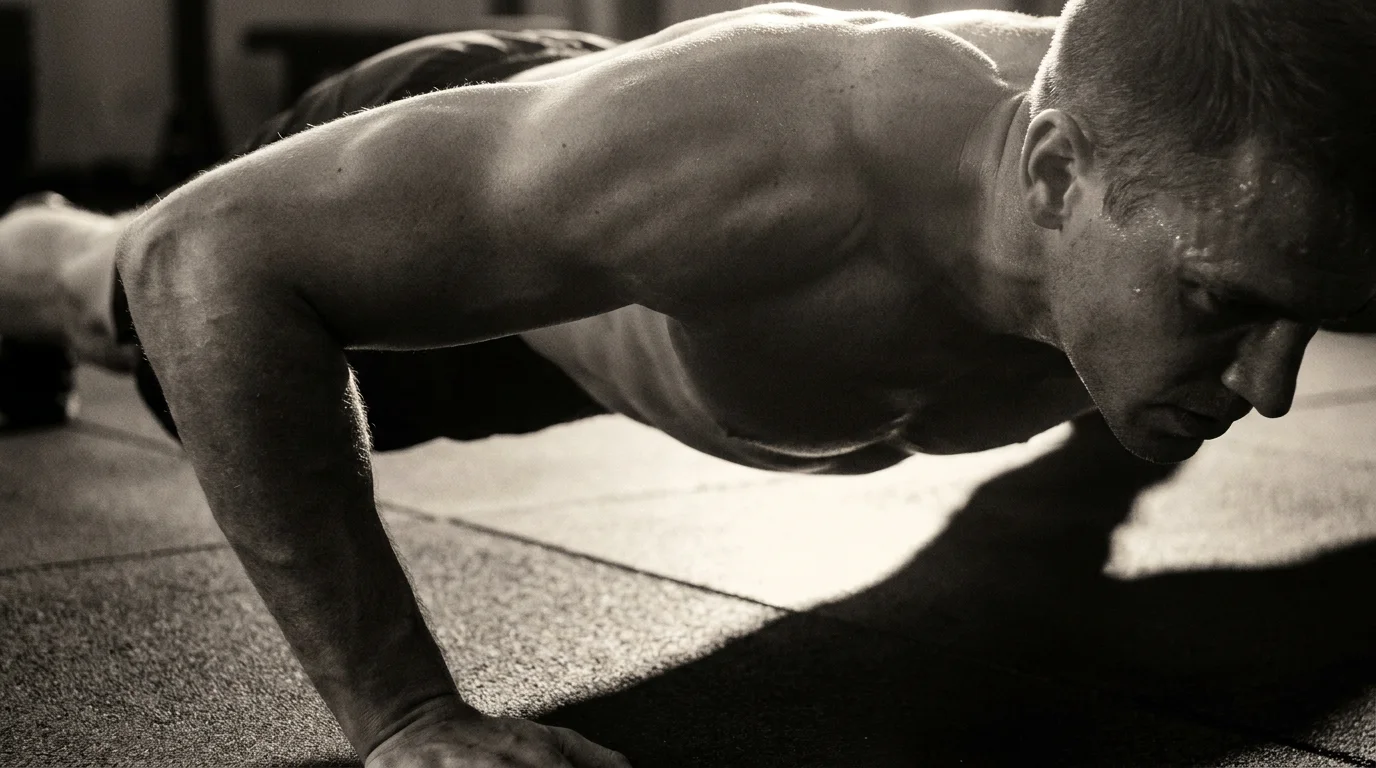
Biomechanics and Form: Activating the Chest Across Push-Up Variations
Push-ups activate the chest by turning on the pectoralis major as you press. Hand position steers which fibers work hardest, and tempo plus breathing deepen chest activation.
Pectoralis major engagement by hand position
- Wide grip: elbows flare to about 45 degrees, increasing activation across the mid to outer chest.
- Keep ribs braced and press through the center of the chest.
- Standard grip: hands under the shoulders with elbows at about 45 degrees, for steady chest activation and balanced load.
- Close/diamond grip shifts more work to the inner chest and triceps; monitor shoulder comfort and keep elbows tucked.
Tempo and breathing cues for chest activation
- Lower in 2–3 seconds, then press up in 1–2 seconds.
- Inhale on the way down and exhale as you press.
- Keep the core braced and the neck in a neutral position.
Common form mistakes and coaching fixes
- Sagging hips: brace the core and tighten the glutes.
- Elbows flare beyond 45 degrees: tuck them to 45 degrees.
- Hands too wide or too close: set grip around shoulder width and adjust if wrists strain.
- Head-forward position: keep eyes forward and neck neutral.
Structured Progression: Beginner to Advanced Push-Ups With Clear Reps, Sets, and Fatigue Metrics
Beginner-to-Intermediate progression
- Week block: 4 sets of 6–8 knee push-ups or incline push-ups; tempo: 3 seconds down, 1 second up; rest 60–90 seconds. Fatigue: finish each set with 1–2 reps in reserve (RIR).
- Next block: 4 sets of 4–6 standard push-ups; tempo: 2 seconds down, 1 second up; rest 90 seconds. Fatigue: last rep challenges, but form stays solid.
- Chest emphasis cue: keep elbows at ~45 degrees and brace your upper back. Optional: add 4 sets of 6–8 wide-grip push-ups to stress the chest more when ready.
- This push-up progression to build a bigger chest hinges on consistency and clean form.
Advanced progression and peak strength work
- Elevate feet push-ups: 4 sets of 6–8; tempo: 2 seconds down, 1 second up; rest 90 seconds. Fatigue: 0–1 RIR.
- Archer or staggered push-ups: 3–5 sets of 4–6 per side; tempo: controlled down, powerful up; rest 90–120 seconds. Fatigue: maintain shoulder stability.
- Explosive push-ups (as able): 3–4 sets of 3–5; soft landings, strict technique. Fatigue: ensure control over every rep.
Fatigue metrics and safe progression
- Track RIR each session; stop if technique degrades. If you regress, revert to the previous block and rebuild. Use this no-equipment chest workout with push-ups as needed to stay on track while you refine push-up progression.
Chest-Focused Routines and Recovery: No-Equipment Workouts, Accessory Moves, and Recovery
These routines rely on bodyweight push-ups with no equipment. Focus on push-up form for chest activation: hands slightly wider than shoulder width, elbows at about 45 degrees, chest lowers toward the floor, then powerfully press up while keeping your core braced. Squeeze the chest at the top and avoid letting the hips sag.
Sample weekly chest-focused plan
- 3 days per week (non-consecutive)
- Each session: 3 rounds of
- Standard push-ups x 12
- Wide-grip push-ups x 8–10
- Incline push-ups (hands on a stable surface) x 12
- Rest 60–90 seconds between rounds
- Progression: add 1–2 reps per week or an extra round when doable
Accessory movements to support chest development
- Scapular push-ups: 2 sets of 12–15
- Isometric chest squeeze: 2 sets of 15–20 seconds (palms pressed together)
- Doorway chest stretch: 30 seconds per side
Recovery, mobility, and injury prevention
- Schedule at least one day between heavy chest sessions
- Include doorway stretches, thoracic rotations, and controlled breathing
- Prioritize sleep and steady progression to prevent overuse
Frequently asked questions
How do you perform a push-up with proper form?
Position your hands under your shoulders with elbows about 45 degrees from your torso, brace your core, and keep hips neutral. Lower with control for 2–3 seconds, pause briefly if needed, then press up with a steady, powerful push; breathe in on the way down and out on the way up, keeping your neck neutral.
How many push-ups should I do to grow my chest?
Start with a structured progression: 4 sets of 6–8 knee or incline push-ups, then progress to 4 sets of 4–6 standard push-ups as you gain strength. Track reps in reserve (RIR) and aim to finish sets with 0–1 RIR, adjusting volume to stay in a sustainable progression.
What’s the difference between incline, regular, and declined push-ups for the chest?
Incline push-ups are easier and good for beginners, regular push-ups provide steady chest activation at a mid-range load, and declined (feet elevated) push-ups increase upper-chest emphasis and overall difficulty.
How can a beginner modify push-ups safely?
Start with knee or incline push-ups to build baseline strength, keep elbows around 45 degrees, brace your core, and use a controlled tempo (about 3 seconds down, 1 up). As you improve, progress to standard push-ups and progressively tougher variations.
About the authors

Goran Huskić
Co-founder · Professional basketball player
Goran Huskić is a Serbian professional basketball player — a 6'11" center currently playing for Monbus Obradoiro in Spain's Primera FEB. He won the 2019–20 Basketball Champions League with San Pablo Burgos and has competed professionally across Spain, Germany, Lithuania, Serbia and the United States. He co-founded PUSHapp to bring pro-level training discipline to everyday workouts.

Nikola Janković
Co-founder · Former professional basketball player
Nikola Janković is a former professional basketball player — a 6'9" forward and the 2016–17 ABA League MVP — who played for Partizan, Union Olimpija and Mega, among others. Today he runs a pilates studio and gym focused on strength, mobility and overall wellbeing. He co-founded PUSHapp to make consistent, measurable training simple for everyone.