
Comparisons
Diamond pushups vs regular pushups: which works best?
Diamond pushups vs regular pushups: compare muscle targets, form, and progressions to optimize triceps, chest, and core.


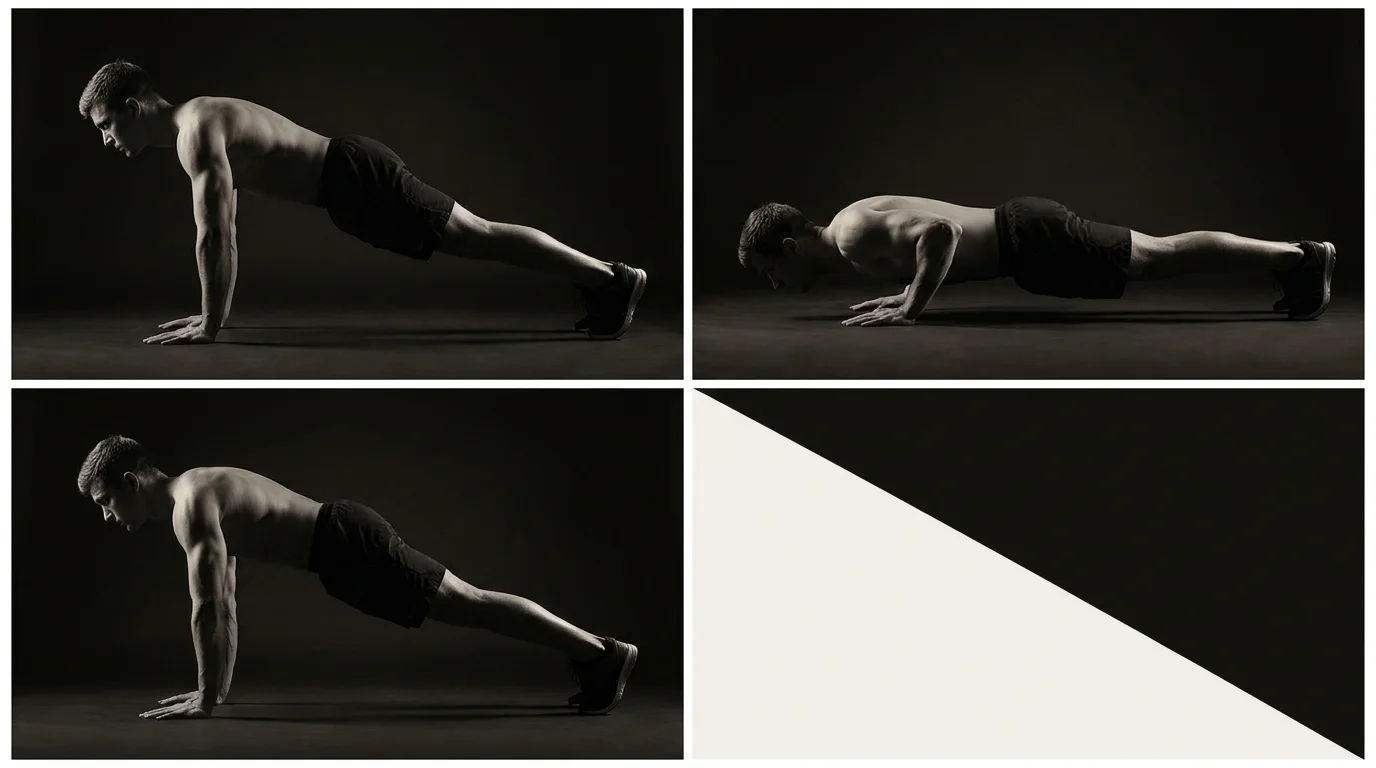
Muscle activation and biomechanics: which muscles are trained and how
Muscle activation profile
Diamond pushups vs regular pushups shift load toward the triceps and inner chest. As a bodyweight pressing variation, the primary target in diamond is the triceps brachii, with the pec major contributing less than in a standard push-up. Regular pushups recruit the chest more, with the front deltoid and triceps as helpers. Serratus anterior activation remains important in both, helping with scapular protraction and overall shoulder stability. Core engagement is essential in both variants to keep the spine steady.
Serratus anterior and scapular mechanics
The serratus anterior drives scapular stability during both moves, but the close grip in diamond pushups adds a greater demand on this muscle to prevent excessive winging and to keep the shoulder blades retracted and protracted as you press. This supports scapular stability throughout the range.
Wrist and elbow loading
Diamond pushups place more load through the wrists and elbows due to the narrow hand position, which can increase stress on these joints. Standard push-ups distribute load more evenly across chest and shoulders; adjust grip or incline if needed.
Form, technique, and common mistakes: how to perform each variation safely
Baseline technique
- Standard push-up form: hands slightly wider than the shoulders, feet together, core braced, and a straight line from head to heels.
- Lower with elbows about 45 degrees; chest approaches the floor, neck neutral.
- Press back up, maintaining the line; don’t let hips sag or shoulders lift toward the ears.
Diamond push-up cues and common mistakes
- Diamond push-up form: hands close to the sternum, thumbs and index fingers kissing to form a diamond; elbows tucked along the torso.
- Maintain a solid plank; descend until the chest nears the floor, then push through.
- Common faults: hips sagging, elbows flaring, or neck cranking. Fixes: tighten the core, keep elbows tucked, and adjust height (knees or incline) if needed. For triceps emphasis, load distribution shifts toward the arms; if you feel pinching, back off ROM slightly.
Standard push-up cues and common mistakes
- Hands under or slightly wider than shoulders; shoulders away from ears; ribs drawn in.
- Lower with control to about chest height, then push back up.
- Faults: sagging midsection, excessive neck extension, or rushing reps. Fix: squeeze glutes, brace the core, and use a slower tempo.
Progression steps
- Start with incline or knee push-ups; move to full standard push-ups, then add diamond variations as tolerated.
Programming and progression: pairing diamond and standard push-ups in a training block
Block pairing strategy
- Alternate between standard and diamond push-ups within the week to balance load.
- Watch load distribution: standard push-ups tend to target the chest and front delts; diamond emphasizes the triceps and inner chest. Adjust frequency if you feel wrist or shoulder strain.
- Beginners start with more standard reps and add diamond gradually.
- Rest 60–90 seconds and maintain a controlled tempo.
4-week template for beginners
- Schedule: 3 days/week (e.g., Mon/Wed/Fri).
- Week 1: 3x5 standard; 3x5 diamond; 3x5 standard.
- Week 2: 3x6 standard; 3x5 diamond; 3x6 standard.
- Week 3: 4x5 standard; 4x4 diamond; 4x5 standard.
- Week 4: 4x6 standard; 4x5 diamond; 4x6 standard.
6-week progression for intermediate/advanced
- 3 days/week. Weeks 1–2: 4x6 standard, 3x6 diamond.
- Weeks 3–4: add tempo (2-0-2); 4x8 standard, 3x8 diamond.
- Weeks 5–6: add load on the standard push-ups (vest/backpack); keep diamond at 6–8; finish 4x6 standard.
Progressions and scaling options
- Tempo variations, range of motion, partials, elevated feet, and weighted options.
- How to pair push-up variations in a block becomes a richer, balanced stimulus while managing joint stress.
Frequently asked questions
Are diamond push-ups better for triceps than regular push-ups?
Yes—diamond pushups place more emphasis on the triceps and inner chest, while standard pushups recruit the chest more and front shoulders; use the variation that matches your goals.
Do diamond push-ups work the chest as much as standard push-ups?
They target the inner chest more and place greater load on the triceps; standard push-ups tend to recruit the chest more overall, though both involve serratus and core.
How do you perform a proper diamond push-up?
Place hands close to the sternum to form a diamond, keep elbows tucked, maintain a tight core and a straight line from head to heels, then lower until the chest nears the floor and press back up; use incline or knee modification if needed.
Can you mix diamond and standard push-ups in the same routine?
Yes. A practical approach is to rotate them in blocks (two to three weeks each) or pair them in the same session (main set with standard, finishing set with diamond), while adjusting volume and tempo to stay strong.
About the authors

Goran Huskić
Co-founder · Professional basketball player
Goran Huskić is a Serbian professional basketball player — a 6'11" center currently playing for Monbus Obradoiro in Spain's Primera FEB. He won the 2019–20 Basketball Champions League with San Pablo Burgos and has competed professionally across Spain, Germany, Lithuania, Serbia and the United States. He co-founded PUSHapp to bring pro-level training discipline to everyday workouts.

Nikola Janković
Co-founder · Former professional basketball player
Nikola Janković is a former professional basketball player — a 6'9" forward and the 2016–17 ABA League MVP — who played for Partizan, Union Olimpija and Mega, among others. Today he runs a pilates studio and gym focused on strength, mobility and overall wellbeing. He co-founded PUSHapp to make consistent, measurable training simple for everyone.