
Form & Technique
Where to look during pushups: master form cues
Discover where to look during pushups to maintain neutral spine and engage the core across wall, incline, knee, and standard variations.

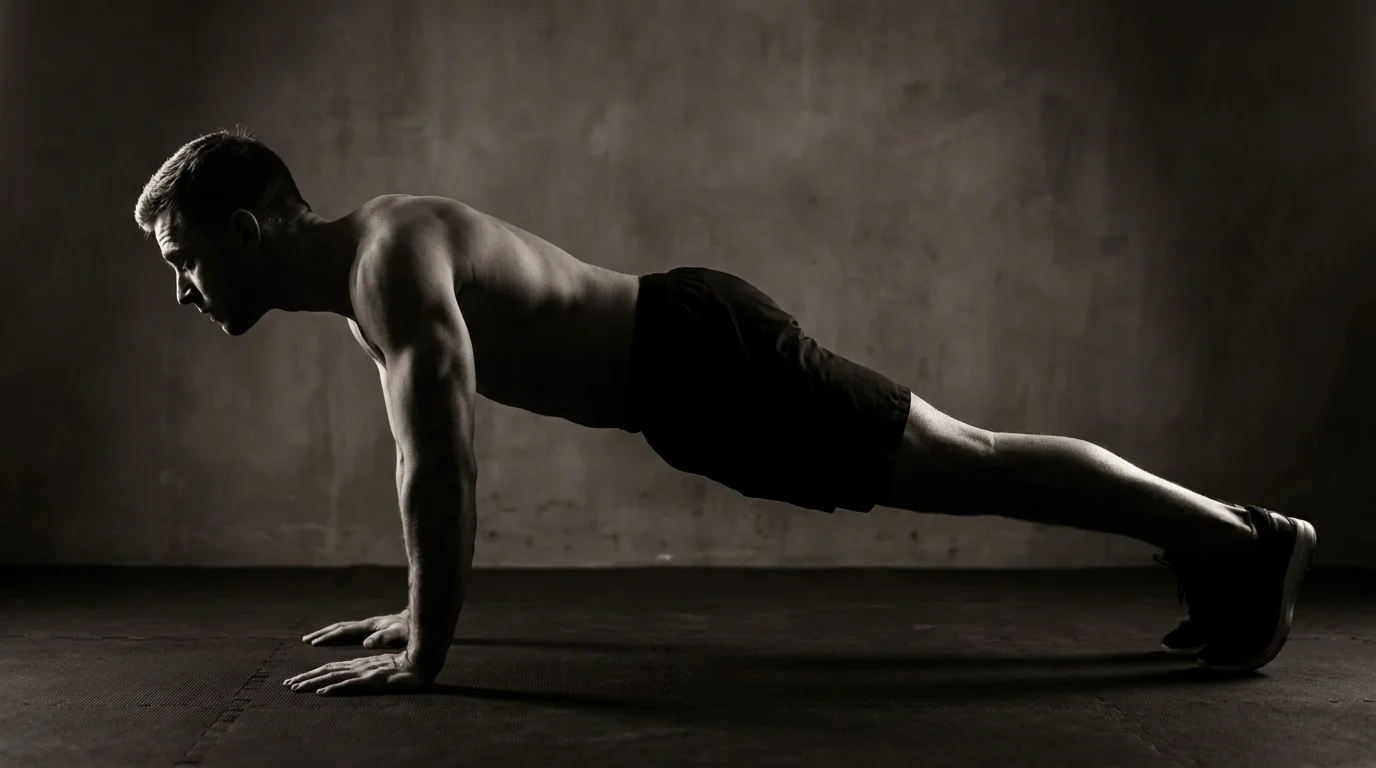
Neck neutral and gaze: where to look across push-up variants
Neutral neck position is simple: keep your head in line with your spine and let your gaze follow a safe path for each variation.
Gaze anchors for each variation
wall pushups: Keep your neck in a neutral position; look at a point on the wall at eye level to help spine alignment.
incline pushups: Look forward or slightly down toward the floor a few feet ahead; avoid looking straight down at your hands.
kneeling push-ups: Gaze at a spot on the floor a short distance ahead; this helps maintain a straight neck as you press.
standard push-ups: Gaze a little in front of your hands, not straight down; this keeps your neck aligned while you push.
Quick cues to keep your neck in line
Long neck cue: imagine a string pulling from the crown of your head.
Chin position: keep it soft and neutral; avoid tucking too much or lifting the chin.
Set your gaze early and hold it through the rep.
If you feel strain, reset to a kinder angle and recheck your alignment.
Core, breathing, and scapular cues: wiring stability into push-ups
Breath, brace, and posture
- Inhale as you descend to set the core, rib cage expands, spine stays neutral.
- Exhale as you press up, brace the core by drawing the navel toward the spine and tightening hips and glutes.
- Scapular retraction during pushups: pull shoulder blades down the back and toward each other, keeping the chest open and shoulders safe.
- Head position during push-ups: keep a neutral neck, eyes a few inches in front of the hands, not turned toward the floor.
Descent and ascent tempo cues
- Descent controlled about 2 seconds, maintaining a solid frame without sag.
- Pause briefly at the bottom to verify scapular retraction and shoulder stability.
- Ascent 2 seconds, exhale through the push while keeping core braced.
- If form slips, reduce tempo or elevate hands to maintain proper push-up form.
Progressions, hand positioning, and fixes: from wall to standard with accessible options
Variation-by-variation progression
Wall pushups: 2-3 sets of 8-12 reps; tempo down 2, up 1. Move closer to the wall as you gain control.
Incline pushups: hands on a sturdy surface 12 to 24 inches high; 3 sets of 6-10 reps; same tempo.
Kneeling push-ups: hands under shoulders, width about shoulder; 3 sets of 4-6 reps; tempo 2 down, 1 up.
Standard push-ups: hands just wider than shoulders; 3-4 sets of controlled max reps; tempo 2 down, 1 up.
Grip width and hand placement rationale
Wall pushups: hands at shoulder width, elbows soft.
Incline pushups: grip slightly wider than shoulders; elbows tuck.
Kneeling push-ups: hands under shoulders; width comfortable.
Standard push-ups: grip just wider than shoulders; wrists under shoulders.
Common mistakes with corrective drills and safe progressions
Sagging hips, elbows flaring. Drill scapular pushups and hollow body holds.
Not bracing the core. Drill knee plank holds with slow tempo.
Rushing to the standard. Drill spend two weeks on incline/kneeling with controlled reps before increasing reps.
Frequently asked questions
What is the correct neck and spine alignment for push-ups?
Keep the neck in a neutral line with the spine. Gaze path varies by variation: wall pushups look at a point on the wall at eye level; incline pushups look forward or slightly down, kneeling push-ups gaze a spot on the floor ahead, and standard push-ups gaze a little in front of your hands.
How do you progress from wall push-ups to standard push-ups?
Wall pushups are 2-3 sets of 8-12 reps; move closer to the wall as you gain control. Then incline pushups on a surface 12 to 24 inches high for 3 sets of 6-10 reps, kneeling push-ups for 3 sets of 4-6 reps, and standard push-ups for 3-4 sets of controlled max reps with a 2 down, 1 up tempo.
What muscles are primarily engaged during push-ups?
Shoulder stability and midline control with a neutral neck are the main priorities across push-up variants.
What cues help maintain form during push-ups?
Descent about 2 seconds, pause briefly at the bottom, and ascent about 2 seconds; inhale on descent, exhale on the push, and brace the core. If form slips, reduce tempo or elevate the hands.
About the authors
Goran Huskić
Co-founder · Professional basketball player
Goran Huskić is a Serbian professional basketball player — a 6'11" center currently playing for Monbus Obradoiro in Spain's Primera FEB. He won the 2019–20 Basketball Champions League with San Pablo Burgos and has competed professionally across Spain, Germany, Lithuania, Serbia and the United States. He co-founded PUSHapp to bring pro-level training discipline to everyday workouts.
Nikola Janković
Co-founder · Former professional basketball player
Nikola Janković is a former professional basketball player — a 6'9" forward and the 2016–17 ABA League MVP — who played for Partizan, Union Olimpija and Mega, among others. Today he runs a pilates studio and gym focused on strength, mobility and overall wellbeing. He co-founded PUSHapp to make consistent, measurable training simple for everyone.