
Variations & Types
Standard Pushups: Form, Variations & Tips
Master standard pushups with clear form cues, beginner options, and variations to build chest, triceps, and core.


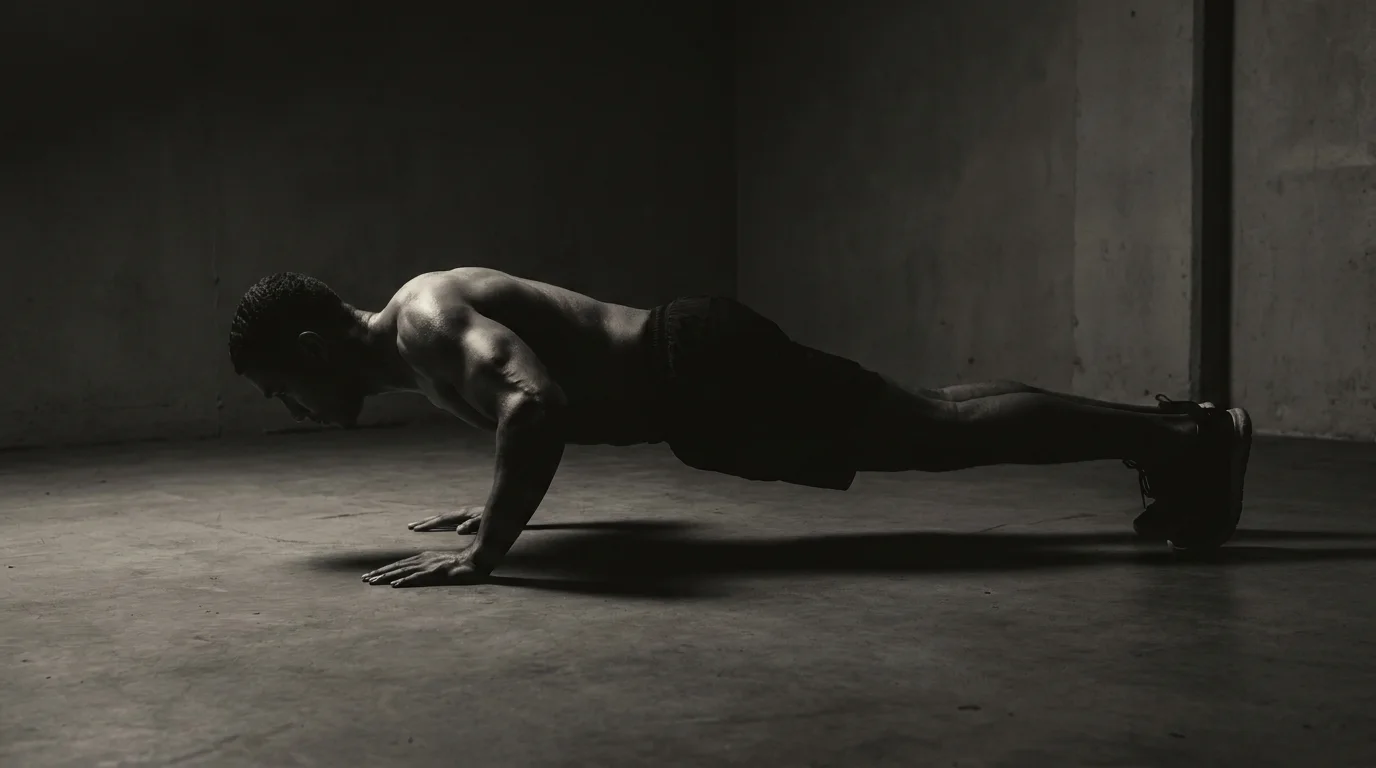
Mastering Standard Pushups: Form, Elbow Angle at 45° and Scapular Setup
Step-by-step setup and start position
This is how to do a standard pushup with proper form.
- Wrist under shoulders; hands just wider than chest.
- Body in a straight line from head to heels; brace core and glutes.
- Scapula setup: pull shoulder blades down and together.
- Elbows at about 45° to your torso.
- Spine neutral; gaze a few inches ahead.
Execution: controlled eccentric and concentric phases
- Eccentric: lower 2–3 seconds, hips level.
- Keep elbows at 45° and maintain a stable torso.
- Concentric: press up through the floor, chest and shoulders working.
- Avoid sagging or piking; pause briefly at the bottom if needed.
Breathing cues and tempo
- Inhale on the way down, exhale as you push up.
- Tempo cue: 2s down, 1s bottom, 2s up.
Depth guidance by rep range
- Start shallow to master form; deepen as control improves.
- Aim for chest near the floor, but stop if form breaks.
Common mistakes and how to fix them
- Hips sag: brace core and glutes.
- Elbows flare: keep ~45°.
- Scapula not set: reset at the start.
- Head drops: keep neck neutral.
Modifications & Progressive Paths: From Beginner to Full Pushups
Beginner-friendly starting points
- Knee push-up: this is a beginner push-up option—align hips, keep core tight, and place hands under shoulders.
- Incline push-up: hands on a bench or table; lower until chest hovers, then press up; aim 8–12 reps.
Tempo, volume, and progression timelines
- Week 1–2: 3x6–8 knee push-ups.
- Week 3–4: 3x8–12 incline push-ups.
- Week 5–6: 3x6–10 standard push-ups; begin working deep controlled range.
- Goal: progress to 3x12–15 standard push-ups with controlled depth within 6–8 weeks.
Shoulder health and depth considerations
- How deep should pushups go? Lower chest to within a few inches of the floor while keeping elbows at about 45 degrees.
- If pain or pinching arises, regress to incline and rebuild.
Cues for serratus anterior engagement and core
- Serratus anterior engagement: as you descend, allow a touch of scapular protraction; at the top, press the floor away to protract the shoulder blades.
- Maintain core stability—braced abs, glutes, and a neutral spine.
Towards advanced variations: one-arm push-up prerequisites
- Prereqs: solid 12-rep standard push-ups with clean form, robust shoulder health, and steady core.
- Progression: move from incline or offset-hand push-ups to elevated one-arm push-ups, then to a full one-arm push-up with a supported surface.
Variations, Training Plans & Bench-Press Comparisons: Choosing the Right Push-Up for Your Goals
Variation highlights and muscle emphasis
- Wide push-up: hands wider than shoulders; elbows at a comfortable angle; press chest forward while keeping hips level.
- Diamond push-up: hands close under chest; elbows tuck; straight line from head to heels.
- Incline push-up: hands on a stable elevated surface; body stays in one line; lower chest to surface.
- Pike push-up: hips high in an inverted V; shoulders bear more load; neck stays long, core braced.
- One-arm push-up: one arm bears most load; progression with incline or offset variations builds stability.
Programming examples: weekly progression
- Beginners: incline push-up 3x8-12, 3 days/week. For beginners, incline push-up and standard variations are among the best push-up variations for beginners.
- Weeks 3-4: add standard or wide push-ups 3x6-10.
- Weeks 5-6: introduce diamond or Pike as a second variation, 3x4-8.
- Push-ups vs bench press form comparison: push-ups demand scapular control and core engagement, while bench press emphasizes bar path and loading.
Form tips for each variation
- Wide: hips level; shoulders stay disciplined.
- Diamond: elbows close to body; press through center of chest.
- Incline: maintain line from head to heels.
- Pike: brace core; neck aligned with spine.
- One-arm: limit torso rotation; progress with incline or offset to start.
Safety and shoulder health considerations
- Warm up; progress gradually; stop if pain or sharp discomfort.
Frequently asked questions
What is the correct form for a standard push-up?
Wrist under shoulders with hands just wider than chest; body in a straight line, core and glutes braced. Elbows should sit at about 45° to your torso and you should pull the shoulder blades down and together, keeping the spine neutral and gaze a few inches ahead.
How can I modify a push-up if I’m a beginner?
Use knee push-ups or incline push-ups to reduce load. Keep hips aligned and core tight, and progress with 3x6–8 knee push-ups, then 3x8–12 incline push-ups before attempting full push-ups.
What are the most common mistakes in push-ups and how can I fix them?
Common mistakes include hips sagging, elbows flaring, scapula not set, and head dropping. Fix them by bracing the core and glutes, keeping elbows around 45°, resetting the scapula at the start, and maintaining a neutral neck.
Which muscles do push-ups work the most?
Push-ups primarily target the chest and shoulders with the triceps, while the core and serratus anterior stabilize and support the movement.
About the authors

Goran Huskić
Co-founder · Professional basketball player
Goran Huskić is a Serbian professional basketball player — a 6'11" center currently playing for Monbus Obradoiro in Spain's Primera FEB. He won the 2019–20 Basketball Champions League with San Pablo Burgos and has competed professionally across Spain, Germany, Lithuania, Serbia and the United States. He co-founded PUSHapp to bring pro-level training discipline to everyday workouts.

Nikola Janković
Co-founder · Former professional basketball player
Nikola Janković is a former professional basketball player — a 6'9" forward and the 2016–17 ABA League MVP — who played for Partizan, Union Olimpija and Mega, among others. Today he runs a pilates studio and gym focused on strength, mobility and overall wellbeing. He co-founded PUSHapp to make consistent, measurable training simple for everyone.