
Variations & Types
Knee Pushups: Beginner Guide & Progressions
Learn knee pushups for beginners with proper form, beginner-friendly variations, and a safe progression toward full push-ups.

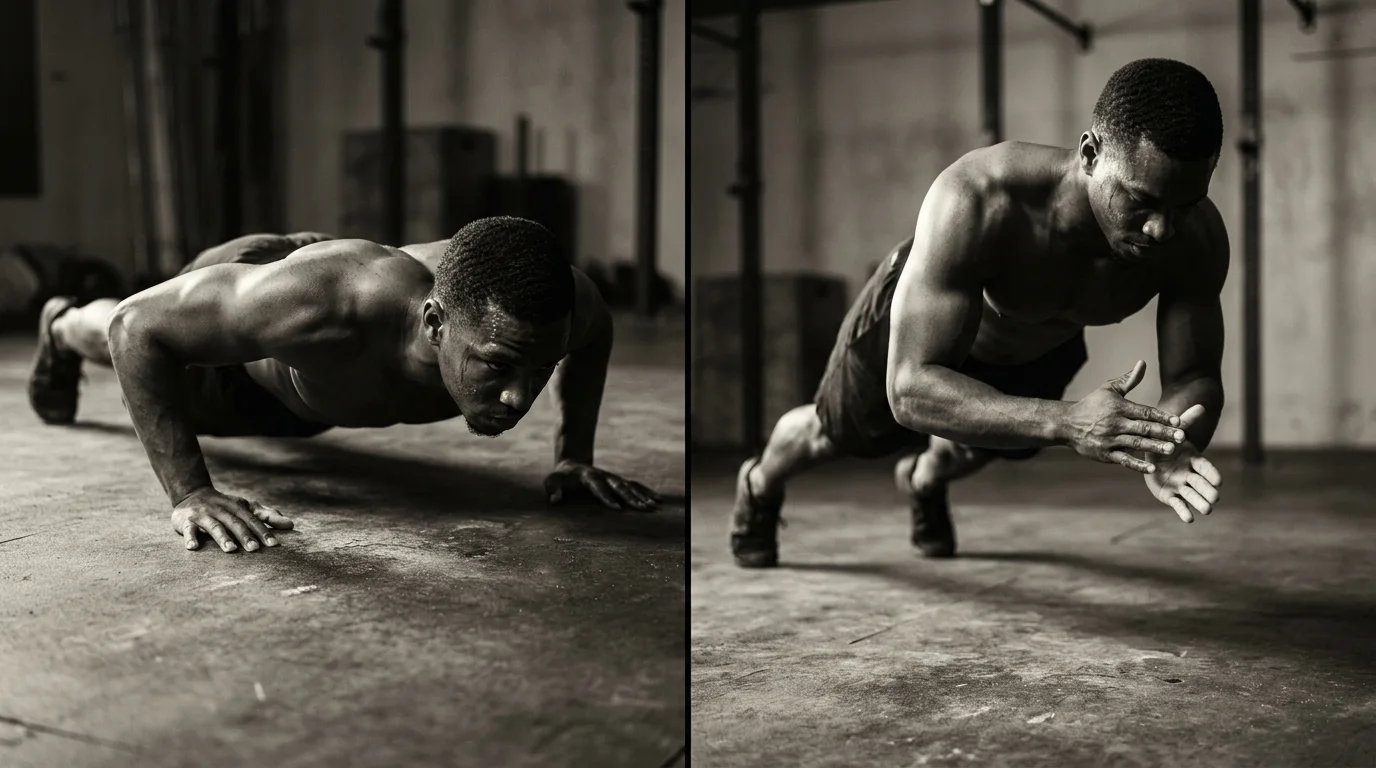
Knee pushups technique: setup, alignment, and form cues
Step-by-step cues (from setup to rep)
- Kneel on a mat with hips over knees, knees hip-width apart.
- Place hands under shoulders, fingers spread, wrists stacked. See diagrams for hand width and knee placement.
- Engage core, ribs down, spine long; gaze a few inches ahead.
- Lower by bending elbows to about 45 degrees, hips level.
- Press through the palms to extend elbows and return to start.
Hand placement and alignment
- Hands under shoulders, width matching your shoulders.
- Elbows at about 45 degrees to torso, not flared.
- Shoulder blades glide down the back; neck stays neutral.
- Keep head in line with spine.
Range of motion and tempo
- Lower until chest is within a couple inches of floor.
- Pause briefly, then press up with control.
- Tempo roughly two seconds down, one second up.
Common mistakes and corrections
- Hips sag or rise: brace core and tuck pelvis.
- Elbows flare: draw elbows in to 45 degrees.
- Hands too wide or close: align with shoulders.
- Looking up: keep gaze forward, neck neutral.
- Not finishing full extension: press to straight arms.
Progressions and programming: from knee pushups to a full push-up
Modifiers and when to use them
- wall pushups: stand facing a wall, hands at chest level, feet hip width apart. Push away and keep a straight line from head to hips. Great to train basic alignment.
- incline pushups for beginners: hands on a stable elevated surface, feet on the floor. Maintain a straight body as you lower and press up.
- knee pushups (modified push-ups): knees down, full body in a straight line, elbows tucked. Use when you need less load while building technique.
- these options let you tailor volume and fatigue while preserving form and building a beginner push-up routine with knee pushups.
4-6 week progression plan
- weeks 1 to 2: wall pushups or incline pushups for 2 to 3 sets of 8 to 12 reps, 60 to 90 seconds rest.
- weeks 3 to 4: add knee pushups, 3 sets of 6 to 10 reps, still use incline as needed.
- weeks 5 to 6: work toward a full range on a low incline or floor, 3 sets of 5 to 12 reps, 60 to 90 seconds rest.
Tempo, sets, reps, and rest
- tempo: control down phase for 2 seconds, pause 0 to 1 second at the bottom, press up 1 to 2 seconds.
- sets and reps: start 2 to 3 sets of 6 to 12 reps, adjust toward 8 to 15 as form holds.
- rest: 60 to 90 seconds between sets.
Progression cues to advance to standard push-ups
- lower the incline height every 2 weeks while keeping alignment.
- brace the core, keep hips from sagging, elbows near 45 degrees.
- when knee pushups and incline reps feel solid, begin floor push-ups and increase range as able.
Safety, biomechanics, mobility, and recovery for knee pushups
Shoulder and knee safety tips
- If shoulder pain occurs during knee pushups, modify hand position, shorten range, or switch to incline pushups until pain subsides.
- For knee tenderness, pad the knees and limit depth or take a brief break from this variation.
- Keep hands under shoulders, elbows at about 45 degrees, and hips in line with shoulders. Maintain a steady breath and a braced core.
- Use a stable surface and avoid collapsing through the spine.
Warm-up and mobility for push-ups
- Do a 5 to 7 minute warm-up: arm circles, scapular push-ups, thoracic rotations.
- Add mobility drills for the chest and shoulders: doorway stretch, doorway floor press, gentle thoracic spine extensions.
- Include a light set of knee pushups with shallow depth to rehearse form.
Biomechanics and muscle activation comparison
- Knee pushups place less load on the torso, making alignment easier to master before full pushups.
- Chest and triceps activate strongly, while core and hip demand are reduced compared with the standard version.
- Focus on keeping hips level and the ribcage stable as you press.
Recovery and soreness management
- Post workout stretches: doorway chest stretch and a brief shoulder stretch.
- Hydration, sleep, and gradual return to training support recovery.
- Track reps, sets, and pain level after each session and adjust volume if pain increases.
Frequently asked questions
What are knee pushups and who should start with them?
Knee pushups are a beginner version of pushups performed with the hips in line with the shoulders and the knees on the floor to reduce load. They're for people building upper-body strength and proper push-up mechanics before moving to harder variations.
How do you perform knee pushups correctly and safely?
Start with hands under your shoulders, core braced, elbows about 45 degrees as you lower and keep your hips level. Lower until the chest is within a couple inches of the floor, pause briefly, then press up with control, using a tempo of roughly two seconds down and one second up.
How can knee pushups help me progress to regular pushups?
They are a stepping stone in a structured progression that starts with wall pushups and incline pushups, then knee pushups, and finally full pushups as strength and control improve. Track progress by reps and how much you incline, not by speed alone.
What mistakes should I avoid when doing knee pushups and how can I fix them?
Common mistakes include hips sagging, elbows flaring, hands too wide or too close, and looking up. Fix them by bracing the core to keep hips level, tucking the pelvis, keeping elbows around 45 degrees, aligning hands under shoulders, and keeping the neck neutral with a forward gaze.
About the authors

Goran Huskić
Co-founder · Professional basketball player
Goran Huskić is a Serbian professional basketball player — a 6'11" center currently playing for Monbus Obradoiro in Spain's Primera FEB. He won the 2019–20 Basketball Champions League with San Pablo Burgos and has competed professionally across Spain, Germany, Lithuania, Serbia and the United States. He co-founded PUSHapp to bring pro-level training discipline to everyday workouts.
Nikola Janković
Co-founder · Former professional basketball player
Nikola Janković is a former professional basketball player — a 6'9" forward and the 2016–17 ABA League MVP — who played for Partizan, Union Olimpija and Mega, among others. Today he runs a pilates studio and gym focused on strength, mobility and overall wellbeing. He co-founded PUSHapp to make consistent, measurable training simple for everyone.