
Variations & Types
Pushup to Downward Dog Movement: Technique & Progressions
Master the pushup to downward dog movement with step-by-step cues, transitions, and progressions for stronger shoulders, core, and mobility.


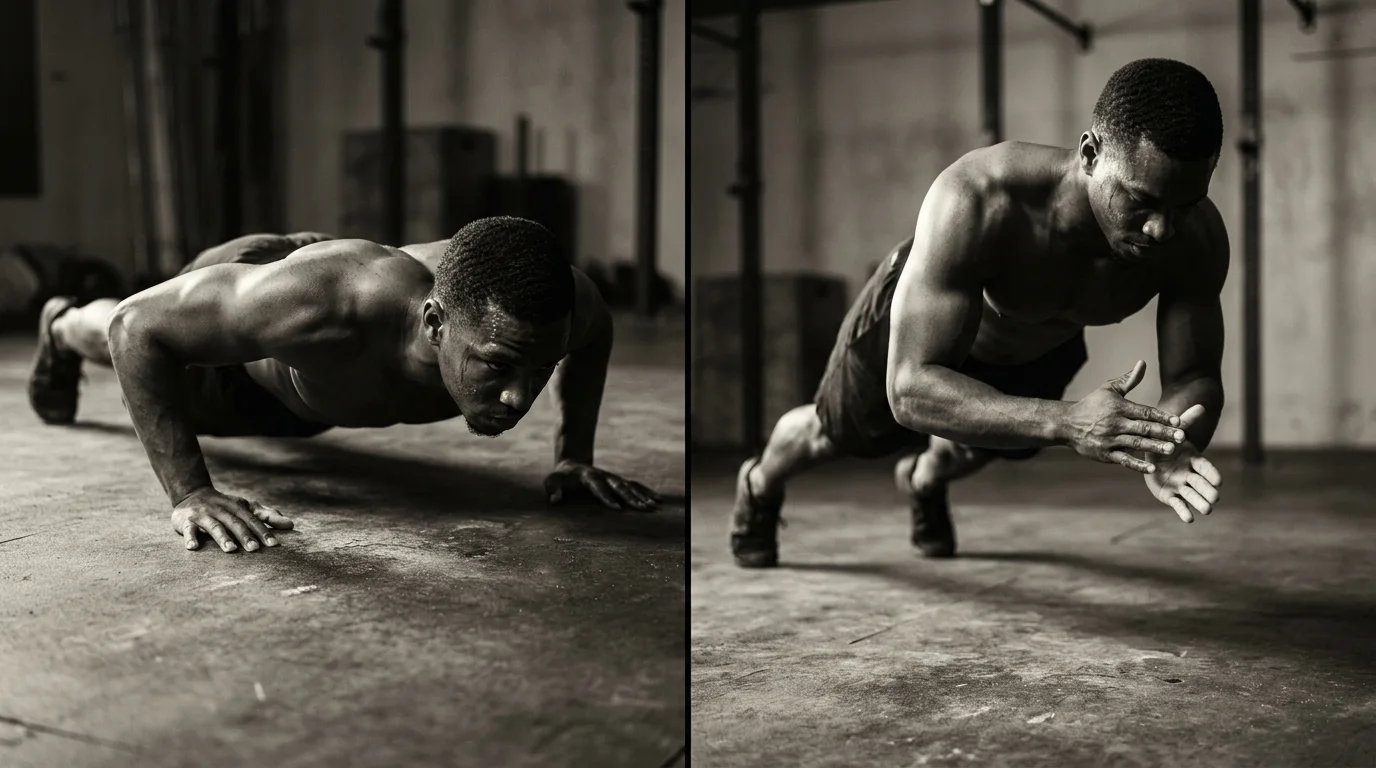
Understanding the pushup-to-downward-dog movement: mechanics, benefits, and context
Anatomy of the transition: scapular control, wrist alignment, hip movement
- scapular control: keep shoulder blades sliding along the rib cage. lower with the chest while the blades glide toward the spine, then widen as you lift into downward dog.
- wrist alignment: wrists under the shoulders, index fingers pointing forward, and the weight spread through the base of the palms.
- hip movement: hips move back and up as you transition, ribs stacked over wrists, core braced for a smooth, long line from hands to hips.
Benefits and goals: strength, mobility, and flow efficiency
- strength: builds shoulder stability, chest engagement, and core control.
- mobility: opens the shoulder girdle and hamstrings through the transition.
- flow efficiency: reduces pauses in a vinyasa and smooths the downward facing dog to push-up sequence.
Common faults to avoid during the transition
- elbows flare or collapse inward
- hips sag or pike
- head drops or neck strains
- weight shifts heavily into the wrists
- breath holds or shallow breathing during the move
What is the push-up to downward dog transition in yoga is a subtle, functional bridge in a vinyasa. It aligns with dand hindu push-up progression and uses hindu push-up technique cues to move smoothly from a push-up position into downward-facing dog. This movement fits in vinyasa as a consistent transitional pattern between plank and a back bend or forward fold, keeping the spine long and the shoulders stacked.
Progression blueprint: from plank to downward dog and through the push-up
Stage-by-stage progression (Plank → Downward Dog → Hindu Push-Up → Upward Dog → Downward Dog)
- Plank to downward dog: three rounds. Hold a solid plank 20 to 30 seconds, then sweep into downward dog and hold 15 to 25 seconds. Keep ribs tucked and glutes active.
- Downward dog into Hindu push-Up: four to six reps. Move with a smooth arc from downward dog into the push-up position, then back to downward dog. Tempo 2 seconds down, 0 pause, 2 seconds up. This is the step-by-step hindu push-up progression from plank to downward dog.
- Hindu push-up to upward dog: four to six reps. Exhale as you press forward into upward dog, pause 2 to 3 seconds, then flow back into downward dog.
- Upward dog back to downward dog: three rounds of 15 to 25 second holds to finish the cycle.
Tempo cues and rep targets by phase
- Phase 1: 3 rounds, 20 to 30s plank and 15 to 25s hold in downward dog.
- Phase 2 to 3: 4 to 6 reps per set, tempo 2‑0‑2.
Drills to reinforce strength and mobility
- Plank variations, lunge-to-push-up drills, knee-down variants. If you know diver bomber push-up vs hindu push-up differences, use the Hindu technique to build the push-up to downward dog movement.
Cues, modifications, safety, and comparisons: Wrist/Shoulder health in Hindu push-ups
Cues for smooth transitions and scapular control
- From downward-facing dog, press into the floor and gently depress the shoulders before you move.
- Lead with the chest and keep your arms near the ribs as you swoop forward.
- Keep the neck long and your gaze down, finishing the arc with a controlled push back to downward-facing dog.
Injury prevention and safe substitutions (knee-down options, wrist-friendly grips)
- If the wrists pinch, use a fist or push-up bars to keep the wrists neutral.
- To reduce load, do the movement from the knees while preserving the arc.
- A wider grip or turning the hands outward about 30 degrees can relieve tension.
Hindu push-up vs dive bomber push-up: key differences
- In Hindu push-up technique, the arc stays closer to the mat with a smoother, more compact path.
- Diver bomber push-ups can involve a larger arc and a different shoulder path; pick the version that matches your tolerance.
Breath work and transition flow in a typical vinyasa sequence
- Inhale as you begin the sweep forward, exhale as you push back into downward-facing dog.
- Coordinate the breath with the downward-facing dog to push-up transition, staying engaged.
Frequently asked questions
What is a Hindu push-up and how do you perform it correctly?
A Hindu push-up is a fluid transition that links a push-up with a sweep into downward dog. Start in a solid plank with elbows soft and ribs braced over the hips, glide the chest forward and upward through a push-up, then sweep the hips back and up into downward dog while keeping the spine long.
How do you move from a plank into downward-facing dog during a Hindu push-up?
From plank, press the chest forward and upward through the push-up, then sweep the hips back and up into downward dog, maintaining a long spine and ribs stacked over the wrists.
What muscles are worked by Hindu push-ups and why are they beneficial?
They target the shoulders, chest, and core, building shoulder stability and core control while opening the shoulder girdle for smoother transitions.
Is downward-facing dog essential for the Hindu push-up sequence?
Yes, in this progression downward-facing dog functions as the bridge from the push-up to the next pose and helps set up the flow.
About the authors
Goran Huskić
Co-founder · Professional basketball player
Goran Huskić is a Serbian professional basketball player — a 6'11" center currently playing for Monbus Obradoiro in Spain's Primera FEB. He won the 2019–20 Basketball Champions League with San Pablo Burgos and has competed professionally across Spain, Germany, Lithuania, Serbia and the United States. He co-founded PUSHapp to bring pro-level training discipline to everyday workouts.

Nikola Janković
Co-founder · Former professional basketball player
Nikola Janković is a former professional basketball player — a 6'9" forward and the 2016–17 ABA League MVP — who played for Partizan, Union Olimpija and Mega, among others. Today he runs a pilates studio and gym focused on strength, mobility and overall wellbeing. He co-founded PUSHapp to make consistent, measurable training simple for everyone.