
Variations & Types
Pause Pushups at the Bottom: Tempo Tips
Learn how pause pushups at the bottom boost control, strength, and hypertrophy using tempo training, pauses, and progressions.


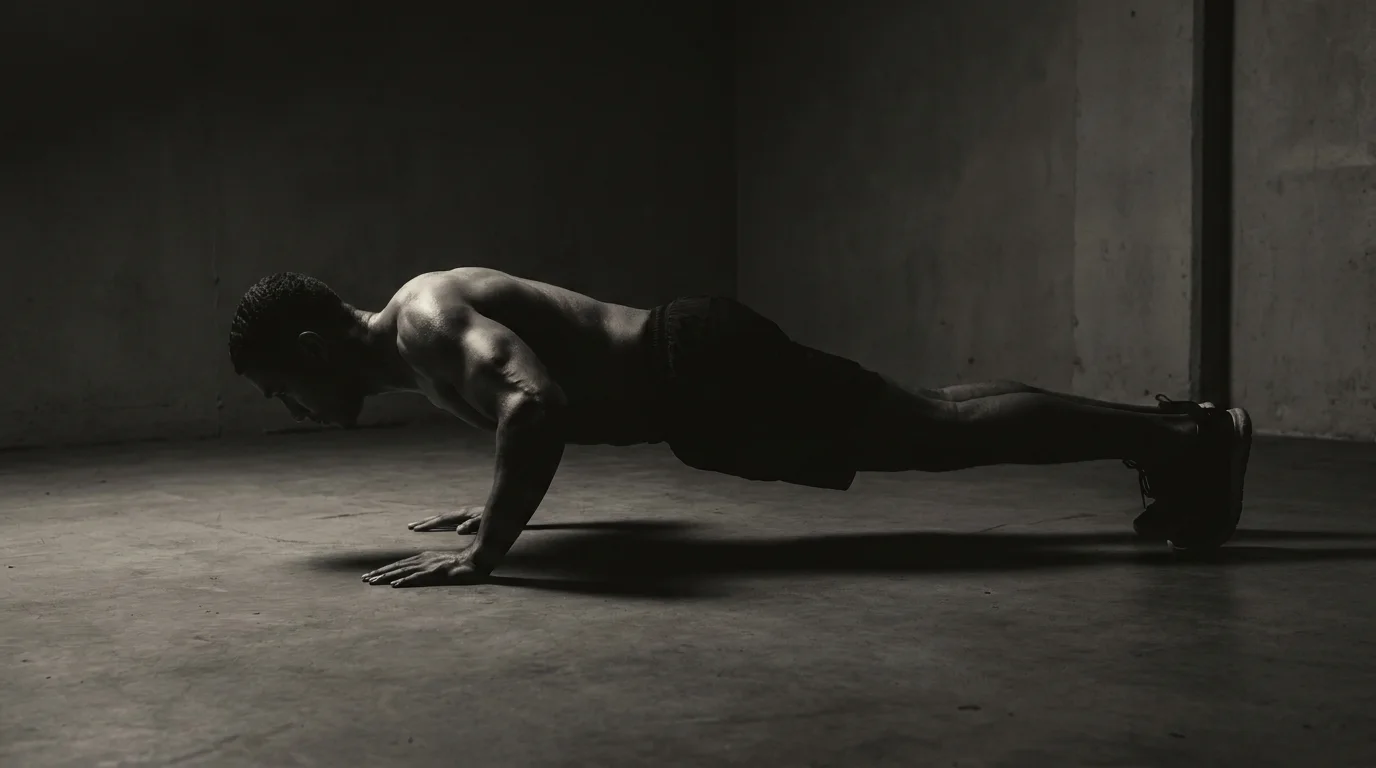
Tempo fundamentals and bottom-pause mechanics
Tempo notation and practical example (3-1-2-0)
Tempo push-ups use four numbers to cue timing: eccentric, bottom pause, concentric, top pause. In 3-1-2-0 you lower the chest in three seconds, hold at the bottom for one second, press up over two seconds, and have zero pause at the top. The eccentric phase is the descent, the bottom-isometric pause is the dead stop at full depth, and the concentric is the ascent. A dead-stop push-up is performed with a complete pause at the bottom before moving again. This tempo trains control and force transfer through the torso.
Bottom-pause mechanics: posture, bracing, and alignment
Focus on lumbopelvic control by keeping the pelvis level and ribs down. Brace the core as if preparing for a punch, without holding your breath. For hip and shoulder alignment, stack shoulders over wrists and keep hips in line with the spine. Squeeze the glutes lightly to stabilize the pelvis and maintain a neutral neck position.
How to perform a bottom-pause push-up safely
Set up with hands under shoulders and a firm core. Lower with control to the bottom, pause for the prescribed moment, then push back up along a straight line. Maintain lumbopelvic control and keep hip and shoulder alignment throughout the rep.
Progression, programming, and loaded teaching tools
Build from control at the bottom to velocity with purpose. Start with a dead-stop push-up to eliminate rebound, then add a fixed isometric pause at the bottom, and finally move into tempo push-ups using 3-1-2-0 for a coordinated push. For how long should the bottom pause be, begin at 1 second and progress to 2 seconds, then 3 seconds when hypertrophy is the goal. The isometric pause is a teaching tool, not a gimmick, so keep it steady.
teaching progressions: from dead-stop to paused reps
- dead-stop push-up. lower with control to the floor and press without momentum. reset between reps.
- paused reps. hold bottom for 1 second, then push.
- tempo push-ups. adopt 3-1-2-0.
- eccentric emphasis. slow the descent to around 4 seconds when ready.
programming templates and progression scales (weeks and sets)
- Weeks 1 to 2. 3 sets of 5 paused reps with a 1 second bottom hold.
- Weeks 3 to 4. 4 sets of 5 with tempo 3-1-2-0.
- Weeks 5 to 6. add light loading or switch to incline to progress load.
- Weeks 7 to 8. move toward decline with pauses and tempo for increased demand.
variations and loading options (incline, decline, knee-based pauses)
- incline pause push-ups for easiest entry.
- knee-based pauses to reduce load while preserving form.
- decline pause push-ups to challenge the bottom position and maintain tempo. End with a bottom hold of 1 to 2 seconds on the final rep.
Coaching cues, troubleshooting, and broader applications
Cues that keep spine and hips stable
- Brace your core as if you are about to lift a load
- Keep hips level and avoid sagging or arching
- Line up your neck with your spine and look slightly forward
Common mistakes and fixes (tempo and bottom pause)
- Rushing the descent or skipping the bottom pause. Fix: count a slow two count and hold for one full second at the bottom
- Elbows flaring or hips drifting. Fix: tuck elbows toward your ribs, engage glutes and quads
- Weak shoulder setup. Fix: establish scapular position before pressing
Expanding tempo pauses to other movements (incline push-up, dips, and chest-focused calisthenics)
- Use a one to three second pause at the bottom of incline push-ups
- Pause at the bottom before pressing in dips
- Apply the same pause in chest-focused moves such as archer push-ups or pseudo planche progressions
Frequently asked questions
What is the isometric pause at the bottom in tempo training?
The bottom isometric pause is the complete hold at full depth during a push-up. It resets momentum and increases time under tension to train control through the hardest part of the rep.
What does a tempo code like 3-1-2-0 mean and how is it applied to push-ups?
Tempo code uses four numbers to cue timing: eccentric, bottom pause, concentric, top pause. In 3-1-2-0 you lower in three seconds, pause at the bottom for one second, press up in two seconds, and have no pause at the top. It is applied as tempo push-ups with a pause at the bottom on each rep.
How long should the pause at the bottom last?
Begin with a one second bottom pause and progress to two seconds, then three seconds when hypertrophy is the goal.
Should you pause at the bottom on every rep or only on certain sets?
With tempo push-ups the bottom pause is performed on every rep; start with a dead-stop and fixed bottom pause before advancing to tempo.
About the authors

Goran Huskić
Co-founder · Professional basketball player
Goran Huskić is a Serbian professional basketball player — a 6'11" center currently playing for Monbus Obradoiro in Spain's Primera FEB. He won the 2019–20 Basketball Champions League with San Pablo Burgos and has competed professionally across Spain, Germany, Lithuania, Serbia and the United States. He co-founded PUSHapp to bring pro-level training discipline to everyday workouts.

Nikola Janković
Co-founder · Former professional basketball player
Nikola Janković is a former professional basketball player — a 6'9" forward and the 2016–17 ABA League MVP — who played for Partizan, Union Olimpija and Mega, among others. Today he runs a pilates studio and gym focused on strength, mobility and overall wellbeing. He co-founded PUSHapp to make consistent, measurable training simple for everyone.