
Form & Technique
Standard Pushup Form: Cues, Depth & Variations
Learn the standard pushup form with cues, depth guidance, and beginner-friendly progressions for safe, effective training.


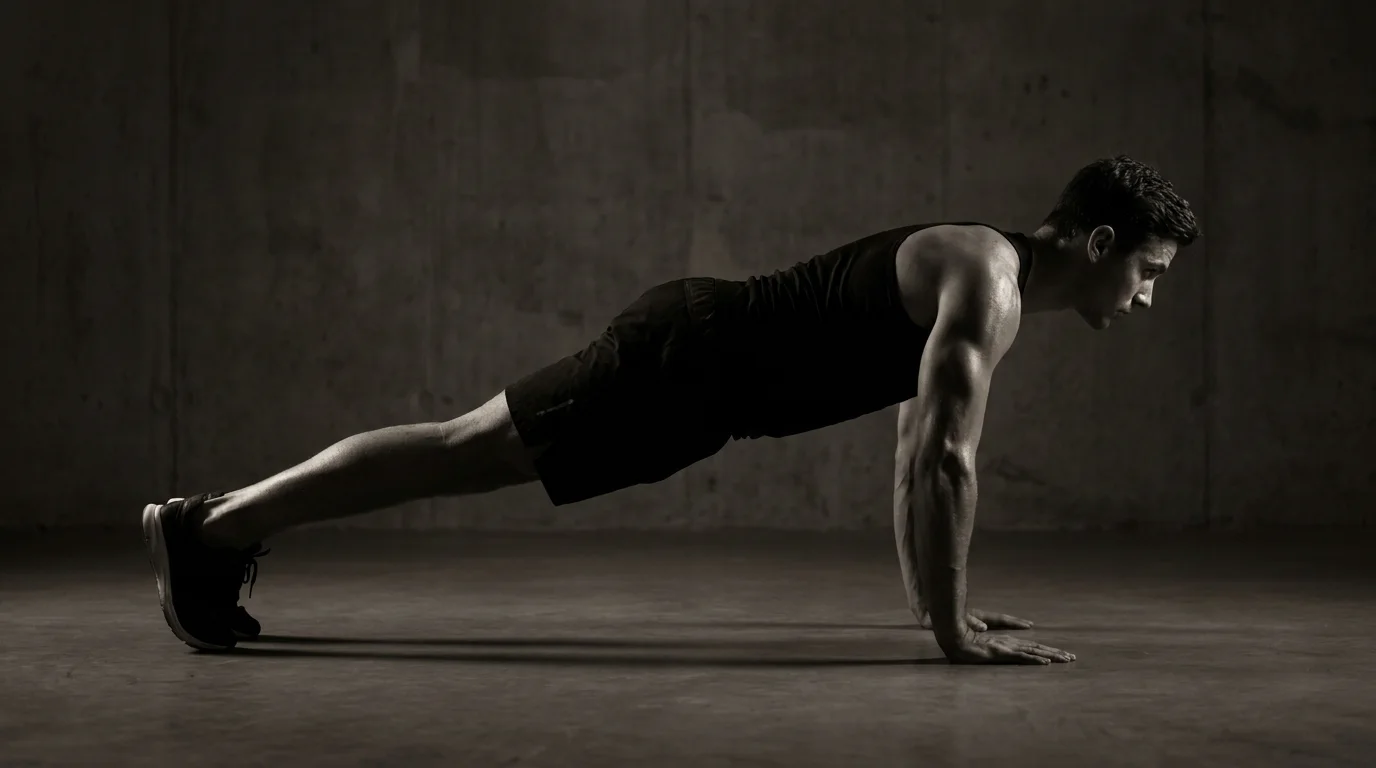
Fundamentals of standard pushup form: setup, alignment, and elbow cues
Starting position and grip: hand placement, shoulder-width stance, and foot position
- Hands slightly wider than shoulders, fingers spread, wrists under shoulders.
- Feet hip width apart, toes tucked, weight evenly between hands and feet.
- Shoulders pulled down and back, chest lifted for proper push-up technique.
Bracing the core and maintaining a neutral spine throughout the movement
- Brace the core as if you expect a light impact to the abdomen.
- Maintain a neutral spine from head to hips; this supports body alignment push-up.
- Look a few inches forward to protect the neck.
Elbow angle guidance: aiming for approximately 45-degree flare and cues for shoulder health
- Elbows track about 45 degrees from your torso, not flared to the sides.
- Think elbow angle push-up 45 degrees as you set your arm line.
- Press evenly through both hands and keep shoulders away from the ears.
Depth targets and tempo cues: how far to press and how to pace the rep
- Lower until chest nearly touches the floor on standard pushup depth.
- Hips stay in line with the rest of the body, core braced.
- Descend two counts, press up one count, pause briefly at the top.
Depth targets, tempo and core stability across variations
ROM benchmarks by variation
- incline push-up bottom distance to floor: about 6 to 12 inches.
- standard push-up bottom distance to floor: about 0 to 2 inches.
- decline push-up bottom distance to floor: about 2 to 6 inches.
Tempo-based progression and practical drills
- start with 2-0-2-0 tempo on standard push-ups to build control.
- progress to 4-0-2-0 and add a 1 to 2 second pause at the bottom.
- emphasize eccentric focus with a slow descent, about 4 seconds, then a controlled ascent.
- use pause reps at midpoint or bottom to reinforce stability during every variation.
Anti-rotation and core stability cues during push-ups
- brace the core and glutes, keep hips level, and avoid sagging.
- maintain anti-rotation by keeping ribs down and torso square to the floor.
- for incline and decline, press evenly through both hands and avoid twisting the hips.
- keep the neck in a neutral position and gaze slightly forward.
Practical movement assessment checklist
- bottom depth matches ROM targets for your variation.
- elbows track at roughly 45 to 60 degrees.
- hips stay level and stable through reps.
- tempo and pauses are consistent on every rep.
Regression, progression, variations, and functional transfer
When to regress or progress: choosing the right variation for goals and shoulder health
Regressions protect form and joints when you can't maintain proper push up technique. Start with incline or wall pushups to build quiet, braced hips and a solid torso. Move toward a standard push up only after you can hold the elbow angle push-up 45 degrees with a neutral spine and controlled tempo. Progress to more challenging options once your shoulders feel stable and your ribs stay connected to your core.
Catalog of common push-up variations and their use cases
Incline push-up easy on the shoulders, good for technique drills. Standard push-up is the baseline for most goals. Wide grip emphasizes the chest, diamond grip targets the triceps and inner chest. Pike presses load the shoulders more. One arm push-ups are advanced and require strong core control and movement assessment before attempting.
Program mapping: progressive templates from incline to standard to decline
Begin with incline 3 x 6-8, then move to standard 3 x 6-8 as form stays solid. When you can complete 3 x 6-8 with good tempo and no sag, try decline 3 x 4-6.
Assessment and functional carryover: translating push-ups to daily activities and sports
Aim for functional strength transfer by pairing push-up work with real tasks. Test movement assessment by pushing a doorway open or carrying a load in front while keeping a braced, stable core.
Frequently asked questions
What is the proper depth for a push-up?
Lower with control until you can return to the start without your hips sagging or elbows flaring. For a standard push-up, bottom distance to the floor is about 0 to 2 inches and the chest nears the floor while the spine stays rigid.
What is the correct elbow position in a push-up?
Elbows track about 45 degrees from your torso, not flared to the sides.
Are push-ups suitable for beginners?
Yes, beginners can start with incline or wall push-ups to build a braced torso, then progress once you can hold the elbow angle of about 45 degrees with a neutral spine and controlled tempo.
How should I progress push-ups in a workout program?
Start with three sets of six to eight reps at a comfortable depth, and only increase intensity when your form stays solid. Use a tempo such as three seconds down and one up, and vary depth, hand position, or incline to progress.
About the authors

Goran Huskić
Co-founder · Professional basketball player
Goran Huskić is a Serbian professional basketball player — a 6'11" center currently playing for Monbus Obradoiro in Spain's Primera FEB. He won the 2019–20 Basketball Champions League with San Pablo Burgos and has competed professionally across Spain, Germany, Lithuania, Serbia and the United States. He co-founded PUSHapp to bring pro-level training discipline to everyday workouts.

Nikola Janković
Co-founder · Former professional basketball player
Nikola Janković is a former professional basketball player — a 6'9" forward and the 2016–17 ABA League MVP — who played for Partizan, Union Olimpija and Mega, among others. Today he runs a pilates studio and gym focused on strength, mobility and overall wellbeing. He co-founded PUSHapp to make consistent, measurable training simple for everyone.