
Muscles & Benefits
Pushups for Chest: Master Form & Variations
Master pushups for chest with proper form, level-based progressions, and variations to build chest strength and definition.


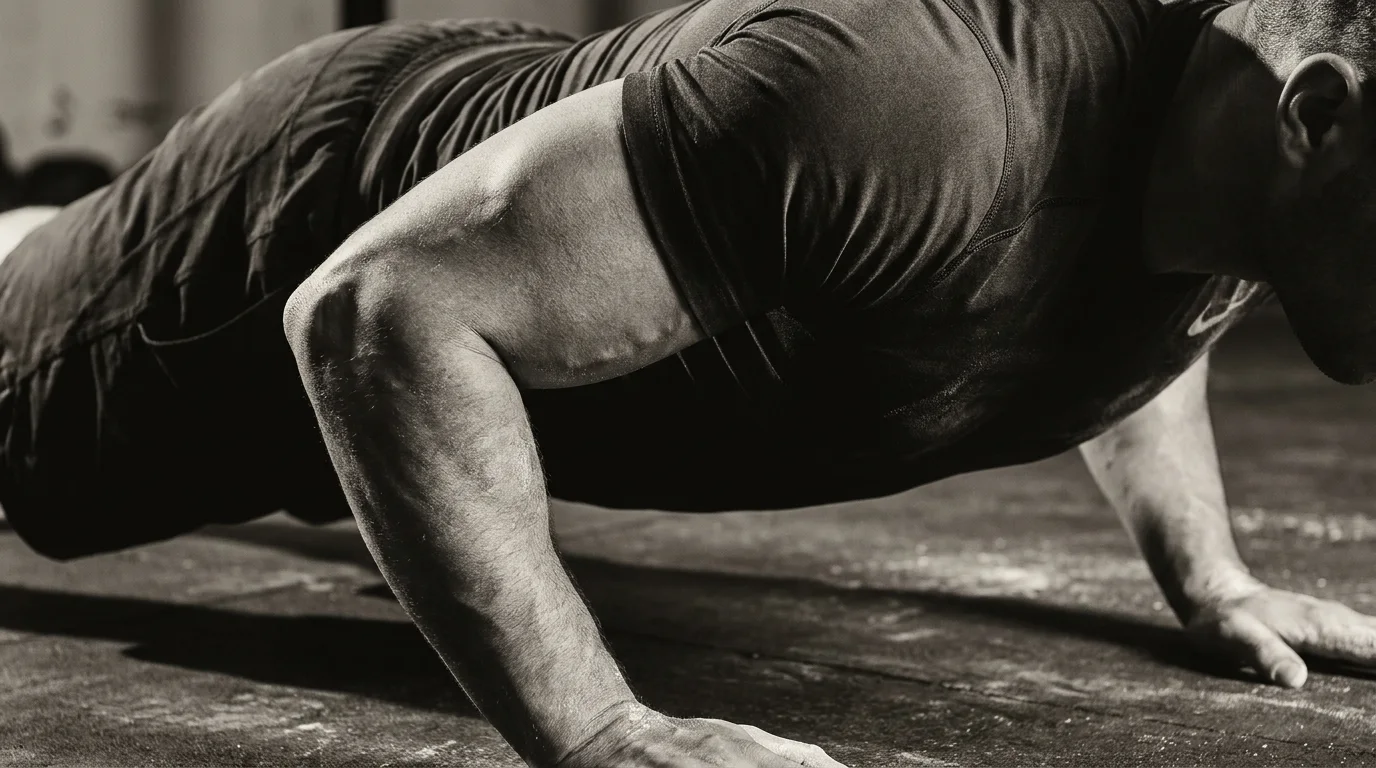
Foundations of Pushups for Chest: Form, Anatomy & Injury Prevention
Solid chest-focused pushups start with anatomy awareness, scapular control, and deliberate tempo.
Anatomy & biomechanics: how the chest muscles drive pushups
- Pectoralis major powers the press and guides elbow extension from the chest.
- Pectoralis minor helps stabilize the shoulder girdle and controls scapular movement.
Scapular stabilization and core engagement: setting a solid foundation
- Set the scapulae by gently drawing them toward the spine before you descend.
- Brace the core and glutes to keep a straight line from head to heels.
Tempo ranges and progression basics: eccentric/concentric sequencing
- Use clear counts: down for 2 seconds, up for 1–2 seconds.
- Prioritize a controlled eccentric to recruit chest fibers and reduce joint strain.
Full ROM vs partial ROM: when and why to choose each
- Full ROM trains pectoralis major through its full length; partials help with ROM limitations.
- Target sticking points with partials, then progress to full ROM when tolerated.
Shoulder health cues, common mistakes, and grip considerations
- Elbows hover about 45 degrees to the torso; avoid flaring to protect shoulder health.
- Maintain scapular set and a rigid torso; don’t let hips sag or chest cave.
- Grip variations: start shoulder-width, explore neutral grip or incline options to shift emphasis.
Push-Up Variations & Grips: Targeting the Chest from Every Angle
Variation-by-variation: which part of the chest each targets
- Incline push-up: Biases the upper chest (clavicular region); keep a straight line, ribs drawn in, core tight. Begin with a higher incline and lower it as strength improves; use partial ROM if you feel shoulder strain, progress to full ROM over time.
- Wide push-up: Emphasizes middle to outer chest; hands flared wider than shoulders, elbows about 45 degrees. Move from kneeling or incline toward a full push-up at a controlled tempo.
- Diamond push-up: Focuses on inner chest and triceps; hands close under the sternum, elbows tucked. Start on knees or a higher surface, progress to full ROM as wrists tolerate it.
- Pike push-up: Hits the upper chest and front delts with a vertical angle; hips high, head toward floor. Use partial ROM if shoulders pinch, then deepen depth gradually.
- Kneeling push-up: A mid-chest, technique-driven regression; maintain a straight line from knees to head, hinge less at the hips, then inch toward standard push-ups.
ROM guidance: when to use full vs partial ROM for each variation
- Early phases: favor partial ROM to protect shoulders and wrists.
- Once form is solid: progress to full ROM for all but the most shoulder-intensive moves.
- If pain occurs, back off to partial ROM and rebuild.
Tempo ranges and progression sequencing for variations
- Use moderate tempos (e.g., 2-0-2-0) for most variations; slow down the lowering phase to feel the chest.
- Progression: kneeling → incline → standard → wide → diamond → pike, adjusting height and depth as control improves.
Shoulder health cues and common mistakes per variation
- Avoid letting elbows flare excessively; keep scapula depressed and stable.
- Incline: prevent hips sagging; keep neck in a neutral line.
- Diamond: watch wrist comfort; elbows tucked to protect shoulders.
- Pike: limit depth if shoulder pinch occurs; prioritize form over depth.
- Kneeling: ensure a long, straight torso to avoid sagging hips.
Grip and hand-position options beyond standard grips
- Neutral grip: palms facing each other to ease shoulder load; great for fatigue days.
- Finger positioning: spread fingers and press evenly, not just on the base of the palm.
- Rotation cues: micro-rotate hands outward or inward to bias upper, middle, or inner chest; avoid forcing awkward wrist angles.
Structured Week-by-Week Progression: Beginner to Advanced + Integration
Structured weekly progression by fitness level: beginner
- Weeks 1–4: kneeling push-ups 3x6–8, incline push-ups 2x6–8; incline push-up to target chest muscles; tempo 2-0-2; progress to incline 3x8–12.
Structured weekly progression by fitness level: intermediate
- Weeks 5–8: standard push-ups 4x8–12; tempo 3-1-3; these are among the best pushups for chest muscles; add 1 chest accessory day (dumbbell presses or flyes).
Structured weekly progression by fitness level: advanced
- Weeks 9–12: weighted or paused push-ups 4x6–10; tempo 2-0-2; maintain full ROM; keep 1–2 accessory days.
Weekly cadences (3–4 days/week)
- Beginner: 3 days; Intermediate: 4 days; Advanced: 3–4 days with a heavy push day.
Integrating pushups with complementary chest exercises
- Pair pushups with dumbbell presses, flyes, cable work; vary angles.
Anatomy recap: pec major and pec minor function
- Pec major drives pressing; pec minor stabilizes scapula and rib cage.
Practical ROM, tempo, and progression sequencing
- Favor full ROM when shoulders tolerate; start partial ROM if needed; blend tempo with pauses.
Frequently asked questions
How do you do a push-up correctly?
Start with your hands slightly wider than shoulders, fingers forward, wrists under your arms, and a braced core with a straight line from head to heels. Lower with control until your chest nears the ground, then press back up, keeping your elbows about 45 degrees from your torso. If your shoulders flare or your hips sag, adjust your stance or raise the surface and rebuild from a higher angle.
Which push-up variation best targets the chest?
There isn’t a single best variation for everyone. Wide push-ups emphasize the middle to outer chest, while incline push-ups bias the upper chest; including both (and other variations) gives balanced chest development.
How can I modify push-ups for beginners?
Begin with incline push-ups on a bench or box to reduce load and learn the pattern, then progress to standard push-ups as you gain strength. For a gentler regression, try kneeling push-ups while maintaining a straight line from knees to head, and gradually deepen the movement.
What is a kneeling push-up?
A kneeling push-up is a regression performed from the knees, maintaining a straight line from knees to head. It reduces load compared to a standard push-up and helps you build form before advancing to full push-ups.
About the authors

Goran Huskić
Co-founder · Professional basketball player
Goran Huskić is a Serbian professional basketball player — a 6'11" center currently playing for Monbus Obradoiro in Spain's Primera FEB. He won the 2019–20 Basketball Champions League with San Pablo Burgos and has competed professionally across Spain, Germany, Lithuania, Serbia and the United States. He co-founded PUSHapp to bring pro-level training discipline to everyday workouts.

Nikola Janković
Co-founder · Former professional basketball player
Nikola Janković is a former professional basketball player — a 6'9" forward and the 2016–17 ABA League MVP — who played for Partizan, Union Olimpija and Mega, among others. Today he runs a pilates studio and gym focused on strength, mobility and overall wellbeing. He co-founded PUSHapp to make consistent, measurable training simple for everyone.