
Muscles & Benefits
Pushup Muscles Worked: What They Do and Variations
Learn which pushup muscles worked, proper form, and progressive variations for all levels.


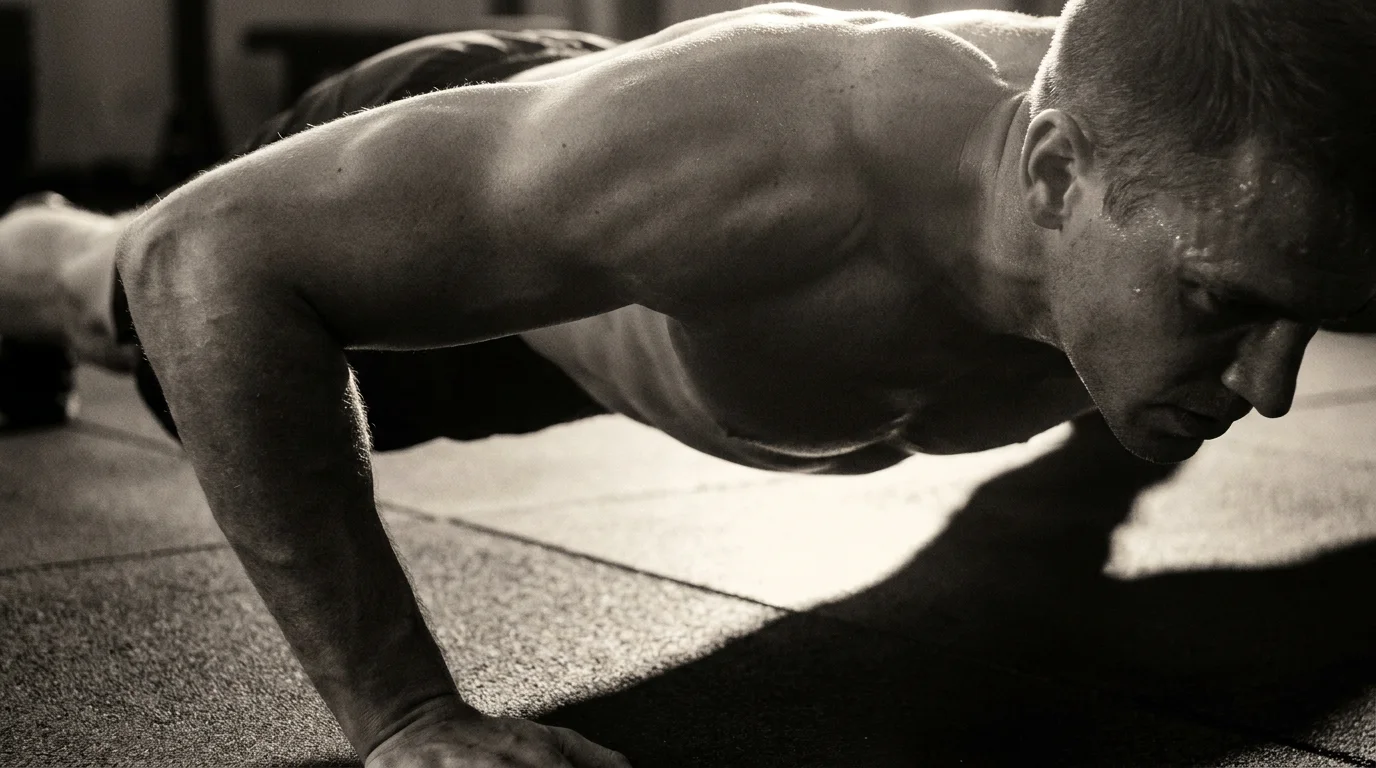
What Pushup Muscles Are Worked and How They Activate
These are the pushup muscles worked, spanning the chest, shoulders, and core. The primary movers are the pectoralis major, pectoralis minor, and the anterior deltoids. Serratus anterior and the lats add stability, with the core acting as a live belt.
Muscle activation by phase (eccentric, concentric, isometric)
- Eccentric: Lowering to the floor lengthens the chest and front shoulder muscles; serratus anterior and lower traps guide scapular movement.
- Concentric: Pressing up shortens these muscles; the scapula protracts and the core braces to keep the spine steady.
- Isometric: At the bottom or top hold, sustain tension to protect alignment and maintain scapular position.
Scapular mechanics and loading (serratus anterior and lats)
- Serratus anterior keeps the scapula stable and protracted, enabling a solid reach.
- The lats help stabilize the torso and prevent excessive sag during descent and ascent.
Breathing cues and bracing during push-ups
- Inhale on descent, exhale on ascent.
- Brace the core: tighten abs and glutes, ribs down; avoid rib flare.
Form, Tempo, and Safety: Mastering Push-Ups with Precision
Proper alignment and form cues
- Line up a straight spine from head to heels. Hands under shoulders, fingers spread, wrists neutral.
- Brace core and glutes so the ribcage stays level; avoid sagging hips or flaring ribs.
- Elbows should be about 45 degrees from the torso; don’t let them flare out or tuck in excessively.
- Keep a neutral neck—look a few inches forward, not down at the floor.
Tempo-based training and breathing
- Use a steady tempo: 2 seconds down, 0-1 second pause at the bottom, 1–2 seconds up.
- Inhale on the way down, exhale during the press. Maintain bracing throughout to protect ROM limits.
Safety considerations: wrists, scapula stability, and advanced mistakes
- Wrist safety: wrists aligned with forearms; press through the entire hand, not just the palm edge.
- Scapula stability: pull blades down and together, then press evenly.
- Watch for advanced mistakes: neck tension, hips sag, head poking, overly wide hands, or uneven weight. If needed, regress to incline or knee push-ups to preserve form and prevent pain.
Progressions, Variations, and Programming for All Levels
Use this spectrum to tailor push-up variations to your current level, with clear regression options and achievable progressions.
Beginner progressions and regression options
- Regression options: wall push-ups, incline push-ups (hands on bench/box), knee push-ups.
- Beginner push-up variations for workouts: start with elevated surfaces, keep hips level, and breathe steadily.
- Key cues: stack ribs over pelvis, brace core, and press evenly.
Tempo- and load-based progressions by level
- Level 1: incline or knee push-ups with a slow tempo (3–0–3) and short sets.
- Level 2: standard push-ups with a controlled descent and a brief bottom pause.
- Level 3: add weighted push-ups or pike push-ups for novel loading; for one-arm progression and form, begin with supported or incline variants, then progress to negative reps and assisted attempts.
Sample 4–8 week programming and progression checks
- Template: 3 sessions/week; alternate A, B, C. Progressions by level: incline/knee → standard → weighted/pike → one-arm when ready.
- Checks: every two weeks, re-test push-up reps, ensure form remains solid before increasing load.
Frequently asked questions
What muscles do push-ups work?
Push-ups primarily target the chest and shoulder muscles—the pectoralis major and minor and the anterior deltoids. The serratus anterior and lats provide stability, and the core acts as a braced belt to keep the spine steady.
How do you perform a push-up with proper form?
Line up a straight spine from head to heels, hands under the shoulders, and elbows about 45 degrees from the torso. Brace the core and glutes, keep the ribs level, and maintain a neutral neck throughout the movement.
What are the best push-up variations for beginners?
Begin with regression options like wall push-ups, incline push-ups on a bench or box, or knee push-ups. Use elevated surfaces to keep hips level and practice steady breathing as you build strength.
Should I start at beginner, intermediate, or advanced level?
Start with an accessible progression and move up as you can control tempo and form; the guide lays out Level 1 (incline/knee with a slow tempo), Level 2 (standard push-ups), and Level 3 (weighted or pike push-ups) as a clear path.
About the authors

Goran Huskić
Co-founder · Professional basketball player
Goran Huskić is a Serbian professional basketball player — a 6'11" center currently playing for Monbus Obradoiro in Spain's Primera FEB. He won the 2019–20 Basketball Champions League with San Pablo Burgos and has competed professionally across Spain, Germany, Lithuania, Serbia and the United States. He co-founded PUSHapp to bring pro-level training discipline to everyday workouts.

Nikola Janković
Co-founder · Former professional basketball player
Nikola Janković is a former professional basketball player — a 6'9" forward and the 2016–17 ABA League MVP — who played for Partizan, Union Olimpija and Mega, among others. Today he runs a pilates studio and gym focused on strength, mobility and overall wellbeing. He co-founded PUSHapp to make consistent, measurable training simple for everyone.