
Muscles & Benefits
Knuckle Pushups Benefits: Muscles & Risks
Discover knuckle pushups benefits, how they differ from traditional pushups, which muscles they target, and how to program safely.


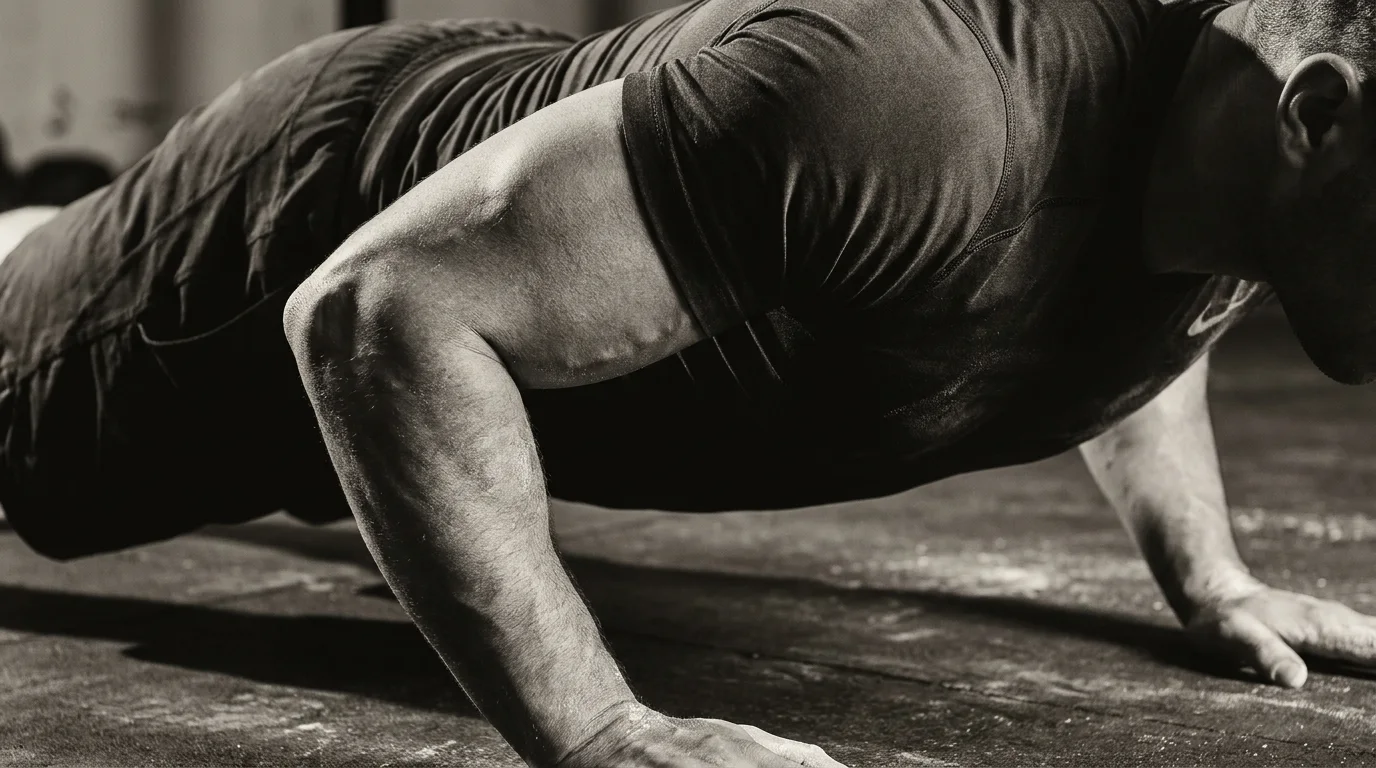
Knuckle Push-Ups vs Traditional Push-Ups: What Changes and Why It Matters
Definition and grip setup
- Knuckle pushups technique involves balancing on the first two knuckles, with fists under the shoulders.
- Wrists stay neutral and stacked; elbows stay close to the torso, spine straight.
- The difference between knuckle pushups vs traditional push-ups is the grip and how load travels through the wrists.
- What are knuckle pushups benefits? Some athletes notice a firmer base and more forearm engagement.
Technique basics and common mistakes
- From a solid plank, roll onto your knuckles and set fists under the shoulders.
- Lower with elbows tucked, then press up while maintaining a straight line.
- Avoid sinking hips, flaring elbows, or letting wrists collapse.
Surface considerations and grip variations
- Hard, flat floors give the most stable knuckles; padded mats help some people.
- You can adjust grip width slightly or try parallel fists to vary load.
- Ensure you maintain a neutral wrist throughout.
Who benefits from knuckle push-ups
- People seeking a different wrist angle or a firmer hand base.
- Athletes who want additional forearm and grip engagement.
- Start slowly and progress to higher reps as control improves.
Muscles, Range of Motion, and Biomechanics: What Knuckle Push-Ups Do for Strength
Muscle involvement and movement emphasis
- Primary movers: pectoralis major, anterior deltoids, and triceps.
- Core and serratus anterior stabilize the torso and shoulder blades.
- The knuckle grip increases demand on forearm flexors and wrist stabilizers, boosting knuckle pushups forearm strength and knuckle pushups wrist strength.
- The hand position subtly shifts load paths, emphasizing controlled scapular movement and solid pressing mechanics.
Range of motion and eccentric loading
- The descent can allow a slightly deeper chest stretch without compromising wrist alignment.
- Slightly greater elbow flexion during the eccentric phase enhances eccentric loading for the chest and shoulders.
- Tempo and control drive the range of motion benefits, not merely depth.
Biomechanics, joint stress, and wrist alignment
- The fist contact redistributes load toward the knuckles and finger joints, while the wrists avoid excessive flexion when braced well.
- Build in wrist and finger mobility to prevent strain; maintain a straight line from wrist to elbow.
- Detailed biomechanics of knuckle pushups explain how load paths shift through forearm and shoulder.
Real-world carryover to martial arts and conditioning
- Strengthen wrist stability and grip readiness for striking and grappling, translating to martial arts conditioning.
Safety, Programming, Surfaces, and Progressions: Training Knuckle Push-Ups Sustainably
Wrist safety, rehab basics, and warning signs
- Warm up wrists with gentle circles and finger spreads; keep load light at first.
- Use padded surfaces and keep wrists neutral—don’t let them bow or cave.
- Wrist rehab for knuckle pushups should be gradual: start with light isometrics or supported holds, then progress to loading.
- Warning signs: sharp pain, numbness, tingling, or swelling. Stop and reassess technique or surface.
Programming progression and periodization (beginner to advanced)
- Beginner: incline knuckle pushups, 2–3x/week, 6–8 reps, 2–3 sets.
- Intermediate: flat-surface knuckle pushups, add tempo, 3x/week, 8–12 reps.
- Advanced: full knuckle pushups on a mat, add pauses or increased volume; consider a deload every 4–6 weeks.
Surface choices and grip variations (fist, knuckles, palms-down)
- Fist: good for beginners on a padded surface.
- Knuckles: classic; ensure wrists stay straight and knuckles share the load.
- Palms-down: softer surface and a gentler load; useful for transitions or regression.
Common pitfalls, troubleshooting, and practical carryover
- Avoid sagging hips and flared elbows; maintain a solid core to carryover into pressing movements.
Frequently asked questions
What are knuckle push-ups and how do you perform them?
Knuckle push-ups are done by balancing on the first two knuckles with fists under the shoulders, keeping wrists neutral and elbows tucked about 45 degrees in a straight-line position. Start on a padded surface or elevated, roll into the knuckle position, then lower and press up with control.
Which muscles are worked by knuckle push-ups (wrists, forearms, chest, triceps)?
Primary movers are the pectoralis major, anterior deltoids, and triceps, with the core and serratus anterior stabilizing the torso; the knuckle grip also increases demand on forearm flexors and wrist stabilizers.
Can knuckle push-ups improve athletic performance for martial artists?
Yes—knuckle push-ups can strengthen wrist stability and grip readiness that support striking and grappling, offering real-world carryover to martial arts conditioning.
Are knuckle push-ups safe for beginners or people with wrist pain?
There are risks on hard surfaces, so start on a padded surface or elevated and progress gradually (2–3 workouts per week, 3–4 sets of 4–6 reps) to build control and maintain pain-free form.
About the authors

Goran Huskić
Co-founder · Professional basketball player
Goran Huskić is a Serbian professional basketball player — a 6'11" center currently playing for Monbus Obradoiro in Spain's Primera FEB. He won the 2019–20 Basketball Champions League with San Pablo Burgos and has competed professionally across Spain, Germany, Lithuania, Serbia and the United States. He co-founded PUSHapp to bring pro-level training discipline to everyday workouts.

Nikola Janković
Co-founder · Former professional basketball player
Nikola Janković is a former professional basketball player — a 6'9" forward and the 2016–17 ABA League MVP — who played for Partizan, Union Olimpija and Mega, among others. Today he runs a pilates studio and gym focused on strength, mobility and overall wellbeing. He co-founded PUSHapp to make consistent, measurable training simple for everyone.