
Form & Technique
How to Do One Arm Pushups: Step-by-Step
Learn how to do one arm pushups with a practical, step-by-step plan. Prereqs, progressions, common mistakes, and programming tips for safe unilateral strength.


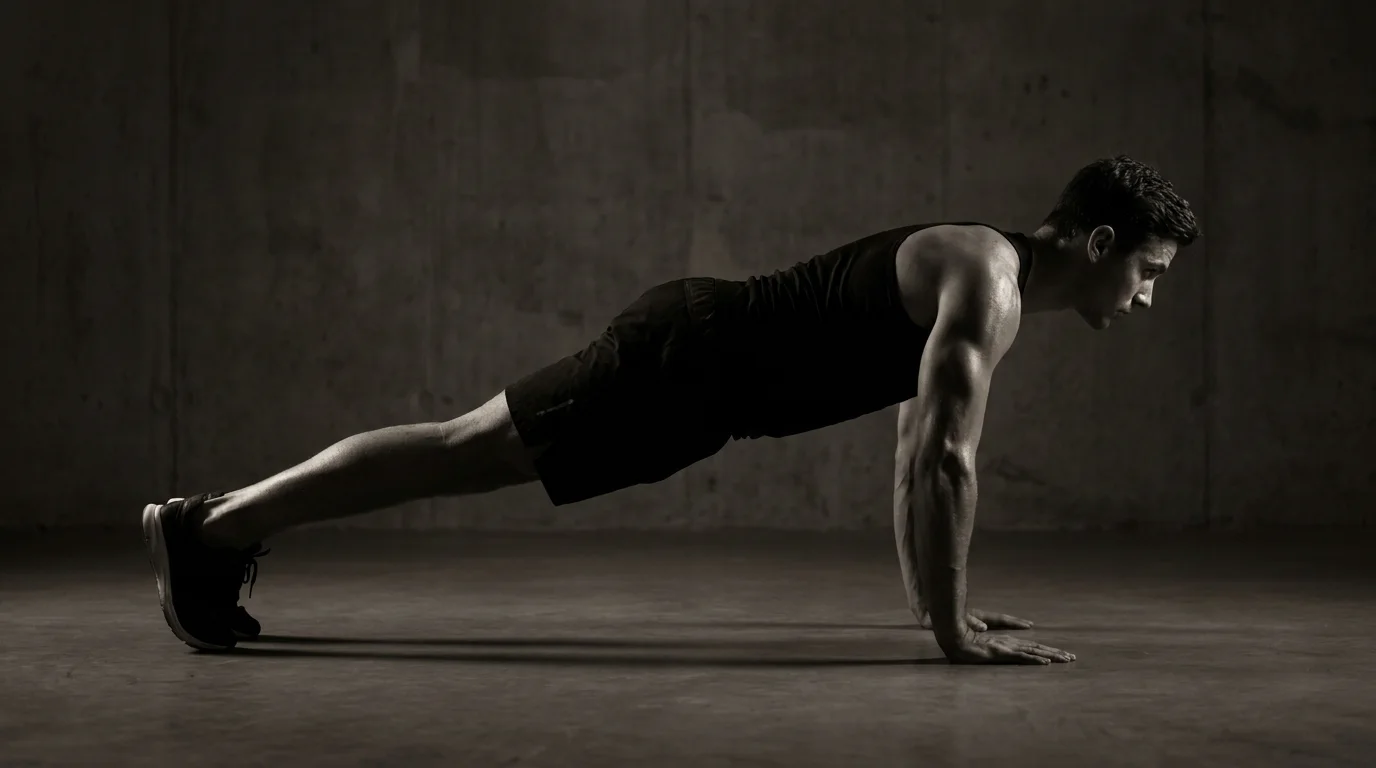
Prerequisites, Mechanics, and Foundations for One-Arm Push-Ups
These prerequisites set the foundation for how to do one arm pushups. They keep you safe and ready to load one side, without falling into injury risk.
Baseline strength and mobility
- A solid standard push-up with good form is the baseline.
- Shoulders and thoracic spine move well; hips stay neutral through the rep.
Wrist and shoulder health checks
- Wrist extension is pain-free; you can bear weight without sharp discomfort.
- Shoulders move without pinching or instability cues; you can maintain control through the press.
Scapular mechanics and core anti-rotation
- Depress and retract the scapula as you press; keep the blades from flaring.
- Brace the core so the torso stays rigid and square; no twisting or sagging hips.
Archer push-ups as a bridge
- Archer push-ups train unilateral loading with preserved scapular control.
- Use them as a bridge to unilateral loading—progress toward a true one-arm push-up while maintaining form.
Complete Progression Ladder: From Incline to One-Arm Push-Ups
This progression ladder shows how to progress up to the one-arm push-up. Train 3 days per week on nonconsecutive days; rest 60–90 seconds between sets. Reps are guidelines—prioritize form and control. It’s a practical path for the how-to progress up to the one-arm push-up, part of a solid one-arm push-up progression.
Rung-by-rung ladder (incline to decline)
- Rung 1: Wall push-ups. 3–4x8–12
- Rung 2: Incline push-ups on a bench. 3–4x8–12
- Rung 3: Lower incline on a sturdy step. 3–4x6–10
- Rung 4: Floor push-ups from the knees. 3–4x6–10
- Rung 5: Archer push-ups (variations; 3–4x4–6 per side)
- Rung 6: Uneven loading push-ups (one hand on plate). 3–4x4–6 per side
- Rung 7: Assisted one-arm push-ups (supporting arm on bench). 3–4x2–4 per side
- Rung 8: Full one-arm push-ups (knee-mod as needed). 3–4x1–3 per side
Volume, tempo, and autoregulation guidelines
- Tempo 2-0-1; rest 60–90s; use RPE 6–8; autoregulate to daily readiness.
Checkpoint tests to advance
- A: complete Rung 4 with solid form; advance to Rung 5.
- B: 3x4–6 per side on Rung 7 across two sessions.
- C: perform a controlled one-arm attempt with progressive loading.
Technique, Safety, and Mastery: Form, Common Mistakes, and Timeline
Technical cues for stable form
- Core bracing: brace the midsection, keep the ribcage lined up with the pelvis, and exhale on the toughest part of the press.
- Anti-rotation: keep the hips square to the floor; imagine a straight line through spine, resisting any twist as you press.
- Scapular mechanics: pinch shoulder blades down and back against the rib cage; keep the scapula stable as you push.
- Loading patterns: start with elevated surfaces or assisted variants; progress to lower angles gradually; maintain neutral wrists and a solid base.
Common mistakes and fixes
- Hips sag or rise: engage glutes and abs; adjust stance for a steadier base.
- Elbows flare wide: tuck elbows to about 45–60 degrees from the body.
- Shoulders shrug: reset scapula, and pause briefly at the top before lowering.
Progress checks and timeline expectations
- Weekly frequency: 2–3 sessions; autoregulate volume based on how you feel.
- Monthly milestones: solid reps on an incline, then increase difficulty; test on a stable surface as you progress.
- Are one-arm push-ups safe for beginners? With proper progressive loading and technique, many can approach safely; expect months to a year depending on baseline strength.
Frequently asked questions
What prerequisites do I need before attempting a one-arm push-up?
Have a solid standard push-up with good control, pain-free wrists, shoulders that move without pinching, a braced core, and the ability to keep your rib cage and hips square during the press; use archer push-ups as a bridge toward unilateral loading.
Are one-arm push-ups safe for shoulders and wrists?
Yes, when you train with a thorough warm-up, listen to your body, and progress gradually with controlled loading; stop if sharp pain or joint grinding appears.
How many reps should I aim for at each progression stage?
Follow the ladder: Archer push-ups (Rung 5) 4–6 per side; Assisted one-arm push-ups (Rung 7) 2–4 per side; Full one-arm push-ups (Rung 8) 1–3 per side; prioritize form, tempo, and daily readiness.
How does the Archer push-up contribute to unilateral pressing strength?
Archer push-ups train unilateral loading with preserved scapular control, serving as a bridge to a true one-arm push-up.
About the authors

Goran Huskić
Co-founder · Professional basketball player
Goran Huskić is a Serbian professional basketball player — a 6'11" center currently playing for Monbus Obradoiro in Spain's Primera FEB. He won the 2019–20 Basketball Champions League with San Pablo Burgos and has competed professionally across Spain, Germany, Lithuania, Serbia and the United States. He co-founded PUSHapp to bring pro-level training discipline to everyday workouts.

Nikola Janković
Co-founder · Former professional basketball player
Nikola Janković is a former professional basketball player — a 6'9" forward and the 2016–17 ABA League MVP — who played for Partizan, Union Olimpija and Mega, among others. Today he runs a pilates studio and gym focused on strength, mobility and overall wellbeing. He co-founded PUSHapp to make consistent, measurable training simple for everyone.