
Variations & Types
Feet Elevated Pushups: Form, Benefits, Variations
Master feet elevated pushups with proper form, progressions, and benefits. Learn how they differ from incline and standard pushups and target chest, shoulders,


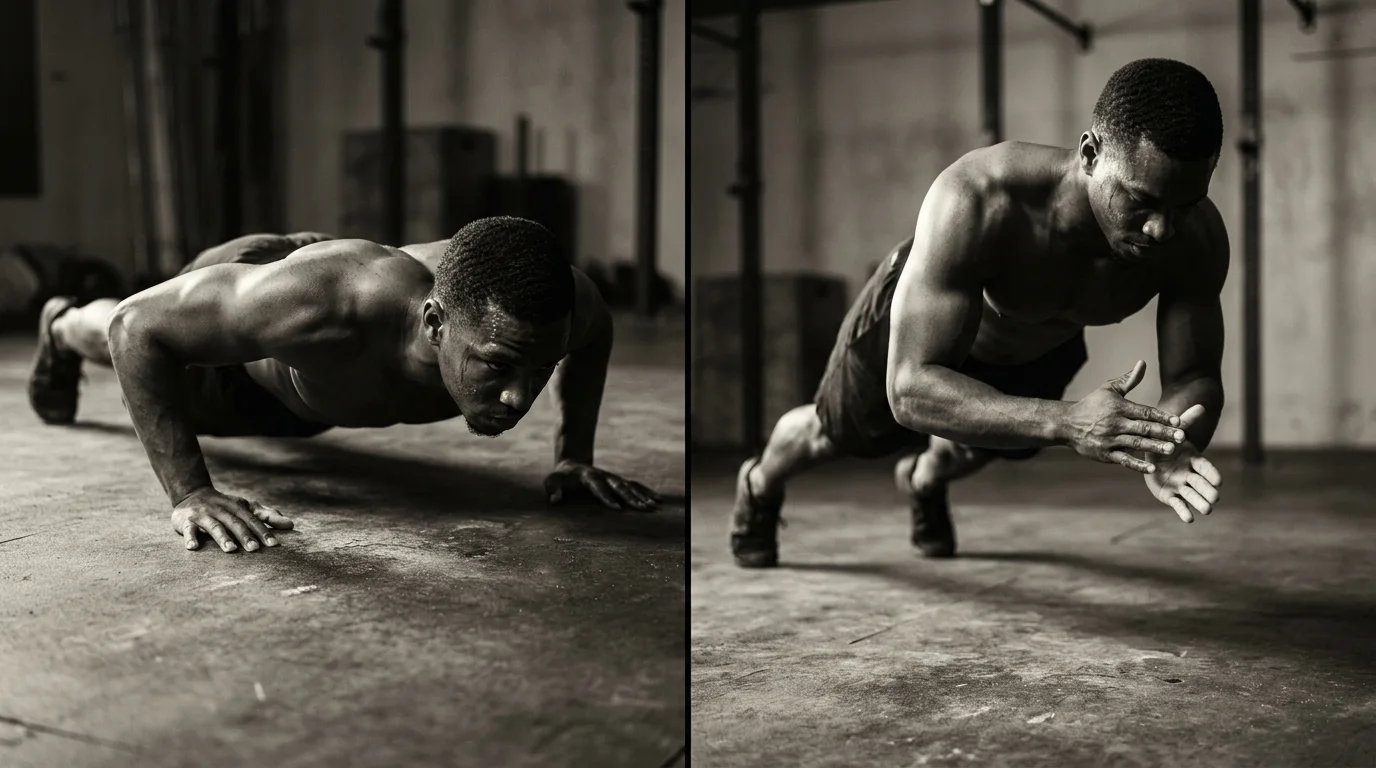
Feet Elevated Pushups Form: Setup, Scapular Mechanics, Breathing, and Safety
Choosing your elevation and foot height
- Start with a low surface (sturdy chair, box) so your body stays in a straight line from head to heels.
- Place hands on the floor, just wider than shoulder width; feet rest on the elevated surface.
- Keep hips level with shoulders; if your back sags, lower the elevation or drop to a standard pushup.
- If you're wondering how to perform feet elevated pushups, begin with a modest elevation so you can maintain control through the descent.
Scapular setup and rib-cage breathing
- Before you descend, pull shoulder blades down and together; keep neck long.
- Inhale, letting the rib cage expand as you lower; exhale on the way up while bracing the core.
Step-by-step cues for the flawless rep
- Stack wrists under shoulders, elbows angled ~45 degrees.
- Brace lats, glutes, and abs; maintain a neutral spine.
- Lower until chest nears floor; press back up while keeping scapulae depressed.
Common mistakes and fixes
- Hips pike or sag: brace core; adjust height.
- Elbows flaring: tuck elbows to 45 degrees.
- Wrists collapsing: shift weight to the whole hand; consider mats.
- Looking up: gaze a few inches ahead; avoid neck strain.
Benefits, Muscle Targets, and Variation Comparisons (Incline, Standard, Decline)
Muscles worked and activation patterns
- Feet elevated pushups (decline) shift load toward the upper chest and front deltoids; the triceps still drive the press, and the core must brace to keep a rigid spine.
- Standard pushups offer a balanced mix across chest, shoulders, and triceps, with solid core engagement.
- Incline pushups are easier and tend to emphasize the lower chest and triceps, serving as a stepping stone to more challenging variations.
How feet elevated pushups differ from incline and standard
- Elevation increases difficulty and raises the pressing angle, boosting upper-chest and shoulder demand; the lever arm is longer, challenging stabilizers.
Choosing the right variation for your goals
- For upper-chest strength and push power, use feet elevated pushups; for lower-chest emphasis or rehab progressions, incline; for overall strength, standard.
- For beginners, follow step-by-step pushup instructions to build form safely.
Breathing and tempo considerations
- Inhale on the way down, exhale as you press up; keep a braced torso; aim for controlled 2-0-2 or 3-0-2 tempo.
Eight-Week Progression, Benchmarks, and Modifications (No Bench or Limited Equipment)
Week-by-week roadmap with benchmarks
- Week 1: Baseline 3x6-8 floor pushups; use benchless elevation only if needed. Focus on hip position and wrist alignment.
- Week 2: 3x8-10 with steady depth.
- Week 3: 3x8-12 with feet elevated on a sturdy step (6–8 in); if wrists flare, drop to floor.
- Week 4: 3x10-12 with higher feet elevation; aim for full range.
- Week 5: 3x8-12 with tempo (2s down, 0s pause).
- Week 6: 3x12-15; hips stay level.
- Week 7: 4x12-15 or 3x15; maintain control.
- Week 8: Benchmark: 3x12-15 with feet elevated or max reps with sound form.
Regression and progression options
- Regress: incline pushups, then knee pushups, then wall pushups.
- Progress: add tempo, a brief pause at the bottom, or raise feet higher when safe.
Equipment-free variations and tips
- benchless elevated pushups: raise feet on stairs or a sturdy chair; if none, do incline pushups against a wall or countertop.
Safety and form checks throughout the program
- Common mistakes with hip position: avoid sagging or piking; keep a straight line. Check shoulders and wrists stay safe, and breathe steadily.
Frequently asked questions
What muscles do feet-elevated pushups work?
They shift load toward the upper chest and front deltoids, with the triceps driving the press, while the core must brace to keep a rigid spine.
How do you properly perform a feet-elevated pushup?
Place your hands shoulder-width apart on a stable surface and rest your feet on an elevated, secure platform; keep hips level with shoulders and a straight line from heels to head, with elbows around 45 degrees. Brace the lats, glutes, and core, inhale on the descent, exhale on the press, and lower until the chest nears the floor before pressing back up.
Are feet-elevated pushups harder than standard pushups?
Yes. Elevation raises the pressing angle and upper chest/shoulder demand, and the longer lever arm challenges stabilizers more than a standard pushup.
How can I modify feet-elevated pushups if I'm a beginner?
Start with a lower elevation (a sturdy chair or box) to maintain a straight head-to-heels line. If wrists flare or form breaks, revert to incline or floor pushups and progress gradually to higher elevations.
About the authors

Goran Huskić
Co-founder · Professional basketball player
Goran Huskić is a Serbian professional basketball player — a 6'11" center currently playing for Monbus Obradoiro in Spain's Primera FEB. He won the 2019–20 Basketball Champions League with San Pablo Burgos and has competed professionally across Spain, Germany, Lithuania, Serbia and the United States. He co-founded PUSHapp to bring pro-level training discipline to everyday workouts.

Nikola Janković
Co-founder · Former professional basketball player
Nikola Janković is a former professional basketball player — a 6'9" forward and the 2016–17 ABA League MVP — who played for Partizan, Union Olimpija and Mega, among others. Today he runs a pilates studio and gym focused on strength, mobility and overall wellbeing. He co-founded PUSHapp to make consistent, measurable training simple for everyone.