
Muscles & Benefits
Bodyweight Chest Workout: At-Home Push-Up Power
Master a comprehensive bodyweight chest workout with no equipment. Learn push-up progressions, dips, and home routines to build pecs safely.


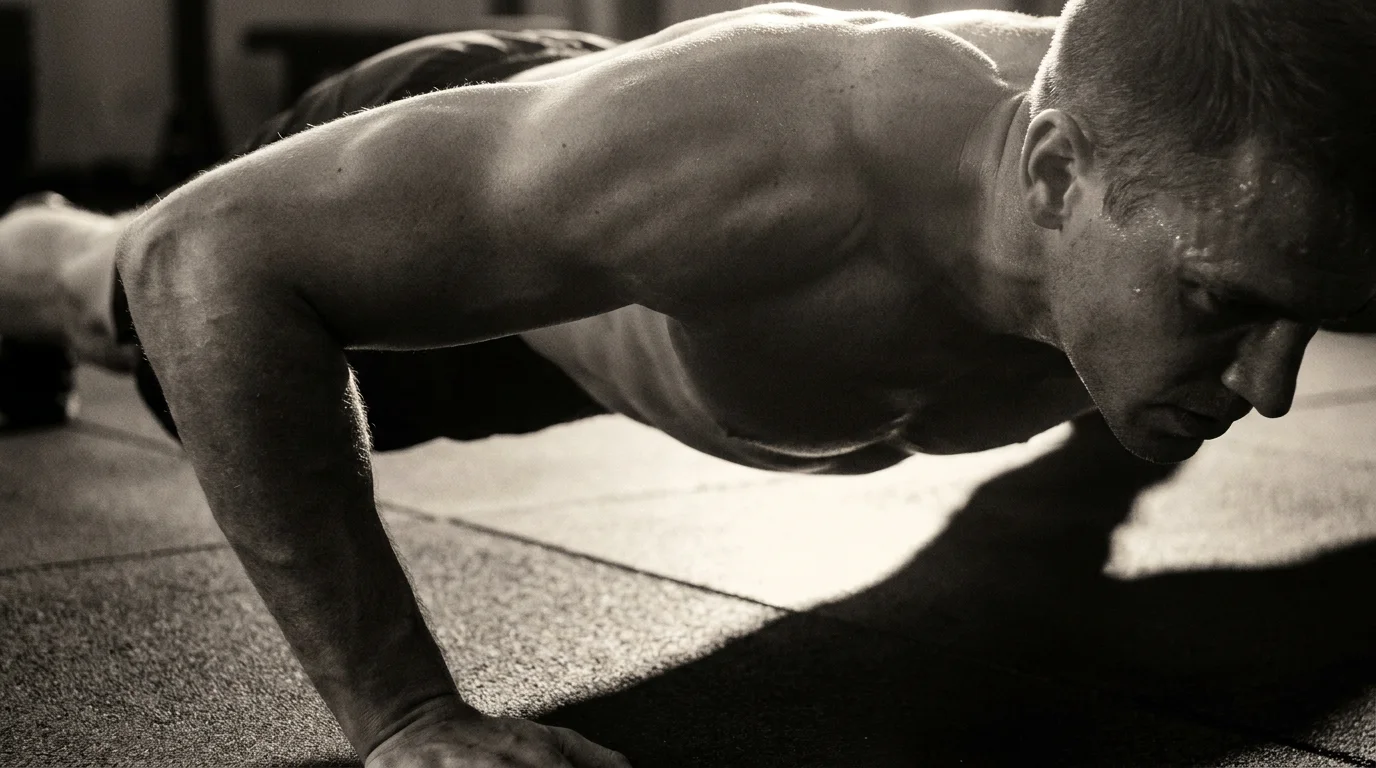
Anatomy, Focused Muscles, and Foundational Bodyweight Chest Movements
A clear map of the chest helps you train safely and effectively at home. The chest is built mainly by the pectoralis major (with its clavicular and sternal heads), with the pectoralis minor underneath and the serratus anterior running along the ribs. In a bodyweight chest workout, these muscles partner with the front deltoids and triceps to press, stabilize, and control the movement.
Muscle groups involved
- Pectoralis major (clavicular and sternal)
- Pectoralis minor
- Serratus anterior
- Anterior deltoids and triceps (supporting)
Core bodyweight chest movements
- Standard push-up: hands shoulder-width apart, body in a straight line, lower to mid-chest, press up.
- Incline push-up: hands on a bench or chair, feet on the floor; keeps the same line, easier to start.
- Decline push-up: feet elevated, hands under shoulders; maintain a straight spine.
- Chest dips: using two sturdy chairs or a low parallel setup; elbows close, torso upright, press back up.
Activation, setup, and safety tips
- Engage the core and pull shoulders down and away from the ears.
- Elbows flare to about 45 degrees to protect the shoulders.
- Breathe: inhale lowering, exhale pressing.
- This can be a no-equipment chest workout, but ensure stable surfaces and controlled reps.
Progressions, Tempo, and Overload for Bodyweight Chest Development
If you're wondering how to train chest with bodyweight at home, follow this progression to overload safely without equipment.
Tempo and time-under-tension
- Use a controlled tempo: descend 3 seconds, pause 0–1 second, press up 1–2 seconds.
- Increase total work by extending the sets or reps at the same tempo.
Eccentrics, isometrics, and holds
- Emphasize the lowering phase: insist on a slow 4–5 second descent.
- Add isometric holds: pause 5–10 seconds at the bottom or mid-range for extra stimulus.
Push-up progressions for chest development
- Start with incline push-ups, then standard push-ups, then decline push-ups.
- Add challenging variants (archer or wide-to-narrow) as you progress.
Incline vs decline push-ups
- Incline push-ups bias the lower chest and are kinder on shoulders.
- Decline push-ups load the upper chest more and increase difficulty.
At-Home Circuits, Programming, and Injury Prevention
Circuit templates by experience level
- Beginner (bodyweight chest workout circuit for beginners): 3 rounds of incline push-ups on a table (8–12), knee push-ups (6–10); rest 60–90s.
- Intermediate: 3 rounds of standard push-ups (6–10), decline push-ups on a chair (6–8), chest dips with two sturdy chairs (4–6); rest 60–90s.
- Advanced: 4 rounds of decline push-ups (6–10), tempo push-ups (4–6), chest dips (6–8); rest 60–90s.
Warm-up, mobility, and shoulder health
5 minutes dynamic prep: arm circles, scapular push-ups, inchworms. Mobility: doorway pec stretch 20–30s per side.
Safety, regression, and progression options
Regression: wall or incline push-ups; progression: decline push-ups and chest dips. How to train chest with bodyweight at home: start with incline push-ups, progress to standard push-ups, then decline or chest dips. Cues: wrists neutral, elbows at 45°, move with control, stop if pain.
Sample programs and rest intervals
Program A: 3x/wk, 60–90s between rounds. Program B: add one extra round every two weeks for gradual volume increase.
Frequently asked questions
Can you build a strong chest with only bodyweight exercises?
Yes. A structured program of progressive bodyweight push-ups, with tempo control and overload, can build chest strength and size without equipment.
What are the best bodyweight exercises for chest development?
Key moves are incline push-ups, standard push-ups, decline push-ups, and chest dips; use tempo and full-range presses to maximize chest stimulus.
How many sets and reps should I do for a bodyweight chest workout?
Follow circuit templates by experience: Beginner—3 rounds of incline push-ups (8–12) and knee push-ups (6–10) with 60–90s rest; Intermediate—3 rounds of standard push-ups (6–10), decline push-ups (6–8), chest dips (4–6); Advanced—4 rounds of decline push-ups (6–10), tempo push-ups (4–6), chest dips (6–8).
How do I progress push-up variations to continually challenge the chest?
Progress from incline to standard to decline push-ups, then add challenging variants (archer or wide-to-narrow), tempo changes, and isometric holds to keep advancing.
About the authors

Goran Huskić
Co-founder · Professional basketball player
Goran Huskić is a Serbian professional basketball player — a 6'11" center currently playing for Monbus Obradoiro in Spain's Primera FEB. He won the 2019–20 Basketball Champions League with San Pablo Burgos and has competed professionally across Spain, Germany, Lithuania, Serbia and the United States. He co-founded PUSHapp to bring pro-level training discipline to everyday workouts.

Nikola Janković
Co-founder · Former professional basketball player
Nikola Janković is a former professional basketball player — a 6'9" forward and the 2016–17 ABA League MVP — who played for Partizan, Union Olimpija and Mega, among others. Today he runs a pilates studio and gym focused on strength, mobility and overall wellbeing. He co-founded PUSHapp to make consistent, measurable training simple for everyone.