
Variations & Types
T Pushups: Form, Benefits & Variations
Discover what t pushups are, how to perform them correctly, their benefits, and practical variations to progress safely.


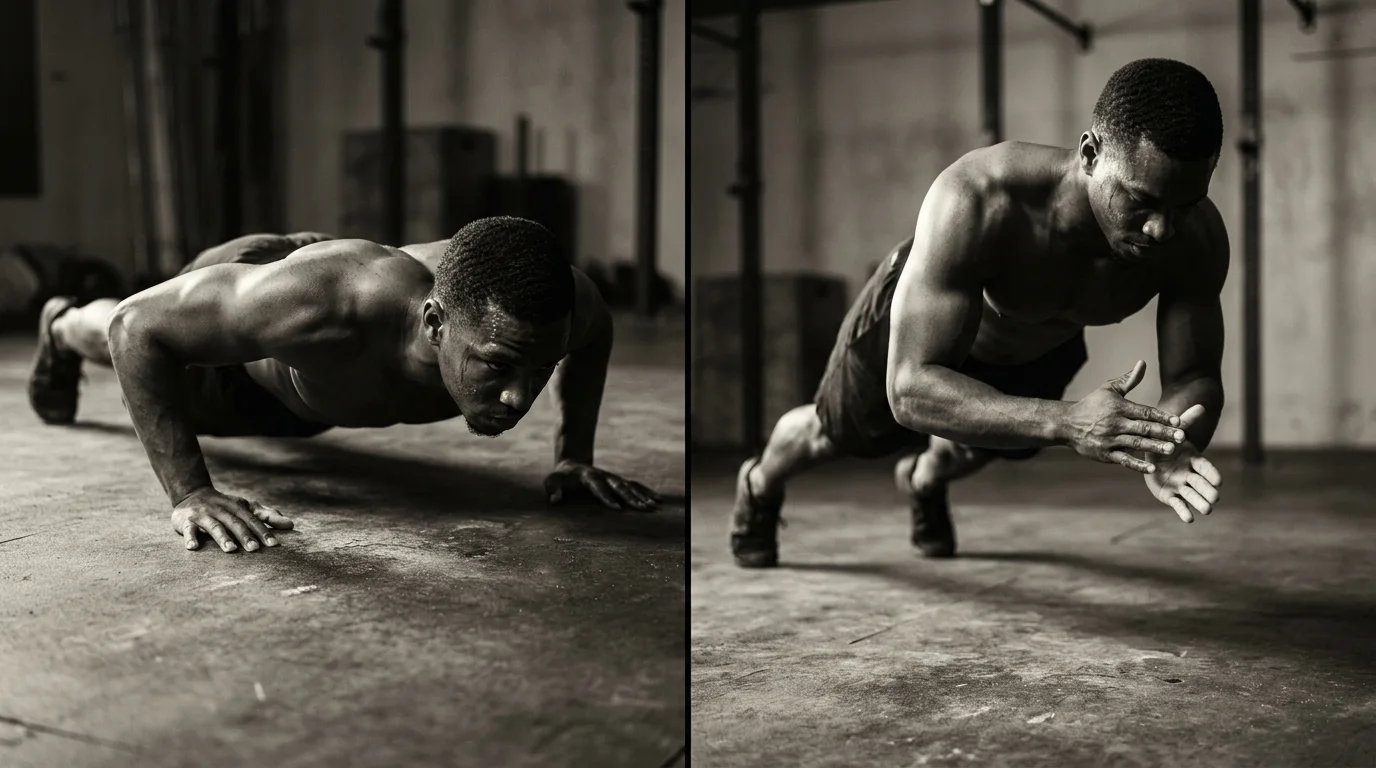
What is a T Push-Up? Mechanics, Muscles, and Shoulder Stability
Definition and setup
- Start in a standard push-up position and lower toward the floor.
- Rotate your body into a side plank on one side.
- Extend the top arm, reaching overhead to form a T with your torso.
- Return to center and repeat on the other side.
- How to do a t push-up form and technique: keep hips level, core braced, and the bottom hand under the shoulder.
Muscles worked and scapular stability cues
- Primary: pectoralis major, anterior deltoid, and triceps.
- Core and stabilizers: serratus anterior, obliques, and rotator cuff.
- Cues: squeeze shoulder blades down and together; keep the top arm aligned with the shoulder; hips square; reach through the top hand to maintain a stable torso.
Common mistakes and fixes
- Hips sag or twist: brace the core and keep hips level.
- Top arm drifts or points behind the ear: actively reach to the ceiling and keep the elbow high.
- Shoulders creep toward the ears: depress the shoulders and set the scapula before rotating.
Performing the T Push-Up: Form, Tempo, and Progressive Variations
Step-by-step setup and descent
- Start in a tall push-up position: hands under shoulders, feet hip-width apart, body in a straight line. Engage your core and glutes; keep neck neutral.
- Lower with control, elbows about 45 degrees to the sides.
- At the bottom, press up halfway and rotate your torso to one side, reaching the top hand toward the ceiling to form a T. Return to center and repeat on the other side.
- Keep hips square and ribs braced throughout the rotation.
Tempo
- Descend for 2 counts, pause briefly if needed, push back up for 2 counts while rotating to form the T. Maintain steady breath and control on each rep.
Breathing, and body line
- Inhale as you descend, exhale as you rotate and press up.
- Maintain a long spine, active glutes, and a steady gaze to support neck alignment.
Progression ladder: from basics to advanced
- Basic t pushups with rotation
- Knee-supported t push-up
- Single-leg t push-up
- Unilateral stability push-up
- Weighted t push-up (plate or vest)
Programming, Variations, and Mobility for T Push-Ups
Variations by level and goal
- Beginner: incline T push-ups from the knees to build control (2–3 sets of 6–8).
- Intermediate: standard T push-ups; single-leg T push-ups to challenge balance.
- Advanced: weighted T push-ups; unilateral stability push-up with one hand on a platform—t push-up variations for core strength. Progression: start light, increase weight gradually.
Programming placements in upper-body and core days
- Upper-body days: 2–4 sets after presses, paired with rows for scapular stability.
- Core days: use T push-ups as anti-rotation work, 2–3 sets per side.
Mobility and remediation: thoracic spine and shoulder flexibility
- Focus on thoracic mobility: thoracic extensions with a foam roller; 1–2 minutes per side.
- Thoracic rotations and thread-the-needle; 30–60 seconds each.
- Shoulder openness and scapular stability cues: ribs down, shoulders depressed.
Technique cues to avoid over-rotation and maintain a straight line
- Brace core, stack hips, and keep a straight line.
- Don’t let the torso twist; rotate through the shoulders, not the hips.
- Squeeze shoulder blades down and back during rotation.
Frequently asked questions
What is a T push-up and how is it different from a standard push-up?
A T push-up starts like a regular push-up but rotates into a side plank at the top, forming a T with your torso. It emphasizes shoulder stability and anti-rotation by lifting the top arm while keeping the hips square.
How exactly do you perform a T push-up step-by-step?
Start in a standard push-up position and lower toward the floor, then rotate your torso to one side into a side plank and reach the top arm to form a T; return to center and repeat on the other side. Keep hips square and core braced throughout the rotation.
Which muscles do T push-ups primarily target?
Primary: pectoralis major, anterior deltoid, and triceps. Stabilizers include serratus anterior, obliques, and rotator cuff.
Are T push-ups safe for shoulders, and what cues help prevent injury?
They’re safe when performed with solid form and controlled rotation. Cues: depress the shoulders and set the scapula, keep the top arm aligned with the shoulder, brace the core, and maintain square hips throughout.
About the authors

Goran Huskić
Co-founder · Professional basketball player
Goran Huskić is a Serbian professional basketball player — a 6'11" center currently playing for Monbus Obradoiro in Spain's Primera FEB. He won the 2019–20 Basketball Champions League with San Pablo Burgos and has competed professionally across Spain, Germany, Lithuania, Serbia and the United States. He co-founded PUSHapp to bring pro-level training discipline to everyday workouts.

Nikola Janković
Co-founder · Former professional basketball player
Nikola Janković is a former professional basketball player — a 6'9" forward and the 2016–17 ABA League MVP — who played for Partizan, Union Olimpija and Mega, among others. Today he runs a pilates studio and gym focused on strength, mobility and overall wellbeing. He co-founded PUSHapp to make consistent, measurable training simple for everyone.