
Variations & Types
regular pushups: perfect form & variations for all levels
Master regular pushups with step-by-step form tips, beginner progressions, and variations to boost chest, shoulders, and core.


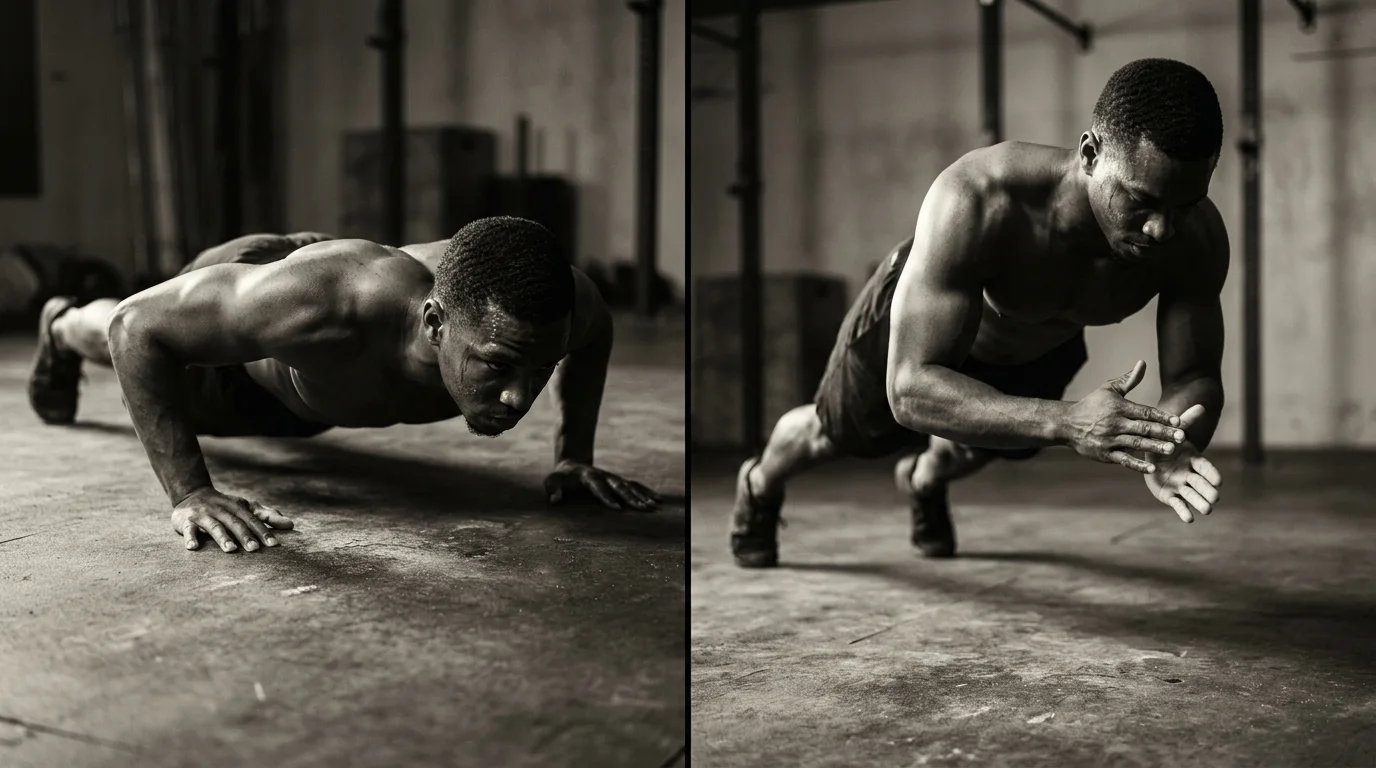
Mastering regular pushups: form, cues, and shoulder-friendly technique
Baseline setup and posture
- Hands just outside shoulder width, wrists under shoulders.
- Feet hip-width apart; body in a straight line from heels to crown; engage core and glutes.
- This setup supports proper push-up form and scapular stability; keep shoulders down and back; gaze neutral.
Tempo and breathing cues
- Lower 2–3 seconds; small pause at chest; press up 1–2 seconds.
- Inhale on the way down, exhale on the way up; maintain a tight core.
Common form flaws and fix-it cues
- Hips sag: brace core; pelvis stays level.
- Elbows flare beyond 45 degrees: tuck elbows toward your ribs.
- Head pokes forward: keep a neutral spine and gaze.
Shoulder health and wrist-friendly tips
- Draw shoulders away from ears; use rotator cuff safe cues: modest elbow angle and scapular stability.
- For wrists, keep them under shoulders; if pain, try fists or push-up bars; or incline push-ups.
No-equipment comfort options (fists, bars)
- Fists on the floor or parallel bars reduce wrist strain while preserving form.
- For travel or uneven surfaces, no-equipment alternatives like incline push-ups still build strength.
Structured progressions and variations for every level
Beginner path: foundation and consistency
- 3 days per week. Start with incline push-up or knee push-up: 3x6-8.
- After 2–3 weeks, progress to regular push-ups: 3x5-8.
- Add one variation (wide or diamond) on a fourth workout day to build balanced strength.
Intermediate path: increasing volume and control
- 4 days per week. 3–4 sets, 8–12 reps per exercise.
- Rotate through regular push-ups, wide push-ups, and diamond push-ups; add a few sets of pike push-ups as shoulder strength grows.
Advanced path: strength and endurance
- 5 days per week. 4–6 sets, 6–12 reps.
- Combine tempos and density: tempo push-ups, then short blocks of higher-rep work to push endurance.
Tempo-breathing progressions
- Use controlled tempo: 3-second descent, 1-second pause, 1-second press.
- Exhale on the push; inhale as you reset.
Micro-workouts for busy schedules
- 2–3 short sessions daily, 5–7 minutes each.
- Density training: 5-minute blocks of max reps, 30–60 seconds rest, repeat to accumulate total reps. Regular push-ups stay the core.
Assessment, corrections, and equipment-friendly options
Self-assessment checklist (setup, descent, push, lockout)
- Setup: hands under shoulders, core braced, spine neutral; proper technique for regular pushups starts here.
- Descent: elbows at 45 degrees, ribs connected to hips; scapular stability anchors the shoulders.
- Push: press through the floor, not into the chest alone; engage the lats.
- Lockout: wrists under shoulders, hips level, hips and spine in a straight line.
- Use this assessment checklist before each session to verify form.
Fix-it cues for common flaws
- Hips sag: brace glutes and abs; imagine a straight line from head to heels.
- Elbows flare: tuck to 45 degrees; keep forearms vertical.
- Head poke: look a few inches ahead, not down.
Shoulder health cues and rotator cuff safety
- Scapular stability throughout; rotator cuff safe cues: maintain a 45-degree elbow angle and steady shoulder blades.
Wrist-friendly options and equipment pros/cons
- Fist push-ups: pros—wrist extension is reduced; cons—knuckles take load.
- Push-up bars: pros—better hand position and height; cons—needs space and setup.
- Incline variations: pros—easier load; cons—less absolute stimulus.
Injury prevention and recovery strategies
- Warm up, progress gradually, listen to joints, and include mobility work and rest days.
Frequently asked questions
What is the proper form for a push-up and how do you perform it?
Start with hands under the shoulders and feet hip-width apart, your body in a straight line from heels to crown, and your core and glutes braced. Lower with a controlled 2–3 second descent, pause briefly at the chest with elbows around 45 degrees, then press up 1–2 seconds.
What are the best push-up variations for beginners?
Begin with incline or knee push-ups to build form and strength, then progress to full push-ups. As you grow stronger, add variations like wide or diamond push-ups to balance development.
How can you modify push-ups if you can't do a full rep?
Use incline or knee push-ups, or props like a bench, wall, or even fists to reduce load; gradually decrease the incline as you gain strength.
What muscles do push-ups work and what are the benefits?
Push-ups primarily target the chest, shoulders, and triceps, while also engaging the core and glutes for stability. They build upper-body strength, shoulder stability, and can be done anywhere without equipment.
About the authors

Goran Huskić
Co-founder · Professional basketball player
Goran Huskić is a Serbian professional basketball player — a 6'11" center currently playing for Monbus Obradoiro in Spain's Primera FEB. He won the 2019–20 Basketball Champions League with San Pablo Burgos and has competed professionally across Spain, Germany, Lithuania, Serbia and the United States. He co-founded PUSHapp to bring pro-level training discipline to everyday workouts.

Nikola Janković
Co-founder · Former professional basketball player
Nikola Janković is a former professional basketball player — a 6'9" forward and the 2016–17 ABA League MVP — who played for Partizan, Union Olimpija and Mega, among others. Today he runs a pilates studio and gym focused on strength, mobility and overall wellbeing. He co-founded PUSHapp to make consistent, measurable training simple for everyone.