
How Many & Who
Pushup Test Guide: Protocols, Norms, Training
Explore the pushup test protocol, scoring, age/gender norms, and practical training tips to boost endurance and accuracy.

Pushup Test Protocols, Variants, and Safety
What counts as a rep and basic scoring
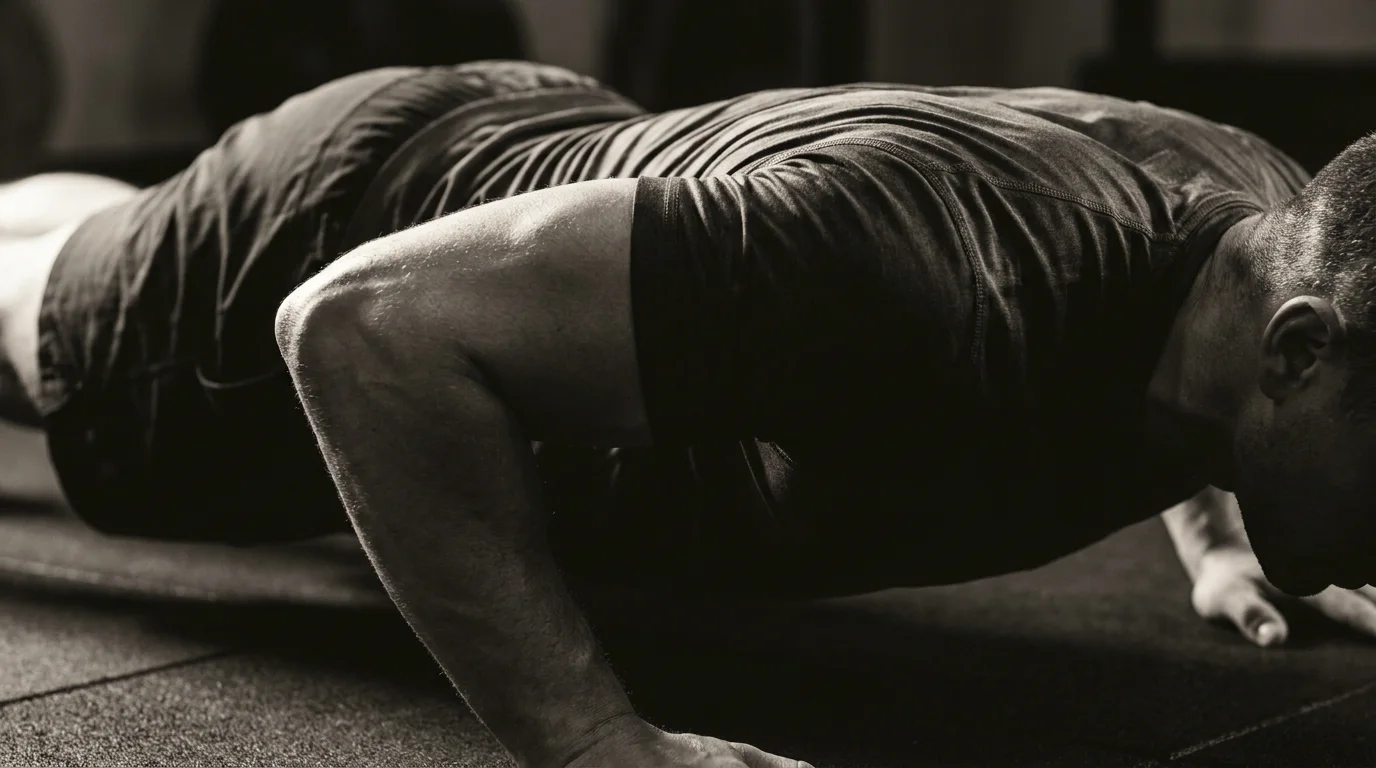
- A rep = one full pushup ROM: from full extension at the top to a consistent bottom position, then back to full extension.
- Bottom depth varies by variant (standard, knee, incline); only reps that return to full extension count.
- Tempo guideline: about 2 seconds down, 1 second up; a brief pause is allowed only to preserve form.
- Scoring: count every clean rep performed with proper alignment.
Choosing the right variant: standard, knee, incline
- Standard pushups test upper-body pressing strength.
- Knee pushups reduce load; good for beginners or limited ROM.
- Incline pushups ease the bottom depth and shoulder demand; use for progression or shoulder rehab guidance.
1-minute pushup test protocol and pacing cues
- Goal: max full ROM reps in 60 seconds.
- Cue: stay in a solid plank, hips level; tempo 2s down, 1s up; count reps on the ascent.
2-minute pushup test protocol and pacing cues
- Same tempo and form, sustained for 120 seconds; minimize micro-rests; track total reps.
Max rep test protocol and scoring
- Push to failure with strict form; count all clean reps; stop if form breaks or depth is inconsistent.
Safety, red flags, and medical exclusions
- Warm up 5–10 minutes; stop for chest pain, dizziness, shoulder pain, numbness, or loss of neutral spine. Seek medical advice if concerned.
Norms, Scoring, and Tracking: Pushup Test by Age, Gender, and Platform
Understanding pushup standards by age and gender
- Norms exist in age bands (e.g., 17-29, 30-39, 40-49, 50+), with separate charts for each gender. Younger groups and men typically post higher reps; use percentile context to compare within your cohort.
- Percentile context: 50th percentile is the median; higher percentiles indicate stronger relative performance.
- Use these references to set personal targets and track progress over time.
APFT alignment: how pushups map to broader tests
- APFT pushups are counted in two minutes and scored by age/gender tables.
- ACFT has its own push-up metric; treat your result as a point on that scale.
- For planning, map your reps to APFT-style targets and use the percentile framework for progress.
Interpreting scores: percentiles and goals
- Reps translate to percentiles; aim for a realistic target (e.g., 60th–80th percentile) and adjust as you improve.
Templates for tracking and scoring
- Tracking template (copy-paste): Date | Age | Gender | Reps | Time | APFT Score | ACFT Score | Percentile | Target
- Scoring sheet (copy-paste): Date, Reps, Score, Percentile, Notes
- These templates work across platforms—print, notes app, or the app’s tracker.
When to retest and how to set targets
- Retest after 2–4 weeks of focused training; add small reps steps (2–5 reps) as you can.
Training Plans to Improve Pushup Performance (1-min, 2-min, and Max Tests)
Use these blocks to raise reps across 1-min, 2-min, and max tests, with tempo work, solid technique, and a simple progression.
Foundational technique and cues
- Keep a solid plank: neutral spine, hips level, gaze forward.
- Elbows tuck ~45 degrees; brace the core; scapular control on every rep.
- Breathe smoothly; exhale during press.
Block-based progression: baseline, build endurance, peak
- Baseline: establish a comfortable max reps at moderate effort.
- Build endurance: 3–4 sets with 60–90s rest; add 20–30% volume weekly.
- Peak: near-test pace in back-to-back sets; simulate test density.
Tempo and paused reps: precision training
- Tempo pushups: 3-0-2-0 (3s down, 0s bottom pause, 2s up, 0s top pause); add 1–2s bottom pause as you progress.
Periodization plan: 4-week and 8-week templates
- 4-week: weeks 1–2 accumulate, week 3 deload, week 4 test.
- 8-week: two 4-week cycles with light deload between; increment reps or density each cycle.
Sample week for 1-min, 2-min, and max goals
- Mon: tempo sets; Wed: density work; Fri: max-rep practice.
Common mistakes and corrective cues
- Sagging hips or flared elbows; cue: brace core, tuck elbows, reset between reps.
Safety and red flags
- Injury prevention: stop for sharp pain, numbness, or shoulder pinching; reassess form and load.
Frequently asked questions
What is a good push-up test score for my age and gender?
Norms are published by age bands and gender with percentile context, so compare your results to the appropriate chart and set targets within your cohort. Younger groups and men typically post higher reps, so aim for a realistic milestone in the 60th-80th percentile as you improve.
What is the standard push-up test protocol (time and form)?
Use 1-minute, 2-minute, or max-rep formats; keep a solid plank with hips level and elbows tucked about 45 degrees, and move with a 2-second down, 1-second up tempo. Count every clean rep that returns to full extension, and stop if form breaks or depth becomes inconsistent.
How do you perform a push-up test correctly?
Choose the variant (standard, knee, or incline) and follow consistent tempo and form: full ROM from top to bottom, hips neutral and core tight, and count only reps that return to full extension. Maintain proper alignment throughout and pause only to preserve form when needed.
How can I train to improve my push-up test results?
Follow progressive plans that blend volume, pacing, and control while prioritizing safe form and a proper warm-up. Retest every 2-4 weeks and log reps to track small gains as you increase total reps.
About the authors

Goran Huskić
Co-founder · Professional basketball player
Goran Huskić is a Serbian professional basketball player — a 6'11" center currently playing for Monbus Obradoiro in Spain's Primera FEB. He won the 2019–20 Basketball Champions League with San Pablo Burgos and has competed professionally across Spain, Germany, Lithuania, Serbia and the United States. He co-founded PUSHapp to bring pro-level training discipline to everyday workouts.
Nikola Janković
Co-founder · Former professional basketball player
Nikola Janković is a former professional basketball player — a 6'9" forward and the 2016–17 ABA League MVP — who played for Partizan, Union Olimpija and Mega, among others. Today he runs a pilates studio and gym focused on strength, mobility and overall wellbeing. He co-founded PUSHapp to make consistent, measurable training simple for everyone.