
How Many & Who
Pushups for Women: Form and Progressions
Master pushups for women with beginner mods, step-by-step form, progressions, and safety tips to build strength and confidence.



Foundations of Form: Female-Specific Cues for Safe Pushups
- For pushups for women, start with alignment that protects the spine, shoulders, and core. Use these cues to move with control through each rep.
Hip alignment and neck position for stability
- Keep hips in line with shoulders and ankles; no sagging or excessive arch.
- Neck stays neutral; gaze a few inches ahead, chin tucked softly.
- Engage the glutes and abs to hold the line as you descend and press.
Wrist comfort, grip width, and hand placement
- Hands outdoors shoulder width, wrists stacked under forearms, wrists straight.
- If wrist discomfort arises, opt for a knee-modification or incline pushups; this also covers how to do pushups for beginners with knee modifications.
- Lightly press through the base knuckles for stable support.
Scapular control and elbow flare prevention
- Set scapulae down and back before the press.
- Elbows track at about 45 degrees from the torso; avoid wide flare.
- Maintain scapular position as you lower and rise.
Shoulder safety and diastasis considerations
- Keep shoulders away from ears; ribs and hips stay connected through a braced core.
- For diastasis considerations, progress gradually, favor incline or knee-mods, and monitor midline tension.
Modifications, Equipment, and a 4-Week Progression
Starting points: knee, incline, and wall push-ups with setup
- Knee push-ups: on your knees, hands under shoulders, core tight, hips in line with knees. Pause at the bottom briefly; push back up with control. Aim for 3 sets of 6–8.
- Incline push-ups: hands on a stable elevated surface (bench, table). Keep a straight line from head to knees, elbows brushing by your sides. 3 sets of 6–8.
- Wall push-ups: stand close to a wall, hands at chest height. Press away, maintaining a tall spine. 3 sets of 6–8.
Grip width and hand placement guidance
- Hands slightly wider than shoulder-width; fingers forward.
- Elbows about 45 degrees from the body; shoulders away from ears.
- Wrists stacked under shoulders; engage chest and core.
4-week progression: weekly targets and measurable benchmarks
- Week 1: 3x6–8 (knee or incline).
- Week 2: 3x8–10.
- Week 3: 4x8–12.
- Week 4: 4x12–15 or gradually move toward standard push-ups on an elevated surface; aim for consistent, clean reps. Benchmark: complete all sets with solid form.
Equipment options and how to use them safely
- Push-up bars promote a neutral wrist position; ensure non-slip grips.
- Elevated surfaces (bench, step, countertop) must be stable and tall enough to reduce strain.
- Decline push-ups (feet higher) can be added later for resistance, when ready.
When to retire modifications and graduate to full push-ups
- Retire once you can perform 3x12 with proper form on the current setup.
- Transition by decreasing incline height or moving to floor push-ups gradually, while preserving alignment and control.
Variations, Programming, and Injury Prevention for Long-Term Strength
Ultimate variations for women: from incline to decline and archers
- Incline push-ups (hands on a bench) to build confidence and control.
- Standard floor push-ups when form is solid and reps feel controlled.
- Decline push-ups to increase load as you advance.
- Archer and offset push-ups to challenge unilateral strength.
- Pause at the bottom or top to improve stability.
- These form the core of the best push-up variations for women and support are push-ups good for women's strength and core when scaled appropriately.
From knee push-ups to full push-ups: progression roadmap
- Start with knee push-ups, then move to incline floor push-ups.
- Progress to full push-ups with a neutral spine, then add controlled negatives.
- Finish with archer/offset variations or tempo holds as you gain consistency.
- How to progress from knee push-ups to full push-ups is clear with these steps.
Program design: weekly volume, load, and recovery
- 2–3 push-ups for women workout sessions weekly; 4–6 total sets; 6–12 reps per set.
- Use tempo, varied variations, and light to moderate loads for 4–8 weeks, increasing weekly volume gradually with adequate recovery.
Injury prevention: wrist, shoulder, diastasis-aware cues
- Keep wrists neutral; use push-up bars or fists if needed.
- Retract shoulders, pull them away from ears, and keep a stable ribcage.
- Engage a braced core and pelvic floor; exhale on push to protect the diastasis.
- If pain arises, dial back height or switch to incline variants and consult a clinician if persistent.
Frequently asked questions
What is the correct push-up form for women?
Keep wrists under shoulders with elbows tucked about 45 degrees. Set the scapulae, keep hips aligned with shoulders and ankles, and brace the core; neck stays neutral. This cues protect the spine, shoulders, and core throughout the rep.
What are the best push-up variations for beginners?
Begin with knee, incline, or wall push-ups to train control and alignment. Use a stable incline or shorter range, and follow the 4-week progression to increase reps before loading fully. These options protect wrists and allow gradual strength gains.
How do you progress from knee push-ups to full push-ups?
Follow the four-week progression: start with knee or incline to lock in form, then gradually increase range and reps. As you hit 3x12–15 with clean form, taper the incline height or move toward standard push-ups. Transition when you can maintain alignment and control throughout each rep.
How many push-ups should a woman be able to do?
Using the four-week progression, aim for 3x12–15 reps by week 4 on your current setup. If you can maintain clean form through those sets, you’re ready to move toward standard push-ups by reducing incline. Benchmark: complete all sets with solid technique.
About the authors

Goran Huskić
Co-founder · Professional basketball player
Goran Huskić is a Serbian professional basketball player — a 6'11" center currently playing for Monbus Obradoiro in Spain's Primera FEB. He won the 2019–20 Basketball Champions League with San Pablo Burgos and has competed professionally across Spain, Germany, Lithuania, Serbia and the United States. He co-founded PUSHapp to bring pro-level training discipline to everyday workouts.
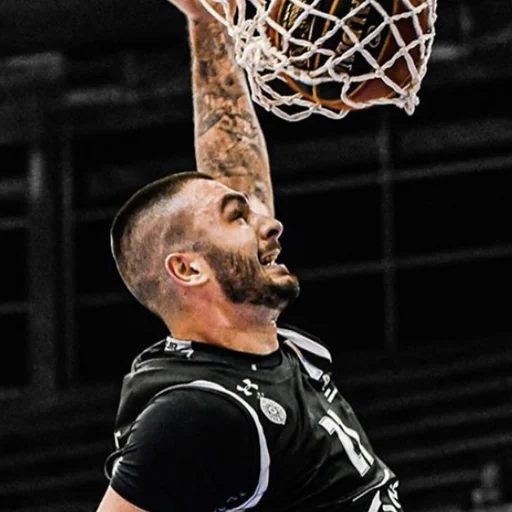
Nikola Janković
Co-founder · Former professional basketball player
Nikola Janković is a former professional basketball player — a 6'9" forward and the 2016–17 ABA League MVP — who played for Partizan, Union Olimpija and Mega, among others. Today he runs a pilates studio and gym focused on strength, mobility and overall wellbeing. He co-founded PUSHapp to make consistent, measurable training simple for everyone.