
Form & Technique
How to Do Weighted Pushups: Form & Progressions
Learn how to do weighted pushups with proper form, gear options, and progression steps to build upper body strength.


Prerequisites, Readiness & Foundational Stability
Assessing Readiness: Standard pushup and plank benchmarks
- Can you perform 30 standard pushups with consistent form and full range?
- Can you hold a 60-second plank with hips level and ribs braced?
- During these tests, scapular movement should be controlled with no winging or shrugging.
Scapular Stability Drills for Load Readiness
- Scapular push-ups: small, controlled movement at the shoulder blades.
- Wall slides: reach arms overhead, keep scapulae stable as you move.
- Light band rows or scapular retractions to train stable pulling mechanics.
Core Bracing and Posture Cues Under Load
- Brace the core as if bracing for a punch; ribs stay down.
- Maintain a neutral spine, with glutes and quads engaged.
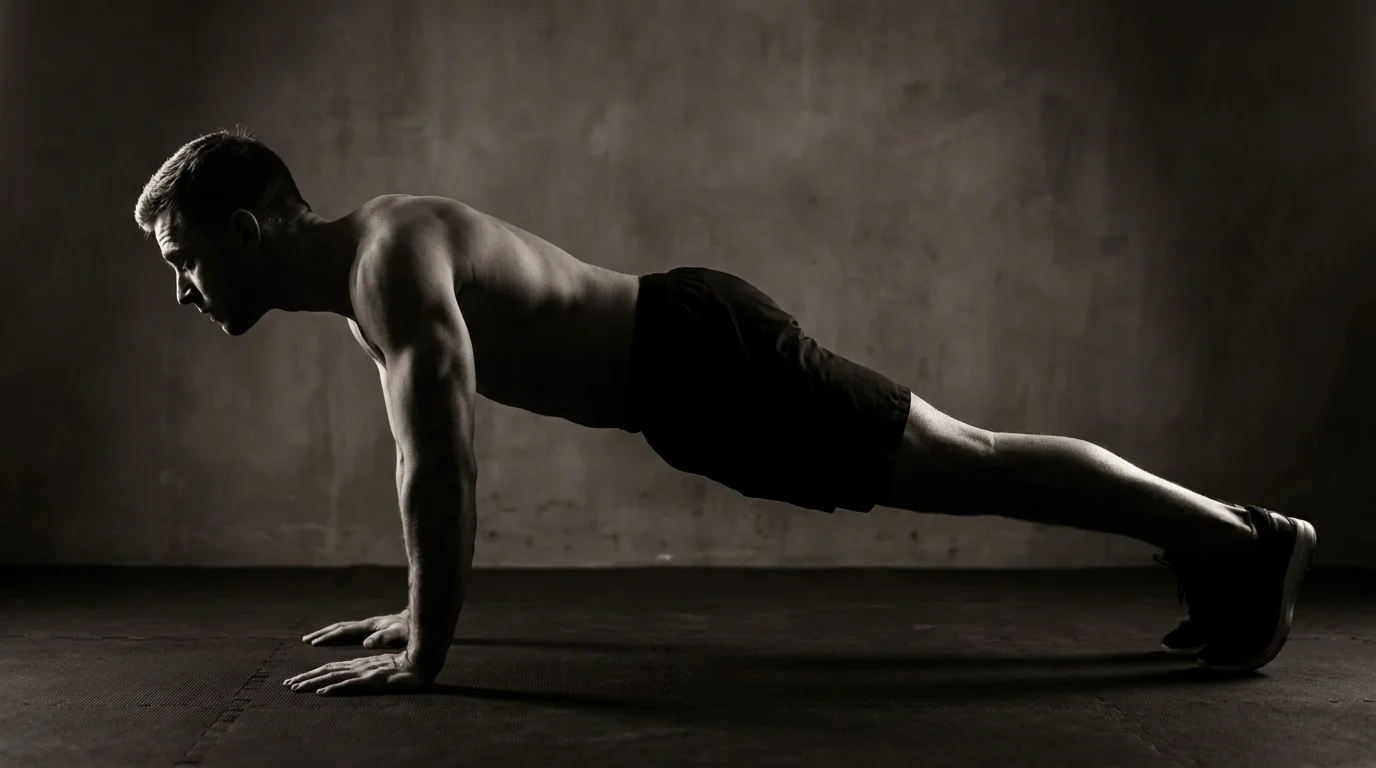
- Keep a long line from head to heels; avoid sagging through the hips.
Readiness Testing Protocols and Entry Points
- If benchmarks pass, start with a light load and 4–6 controlled reps per set, maintaining weighted pushups form.
- Use a small plate or vest, and progress with technique.
- Ensure 2 weeks of clean technique before increasing load or reps.
Technique, Loading Options & Safety for Weighted Pushups
Tempo
- Descent 2–3 seconds; control the tempo.
- Push back up with intent; a brief pause at the bottom is optional if your form stays solid.
Bracing, and Positional Cues (2–3s descent, solid brace at top and bottom)
- Brace the core, glutes, and lats before every rep.
- Maintain a straight line from head to heels; hips don’t sag or spike.
- At the top and bottom, lock in a solid brace to protect the spine.
Elbow Angle
- Elbows stay about 45 degrees from your torso; avoid flaring or tucking in excessively.
- Keep wrists stacked under shoulders; move with control.
Shoulder Position and Spine Alignment
- Retract and depress the shoulder blades; keep the neck neutral.
- Chest stays tall; spine lengthened throughout the set.
Equipment Options: Plates on Back
- Setup: place a plate or two on your upper back, padded to prevent discomfort.
- Pros/Cons and Safety: simple load; watch plate stability and avoid neck pressure.
Vest, Backpack—Setup
- Vest: snug, even weight distribution; tighten straps.
- Backpack: load centrally, use a chest strap if available; secure the pack to prevent shifting.
Alternative Loading Methods: Band-Resisted Pushups and Variations
- Band-resisted pushups add horizontal resistance for progression; maintain 2–3s descent and solid bracing.
- Use variations (incline/deficit) when needed to refresh progress.
Progression Ladder: From Bodyweight to Weighted Pushups
Use this ladder to move safely from bodyweight pushups to weighted pushups, with clear loading milestones, reps and sets, and rest. It supports a steady push-up progression and a practical progression to weighted pushups from standard pushups.
Starting Point: Baseline Testing and Entry Criteria
- Baseline: 3 sets of 5–8 clean pushups with a 2–3 second descent.
- If you hit 8+ clean reps, start Phase 2 with 5–10 lb; 4–7 reps, begin Phase 1 with bodyweight only.
- Keep a stable core brace and hips level through every rep.
6–8 Week Progression Ladder: Reps, Sets, Loads by Phase
- Phase 1 (Weeks 1–2): 3x5–8 bodyweight; tempo 2–3 sec down; rest 60–90s.
- Phase 2 (Weeks 3–4): 3x5–8 with 5–10 lb; same tempo; rest 60–90s.
- Phase 3 (Weeks 5–6): 3x4–6 with 10–20 lb; rest 90–120s.
- Phase 4 (Weeks 7–8): 3x3–5 with 20–30 lb; rest 120–180s.
Coaching Cues Through the Progression: Tempo, Bracing, and Common Pitfalls
- Tempo: 2–3 sec descent, 0–1 sec pause bottom, controlled ascent.
- Bracing: Tight core and glutes; hips level; avoid sagging.
- Pitfalls: Rushing, elbows flaring, losing neutral spine.
Deloads, and Variations Beyond Weighted Pushups
- Deload: every 3–4 weeks, reduce volume by 40–50% or use lighter load.
- Variations: incline/decline, tempo or eccentric-only reps, or single-arm progressions when ready.
Frequently asked questions
How do you perform weighted pushups with proper form?
Start in a solid push-up position with a braced core, neutral spine, and hips level. Use a 2–3 second descent, brace before each rep, keep elbows about 45 degrees, and press up with control while preventing weight shift or sagging.
What equipment can be used for weighted pushups (vest, backpack, plates)?
Common options are a weight vest, plates placed on your upper back with padding, or a backpack loaded centrally and secured; choose the setup that fits your gear and keeps weight from shifting.
What prerequisites should I meet before adding weight to pushups?
Be able to perform solid bodyweight pushups and a 60‑second plank with ribs braced; complete scapular stability drills and core bracing practices, then progress with light loads for 4–6 controlled reps.
How should I progress the load and reps for weighted pushups?
Follow a progression ladder: start with light load and 4–6 controlled reps, ensure two weeks of clean technique, then gradually increase load or reps while maintaining form and tempo.
About the authors

Goran Huskić
Co-founder · Professional basketball player
Goran Huskić is a Serbian professional basketball player — a 6'11" center currently playing for Monbus Obradoiro in Spain's Primera FEB. He won the 2019–20 Basketball Champions League with San Pablo Burgos and has competed professionally across Spain, Germany, Lithuania, Serbia and the United States. He co-founded PUSHapp to bring pro-level training discipline to everyday workouts.

Nikola Janković
Co-founder · Former professional basketball player
Nikola Janković is a former professional basketball player — a 6'9" forward and the 2016–17 ABA League MVP — who played for Partizan, Union Olimpija and Mega, among others. Today he runs a pilates studio and gym focused on strength, mobility and overall wellbeing. He co-founded PUSHapp to make consistent, measurable training simple for everyone.