
Form & Technique
How to Do Perfect Pushups: Form, Progressions & Variations
Master how to do perfect pushups with proper form cues, step-by-step progressions, and variations for beginner to advanced athletes.


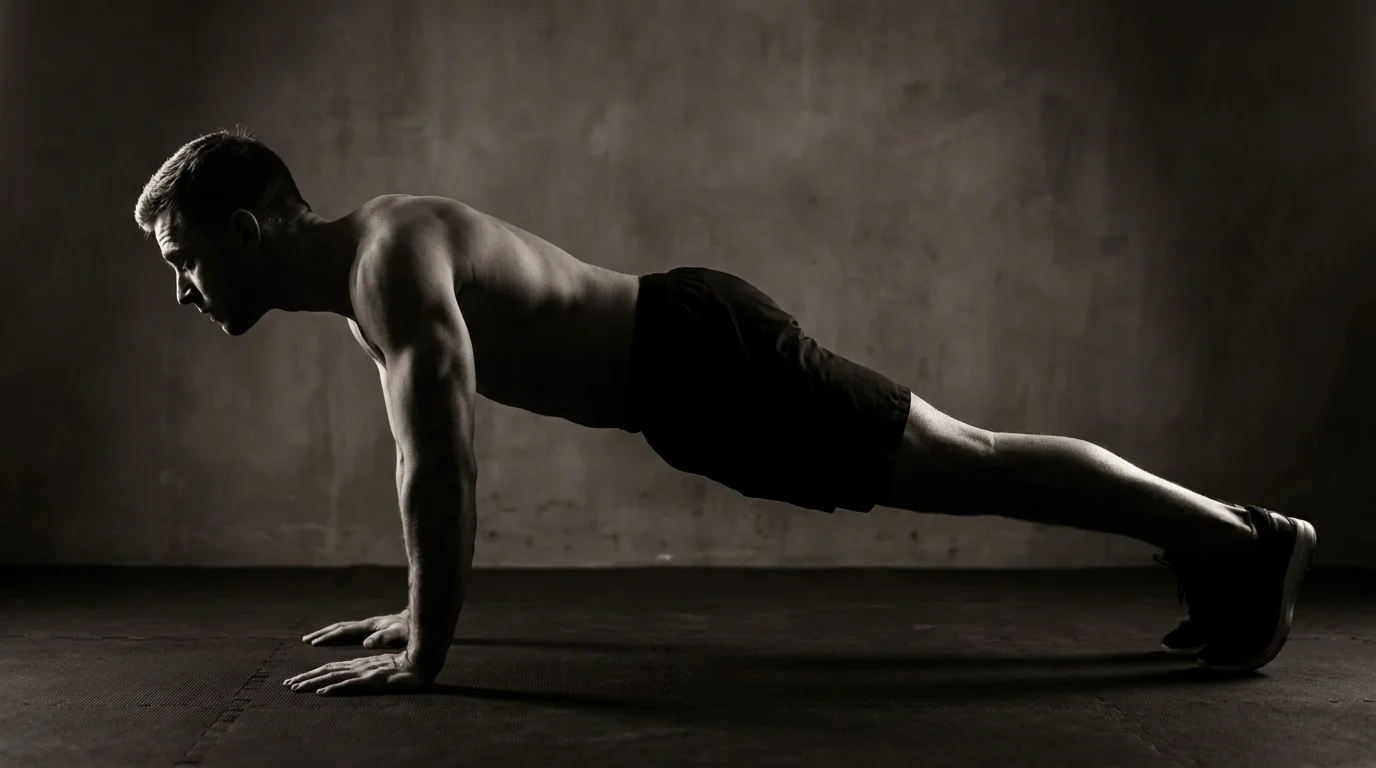
Mastering Perfect Pushup Form: Setup, Cues & Core Stability
Baseline setup: hand placement, shoulder alignment, and feet positioning
- Place hands slightly wider than shoulder width, wrists under or just in front of shoulders, fingers spread.
- Pull shoulders down and back to establish scapular stability, without over-squeezing.
- Align hips with shoulders and ankles; keep feet hip-width apart and engaged through the legs.
Elbow angle and scapular stability: protecting shoulders
- Keep elbows at about 45 degrees from the torso; avoid flaring beyond 90 degrees.
- Maintain a stable scapular position—depressed and a touch retracted—as you move.
Spine neutrality and core engagement: coaching cues for braced midsection
- Hold a neutral spine; ribs down, chin tucked, neck long.
- Brace the core, tighten glutes, and pretend you’re braced for a light punch to keep the hips from sagging.
Tempo and ROM guidelines: optimal depth by level
- Lower with control (about 2–3 seconds); press up smoothly.
- Depth should let form stay solid—build depth gradually as mobility and strength improve.
Common form faults and fixes: hips sagging, elbow flare, and insufficient depth
- Hips sag: tighten core and glutes, keep a straight line.
- Elbows flare: draw elbows in toward the torso (~45 degrees).
- Insufficient depth: scale with incline and progress as you can maintain perfect form.
Progressions, Variations & Tempo: From Beginner to Advanced
Starting strength prerequisites and mobility checks
- Solid plank holds (20–40 seconds) with a neutral spine.
- Shoulder and thoracic mobility enough to reach and extend the arms comfortably.
- Wrist tolerance for loading and a stable core before progressing to harder variations.
Structured progression maps: beginner → intermediate → advanced
- Beginner: incline push-ups or wall push-ups; tempo 2-0-2-0; partial ROM; elbows approximately 60 degrees.
- Intermediate: standard floor push-ups; tempo 2-0-2-0; full ROM; elbows around 45 degrees.
- Advanced: diamond, wide, pike, or one-arm progressions; tempo 3-0-3-0; ROM based on capability; adjust elbow angle per variation.
Variation specifics: incline, standard, wide, diamond, pike, one-arm
- Incline push-up: easiest. Elbows ~60°, ROM limited, great for beginners.
- Standard push-up: middle ground; elbows ~45°.
- Wide push-up: more chest; elbows ~60°.
- Diamond push-up: hands close; elbows near torso.
- Pike push-up: higher hips, more shoulder demand.
- One-arm push-up: advanced stability; use elevated supports first.
Tempo and ROM guidelines by variation
- Incline: 2-0-2-0; touch chest to incline.
- Standard: 2-0-2-0; full ROM.
- Wide: 3-0-2-0; full ROM.
- Diamond: 2-0-3-0; controlled descent.
- Pike: 3-0-3-0; emphasize form.
- One-arm: 3-0-3-0; partial ROM as you build.
Common mistakes by variation and fixes
- Incline: shallow depth; fix by lowering the incline gradually.
- Standard: hips sagging; fix with a tighter core and ribcage brace.
- Diamond: wrists shoulder-sore; fix with neutral wrists or push-up bars.
- Wide: elbows flaring too much; fix by guiding elbows to 40–60°.
- Pike: losing spine line; fix by stacking hips and guiding head.
- One-arm: wobble; fix with a supported progression and longer control holds.
Injury-Safe Modifications, Warm-Up, Mobility & Adherence
Warm-up and mobility sequence to prime shoulders and wrists
- 60–90 seconds of dynamic prep: arm circles, wall slides, thoracic spine rotations.
- Quick wrist prep: gentle circles, palm against a wall stretch, prayer stretch.
Wrist- and shoulder-friendly modifications and pain-free alternatives
- Use incline, knee, or wall push-ups to reduce load while you learn control.
- Try neutral grips, push-up bars, or dumbbells to lessen wrist extension.
- Maintain proper push-up form with elbows at 45–60 degrees, a neutral neck, and active core.
Injury-aware progressions and regressions for common issues
- If pain flares, regress to an incline or wall version; pause and reassess form.
- Slow the tempo (3-0-1-0) and progress only when pain-free; gradually rebuild tolerance.
- How to do perfect pushups becomes clearer as you master pain-free mechanics.
Tracking progress and maintaining motivation
- Tracking progress: log reps, sets, pain level, and days trained.
- Adherence strategies: set a simple schedule, use reminders, and celebrate small wins.
Understanding when to prioritize push-ups vs bench press and vice versa
- Push-ups foster core and shoulder stability; bench press can maintain upper-body load if standard push-ups irritate you.
- Use whichever fits your tolerance, then reintroduce push-ups gradually while keeping form solid.
Frequently asked questions
What is the proper push-up form?
Start with a solid plank: hands slightly wider than shoulder width, wrists under or just in front of the shoulders, and hips in line with shoulders. Keep elbows about 45 degrees from the torso, brace the core, and maintain a neutral spine; lower with control and press back up, avoiding hip sag or spine arch.
How deep should a push-up be?
Depth should let you maintain solid form while moving with control. Build depth gradually as mobility and strength improve, and regress to incline or wall push-ups if form starts to suffer.
How can I modify push-ups as a beginner?
Use wall or incline push-ups to preserve the movement pattern without overloading the shoulders. Progress to standard floor push-ups as you gain strength, then add tempo or pauses to increase challenge.
Are push-ups good for shoulder health?
Yes, when performed with proper form—elbows around 45 degrees, scapular stability, and a braced core—push-ups can support shoulder health; stop if you feel pain and regress to easier variations as needed.
About the authors

Goran Huskić
Co-founder · Professional basketball player
Goran Huskić is a Serbian professional basketball player — a 6'11" center currently playing for Monbus Obradoiro in Spain's Primera FEB. He won the 2019–20 Basketball Champions League with San Pablo Burgos and has competed professionally across Spain, Germany, Lithuania, Serbia and the United States. He co-founded PUSHapp to bring pro-level training discipline to everyday workouts.
Nikola Janković
Co-founder · Former professional basketball player
Nikola Janković is a former professional basketball player — a 6'9" forward and the 2016–17 ABA League MVP — who played for Partizan, Union Olimpija and Mega, among others. Today he runs a pilates studio and gym focused on strength, mobility and overall wellbeing. He co-founded PUSHapp to make consistent, measurable training simple for everyone.