
Variations & Types
Hindu Pushups: Technique, Variations & Benefits
Learn hindu pushups: definition, proper technique, key cues, and benefits. Explore variations, history, and how to include this move in your workout.


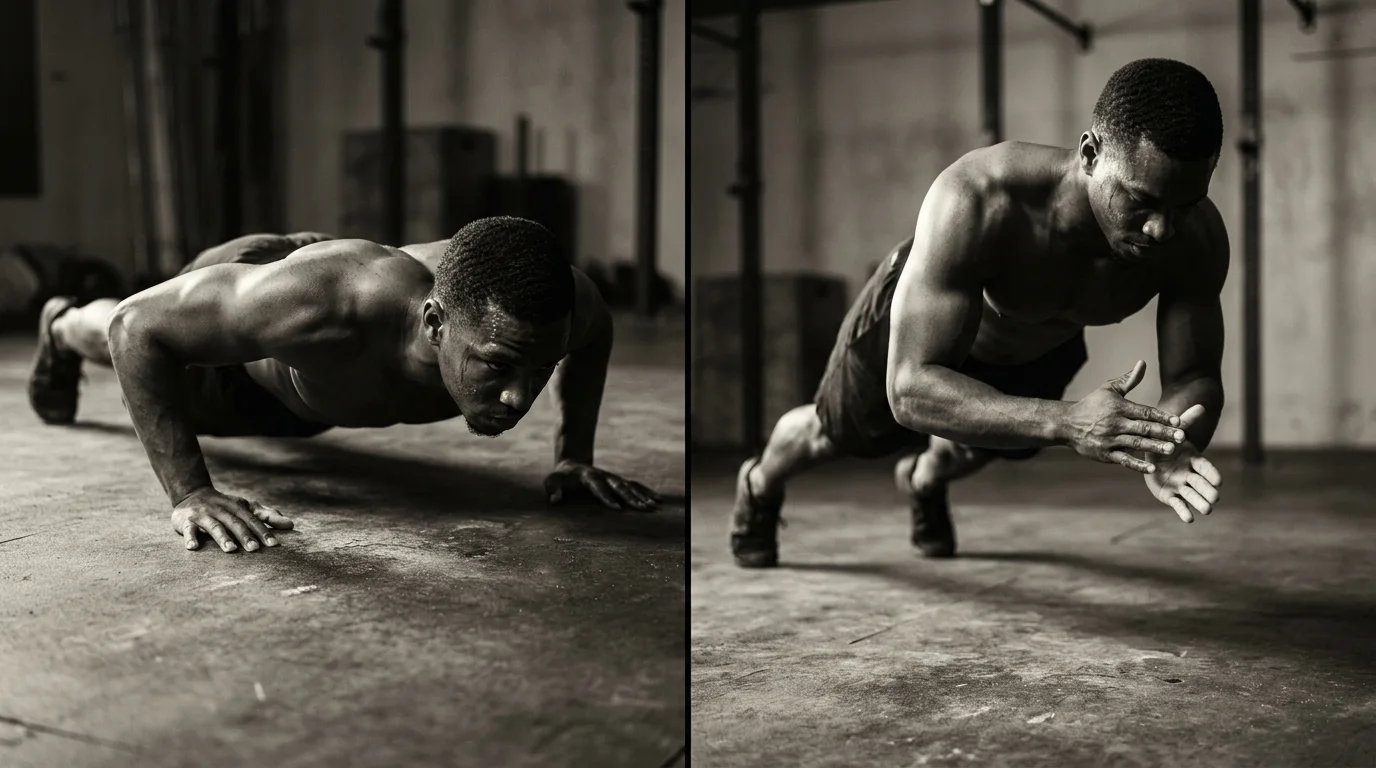
What Are Hindu Pushups? Names, History & Pehlwani Roots
Names & Variants
- Hindu pushups are a flowing, arc-shaped push-up: start with hips high, sweep the chest forward and down along a curved path, then press up into a rounded finish before returning to the start.
- Synonyms you’ll see include dand or daṇḍa, rock and roll push-up, and judo push-up.
- The movement is often discussed alongside the cat stretch as part of spinal mobility cues.
Historical Context: Pehlwani
- In pehlwani, the traditional wrestling art of the Indian subcontinent, Hindu pushups trained grapplers to build shoulder durability, core control, and endurance with minimal gear.
- This practice is a notable piece of the history of hindu pushups in pehlwani, reflecting how conditioning drills supported grappling skill.
Great Gama & Cultural Significance
- Great Gama, a legendary figure in pehlwani, helped popularize the exercise through demonstrations and instruction in the early 20th century.
- Cross-cultural exchange brought terms like rock and roll push-up and judo push-up into Western gyms, while the core arc remained recognizable.
Technique & Step-by-Step Progression: From Beginner to Advanced
Starting Position & Setup
- Hands slightly ahead of shoulders, fingers spread; wrists neutral and aligned under your wrists.
- Feet hip-width apart, knees soft, core braced.
- Hips high, spine in a gentle cat stretch posture; scapulae set down the back.
- Think dand/daṇḍa: stay solid through a straight-line core while you warm up safety wrists, shoulders, hips.
- A quick cat stretch resets the spine before each rep.
Movement Phases & Cues
- Phase 1: initiate with a cat stretch, then shift weight into the hands and begin a smooth arc.
- Phase 2: chest leads the movement, hips drop forward as you sweep the torso downward toward the floor.
- Phase 3: roll into a bhujangasana–like arc (elbows bend modestly, chest opens, gaze forward).
- Phase 4: reverse the arc, push hips back, return to the starting stance.
- Hint: this is the Hindu pushups technique guide you’ll hear as you refine the rock and roll push-up rhythm.
Common Mistakes & Corrections
- Hips sag or flare: brace glutes and core; keep hips driven with the dand posture.
- Elbows flare: tuck elbows in toward the ribs; press through the chest, not just the arms.
- Wrist pain: shorten ROM or modify by performing on fists or with padding; ensure wrists, shoulders, hips stay in alignment.
Muscle Activation by Phase
- Phase 1: scapular control and core stability; light hamstring engagement as the hips move forward.
- Phase 2–3: chest, front shoulders, triceps; bhujangasana cue reinforces spinal extension without overpressure.
Programming, Variations, Benefits & Injury Prevention
Benefits Overview
For wrestlers, Hindu pushups build shoulder endurance, scapular control, hip hinge, and core stability—assets in sprawling, grip work, and bridge transitions. The movement promotes controlled breathing under load and supports shoulder health through a full-range arc. An anatomical muscle activation map per phase helps: Phase 1 activates the lats and upper back; Phase 2 shifts to chest and front shoulders, with the core and hips stabilizing throughout.
Variations & Safe Progressions
Start with kneeling Hindu pushups, advance to an incline, then full-range floor reps. Hindu pushups vs dive bomber push-ups share the same arc, but the path and leverage differ; choose the version that respects wrist comfort and joint health.
4-Week Progressive Plan
This workout template fits into a 3-day-per-week plan.
- Week 1: 3x6–8 on knees or incline
- Week 2: 3x8–10 half-range
- Week 3: 3x6–8 full-range
- Week 4: 4x6–8 full-range with tempo 2-0-2
Warm-Up Integration: Sun Salutation
Include 3–5 rounds of Sun Salutation (Surya Namaskar A) to wake wrists, shoulders, hips, and spine.
Safety Notes: Wrist, Shoulder, Hip Health
Wrist: mobility work and a soft surface; consider fists or pads. Shoulder: retract blades, avoid flaring elbows. Hip: keep pelvis neutral, brace core; stop if pain.
Frequently asked questions
What is a Hindu push-up and where does the name come from?
A Hindu push-up is a flowing, arc-shaped push-up that starts with hips high and sweeps the chest forward and down along a curved path, finishing with a cobra-like chest open before returning. The move has Pehlwani roots in Indian wrestling, with names like dand/daṇḍa and popular western terms such as rock-and-roll push-up.
How exactly do you perform a Hindu push-up step by step?
Start in a downward-dog-like stance with hands under shoulders and hips high, then sweep your chest forward and down in a smooth arc, finishing with a chest-led, cobra-like top. Reverse the arc back to the starting position while keeping a long spine, ribs tucked, and steady breathing.
Which muscles are most engaged during a Hindu push-up?
The movement emphasizes shoulder girdle durability and core control, engaging the chest, shoulders, and triceps, with hips and glutes stabilizing the torso throughout the arc.
Are Hindu push-ups beginner-friendly or advanced?
They can fit a beginner workout when scaled: start with light volume, slow tempo, and limited depth, then progress by increasing depth, reps, or range (incline variations) while maintaining form.
About the authors

Goran Huskić
Co-founder · Professional basketball player
Goran Huskić is a Serbian professional basketball player — a 6'11" center currently playing for Monbus Obradoiro in Spain's Primera FEB. He won the 2019–20 Basketball Champions League with San Pablo Burgos and has competed professionally across Spain, Germany, Lithuania, Serbia and the United States. He co-founded PUSHapp to bring pro-level training discipline to everyday workouts.
Nikola Janković
Co-founder · Former professional basketball player
Nikola Janković is a former professional basketball player — a 6'9" forward and the 2016–17 ABA League MVP — who played for Partizan, Union Olimpija and Mega, among others. Today he runs a pilates studio and gym focused on strength, mobility and overall wellbeing. He co-founded PUSHapp to make consistent, measurable training simple for everyone.