
Muscles & Benefits
Decline Pushups Benefits: Upper Chest & Strength
Discover decline pushups benefits, proper form, target muscles, progressions, and practical tips to maximize upper chest strength and stability.


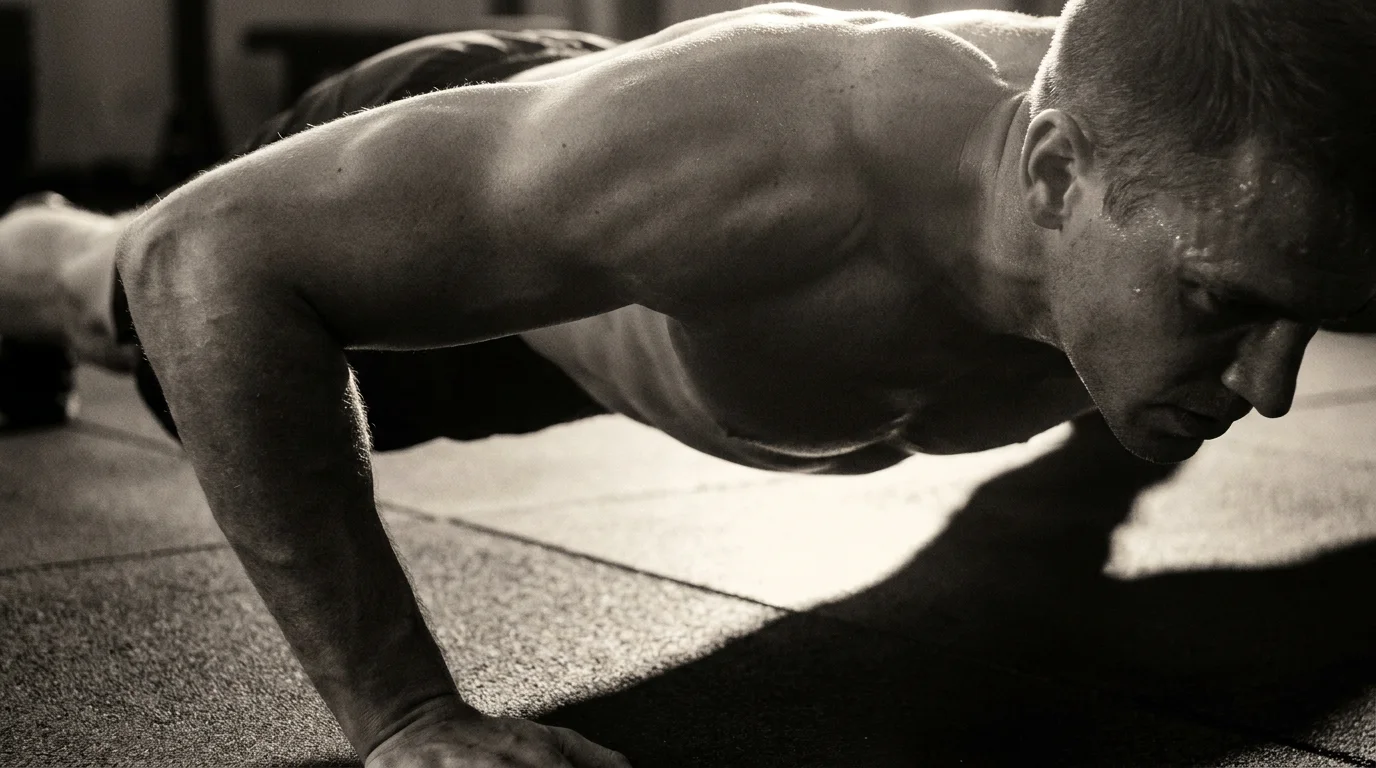
Decline pushups 101: definition, setup, and proper form
What is a decline push-up?
Decline push-ups are done with the feet elevated on a bench or box, creating a steeper angle at the shoulders. The position shifts more load onto the upper chest and front deltoids, compared with a regular push-up. This is the decline pushups definition in practice.
Setting up the elevation and feet placement
Choose a bench height that lets you maintain solid alignment. Place your feet on the elevated surface, legs straight, hips not sagging. The height you pick is what you call bench height for decline push-up; start lower if you are new and progress as you gain control.
Hand placement, wrist position, and grip width
Hands slightly wider than shoulder width. Wrists in line with forearms, not bent back. Fingers spread, chest lifting as you press.
Elbow angle, body alignment, and tempo
Elbows about 45 degrees from the body. Core braced, glutes engaged. Lower with control, pause briefly, press back up. A steady two down, one up tempo works for most.
Initial cues and common setup mistakes
Keep hips in line with shoulders. If the hips sag or the back arches, shorten the range and reset your position.
Targeted muscles, activation, and benefits of decline pushups
Primary and secondary muscles
Decline pushups work the upper chest more than regular or incline variants. Primary: clavicular head of pectoralis major, anterior deltoid. Secondary: serratus anterior, triceps, core stabilizers. Which muscles are worked by decline pushups becomes clear when you tilt your torso higher and feel the chest take on more load.
Activation patterns and tempo
Elevation shifts load toward the upper chest and shoulders. Use a controlled tempo: lower slowly, pause briefly at the chest, then press up with steady force.
Wrist position, grip width, and elbow strain
Hands about shoulder width, slightly wider to touch more chest. Wrists should stay in line with forearms. Elbows at about 45 degrees to reduce shoulder strain.
Decline vs incline vs regular push-ups
Decline emphasizes upper chest and anterior deltoids; incline emphasizes lower chest; regular is a balance. For upper chest focus, use declines with a slightly wider grip and a controlled tempo.
Programming decline pushups: elevation heights, reps, progressions, and common mistakes
Elevation progression scale (easy to hard)
Start with a low bench height for the decline push-up. As you control form, raise the bench to a mid height, then high. Keep the torso in a straight line through every rep.
Rep schemes by goal (hypertrophy, strength, endurance)
Hypertrophy: 6-12 reps per set, 3-4 sets. Strength: 4-6 reps, 4-5 sets. Endurance: 12-20 reps, 2-4 sets.
Tempo and elbow articulation guidance
Lower for 2 seconds, pause briefly at the bottom, push up in 1 second. Elbows stay tucked and the body remains rigid from head to heels.
Common mistakes and fixes
Hip sag decline push-up pattern. Fix by bracing the core and glutes, keeping hips level. Avoid looking up, shallow depth, and early lockout.
Substitutions and related moves
If the decline is too hard, try incline push-up or pike push-up. For context, compare incline push-up vs decline push-up and pike push-up vs decline push-up, and plan progression across elevation heights.
Frequently asked questions
What are the benefits of decline push-ups?
Decline push-ups shift more load onto the upper chest and front shoulders, creating upper chest emphasis compared with a standard push-up. They also engage the core stabilizers to help keep your torso steady.
Which muscles do decline push-ups target?
Primary: clavicular head of pectoralis major and the anterior deltoid. Secondary: serratus anterior, triceps, and core stabilizers.
How do you perform a decline push-up with proper form?
Set up with your feet on an elevated surface and your body in a straight line from head to heels. Place your hands slightly wider than shoulder width, elbows about 45 degrees, lower with control and pause at the chest, then press back up.
How do I progress to harder decline push-ups (higher elevation or advanced variations)?
Start with a low bench height and gradually raise the elevation as your form remains solid. Maintain a straight body and steady tempo, and increase reps or add challenge with higher elevations or advanced variations.
About the authors

Goran Huskić
Co-founder · Professional basketball player
Goran Huskić is a Serbian professional basketball player — a 6'11" center currently playing for Monbus Obradoiro in Spain's Primera FEB. He won the 2019–20 Basketball Champions League with San Pablo Burgos and has competed professionally across Spain, Germany, Lithuania, Serbia and the United States. He co-founded PUSHapp to bring pro-level training discipline to everyday workouts.
Nikola Janković
Co-founder · Former professional basketball player
Nikola Janković is a former professional basketball player — a 6'9" forward and the 2016–17 ABA League MVP — who played for Partizan, Union Olimpija and Mega, among others. Today he runs a pilates studio and gym focused on strength, mobility and overall wellbeing. He co-founded PUSHapp to make consistent, measurable training simple for everyone.