
Variations & Types
Cobra Pushups: Form, Benefits & Modifications
Master cobra pushups with proper form, benefits, and beginner-friendly mods to build chest, shoulders, and core without equipment.


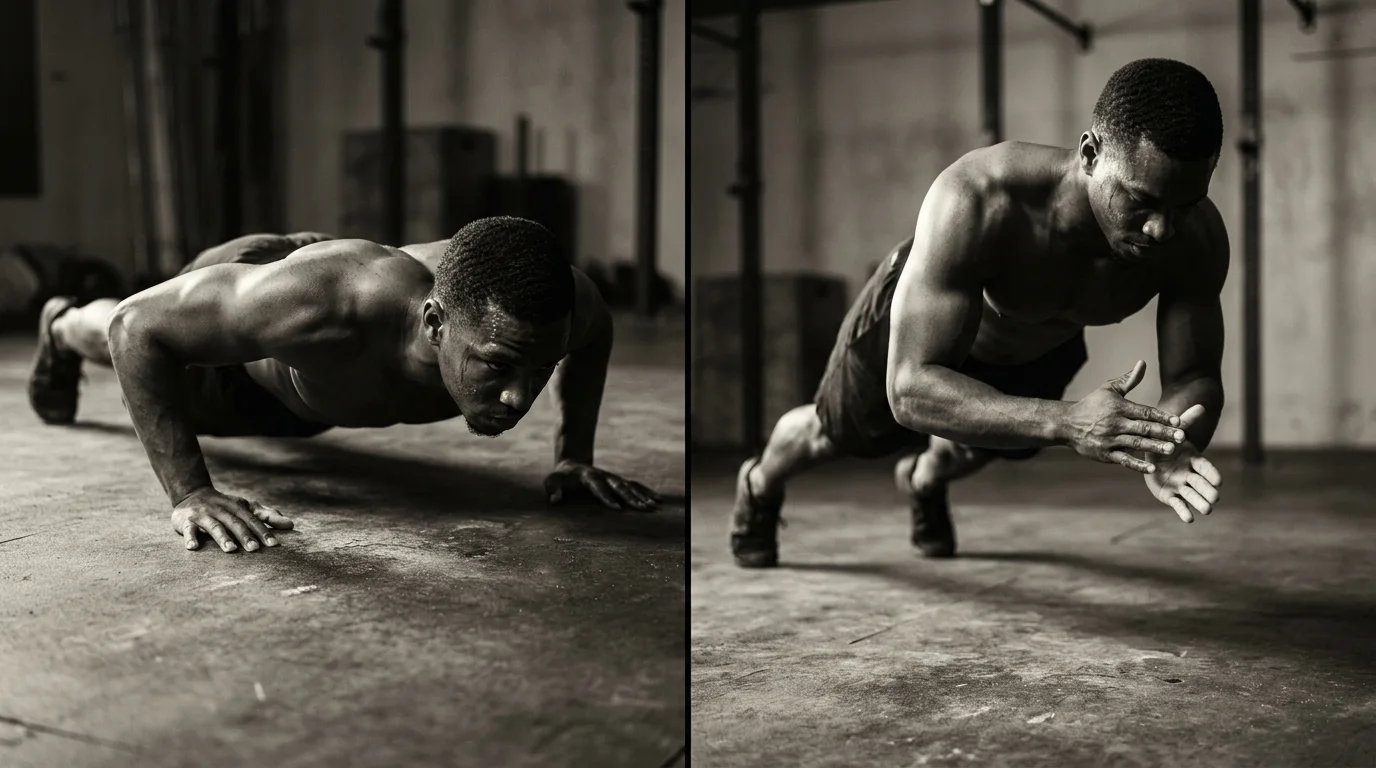
Cobra pushups: technique, setup & real-time cues
Setup and starting position
- Lie face down with legs extended and the tops of your feet resting on the floor.
- Place hands under your shoulders, elbows close to your sides to keep elbow position compact.
- Anchor the hips to the floor and lightly brace the core; this supports hip alignment and scapular stability.
- Draw the shoulder blades gently toward the spine without tensing the neck.
- Your push up depth should be modest; the chest rises only so far while the hips stay grounded.
Movement pattern and breathing
- Inhale to prepare, then press the chest forward and up a small amount while keeping hips anchored.
- Exhale as you return to the starting position.
- Use tempo cues: about two seconds up, two seconds down.
- Maintain scapular stability throughout and avoid shrugging the shoulders.
Common mistakes and how to fix them
- Hips lift or sag: press hips into the floor and engage the glutes.
- Elbows flare out: tuck elbows toward the ribs.
- Neck curls forward: keep a long neck with eyes forward.
- Depth is too shallow: perform a controlled lift that preserves hip contact.
Benefits, muscles worked & how cobra pushups compare to other variations
cobra pushups benefit mobility through the thoracic spine and support healthier shoulder mechanics by guiding you to press with a stable ribcage and retracted shoulder blades. Muscles worked in a cobra push-up include the chest, triceps, front deltoids, and the serratus anterior, with the core and spinal erectors bracing to hold the hips down. Push-up depth is typically gentler than a full standard push-up, which helps you control the range and protect the wrists. The move also trains thoracic extension, a common limiter in many push-up variations.
targeted muscle groups
- chest, triceps, and front deltoids
- serratus anterior and upper back stabilizers
- core and spinal erectors for keeping the hips down
comparison to standard push-ups
- cobra pushups emphasize thoracic extension and scapular control rather than maximal chest loading
- push-up depth is shallower, prioritizing form and control
- wrists typically feel less strain due to the floor position and elbow alignment
when to choose cobra vs other variations
- use cobra on mobility days or when you need a shoulder-friendly session
- warm up before standard or Hindu push-ups to dial in technique
- if you're mitigating irritation, cobra can help reset push-up form without heavy loading
Modifications, progressions & structured no-equipment routines
Beginner-friendly progressions
- Start with floor cobra holds: lie face down, hands under shoulders, press chest up a couple inches and hold 2 seconds, then lower with control.
- Move to knee cobra pushups: knees on the floor, hips down, lift chest a few inches and lower slowly.
- Try incline cobra pushups: hands on a bench or sturdy chair, press up while keeping hips down.
- Progress to full cobra pushups when you can maintain good form for 6 to 8 reps.
Tempo and rep schemes
- Beginner: 3 sets of 4 to 6 reps, tempo 3 seconds down, 1 second hold at the top, 2 seconds up.
- Intermediate: 4 sets of 6 to 8 reps, tempo 2 seconds down, 0 pause, 2 seconds up.
- Advanced: 3 to 4 sets of 8 to 10 reps, tempo 2 seconds down, 1 second hold, 1 second up.
Injury prevention & common mistakes
- Keep hips glued to the floor and avoid dipping or piking.
- Maintain a neutral neck position, eyes forward or down.
- Elbows stay close to the body; avoid flaring outward.
- Engage core and glutes through every rep.
No-equipment workout sequence incorporating Cobra Pushups
- Circuit: cobra pushups 6 to 8, bodyweight squats 12 to 15, glute bridges 12 to 15, planks 20 to 30 seconds, mountain climbers 20, bird dogs 8 per side.
- Repeat 3 rounds with 60 seconds rest between rounds.
Frequently asked questions
how do you perform a push-up with proper form and depth?
lie face down with forearms under your shoulders and elbows close to your sides. press your forearms into the ground and lift your chest using the muscles along your spine, keeping your hips grounded and your shoulder blades pulled down. perform a modest depth with a two seconds up, two seconds down tempo, inhale to prepare and exhale as you return.
what are common push-up mistakes and how can you fix them?
common issues include hips lifting or sagging, elbows flaring out, neck curling forward, and too shallow depth. fix them by pressing the hips into the floor with glute engagement, tucking the elbows toward the ribs, keeping a long neck with eyes forward, and performing a controlled lift that preserves hip contact.
what beginner modifications help you build up to a full push-up?
start with floor cobra holds, then knee cobra pushups, and finally incline cobra pushups on a bench or sturdy chair. as form stays solid, increase reps or add a set, or work toward a higher incline until you can perform a full push-up with control.
what muscles do push-ups train and in what way?
cobra pushups target the chest, triceps, front deltoids, and serratus anterior, with the core and spinal erectors bracing to keep the hips down. they also promote thoracic extension and improved scapular stability, which helps when you progress to standard push-ups.
About the authors

Goran Huskić
Co-founder · Professional basketball player
Goran Huskić is a Serbian professional basketball player — a 6'11" center currently playing for Monbus Obradoiro in Spain's Primera FEB. He won the 2019–20 Basketball Champions League with San Pablo Burgos and has competed professionally across Spain, Germany, Lithuania, Serbia and the United States. He co-founded PUSHapp to bring pro-level training discipline to everyday workouts.

Nikola Janković
Co-founder · Former professional basketball player
Nikola Janković is a former professional basketball player — a 6'9" forward and the 2016–17 ABA League MVP — who played for Partizan, Union Olimpija and Mega, among others. Today he runs a pilates studio and gym focused on strength, mobility and overall wellbeing. He co-founded PUSHapp to make consistent, measurable training simple for everyone.