
Form & Technique
Calisthenics for Beginners: Start Strong with Bodyweight
Learn calisthenics for beginners: what it is, a starter routine, safety tips, and progression using minimal equipment.

What is Calisthenics and How to Start with No Equipment
What is calisthenics?
Calisthenics uses your body weight to train movement patterns, not machines. It builds strength, balance, and mobility through scalable, functional moves. For beginners, it’s approachable, affordable, and portable—a solid path for calisthenics for beginners. This is a practical route for no equipment calisthenics and other bodyweight workouts for beginners.
Warm-up essentials
Warm up for 5–7 minutes with dynamic moves: leg swings, hip circles, ankle circles, arm circles, inchworms, and light air squats, then a 20–30 second plank. This warm-up for calisthenics beginners primes joints and awakens the core.
No-equipment starter routine
Starter routine (3 rounds): incline push-ups 8–12, air squats 12–15, glute bridges 12–15, dead bugs 8–10 per side, plank 20–30 seconds. Rest 60–90 seconds between rounds. A gentle, steady pace keeps form clean.
Progression ladder overview
Progress gradually: start with incline push-ups and bodyweight squats, move to knee push-ups and standard squats, then add reps, rounds, or tempo. Train 2–3 times weekly.
Sample 4-week plan
Week 1–2: 2–3 workouts, 3 rounds, 60–90s rest. Week 3–4: 3 workouts, 4 rounds or +2 reps per exercise; aim to knee push-ups if needed.
Movement Breakdowns: Cues, Common Mistakes, and Beginner Progressions
Squats: setup, cues, and common mistakes
- Setup: feet hip-width, toes slightly out; brace core; chest tall.
- Cues: hips back, weight midfoot, knees tracking over toes; descend to parallel or below; rise through the heels.
- Common mistakes: heels lift, knees collapse inward, back rounds, depth shallow.
- Progressions: 3x8 at tempo 3-0-1-0; 3x10 next; 4x8 or 4x12 as form stays solid.
Push-Ups: hand placement, body line, and tempo
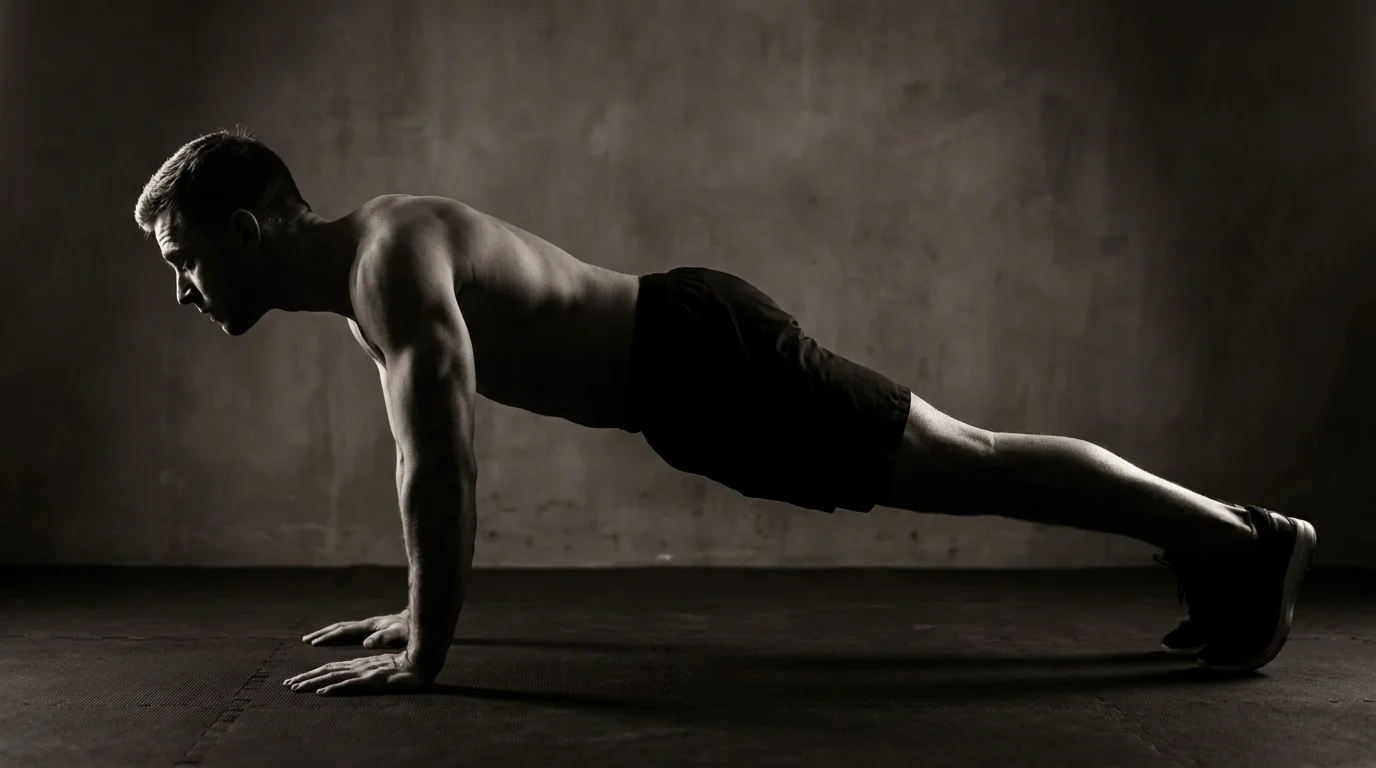
- Setup: hands under shoulders, 1–2 inches inside; full-body line straight; brace core.
- Cues: elbows 45°, ribcage down; inhale down, exhale up; tempo 2-0-2-0.
- Common mistakes: hips sag, butt pikes, elbows flare, incomplete ROM.
- Progressions: incline to full push-ups; 3x6-8, then 3x8-12; aim 4x8-10 on solid form.
Planks and Core: alignment cues
- Alignment: neutral spine, shoulders away from ears, pelvis tucked, glutes active.
- Cues: brace, breathe steadily; avoid sag or hollow spine.
- Common mistakes: hips drop, head tilts.
- Progressions: 3x20–40s; move to 60s; add side planks.
Lunges: step-through, knee tracking
- Setup: long enough stride, torso upright; knee over ankle.
- Cues: descent 2s, pause, push back; knee tracks over toes.
- Common mistakes: knee caving in, knee past toes, leaky hips.
- Progressions: 3x6–8 per leg; tempo 2-0-2-0; advance to walking lunges.
Burpees: safe progressions
- Safe steps: start with half burpee, then add a push-up, then a jump.
- Cues: soft landing, no rounding, chest to floor when possible.
- Common mistakes: hard landings, rushed chest-to-floor.
- Progressions: 3x5–6; increase gradually with control.
Pull-Ups/Rows: progression without equipment
- Progressions: scapular pulls, hollow holds; use table/doorway rows if no gear.
- Cues: shoulders down, core tight; pull toward chest, pause at top.
- Common mistakes: swinging hips, cheating with momentum.
- Progressions: 3x6–8; add negatives and light holds.
Movement ladders and milestones
- Milestones: consistent 3x8 squats, 4x8 push-ups, 60s planks, 3x8 lunges, 5–8 burpees, controlled pulls/rows.
Habit, Safety, Tracking, and When to Add Light Equipment
Weekly schedule and habit formation
- Pick 3 training days per week, same time each day to anchor a routine.
- Start with 20–30 minutes, then gradually extend as you gain comfort.
- Use a simple printable tracker to log sessions, reps, and how you felt.
Safety, warm-up, and injury prevention
- Begin with a 5–10 minute dynamic warm-up (shoulders, hips, ankles).
- Focus on solid form before adding volume; stop if pain or sharp discomfort appears.
- Prioritize risk management: progress when you can complete sets with control.
Health checks, contraindications, and age-specific guidance
- If you have pain, a recent injury, or a known condition, consult a clinician before starting.
- Contraindications: acute pain, severe joint issues, or unstable medical conditions.
- Age-specific guidance: younger beginners emphasize technique over intensity; older adults may need longer warm-ups and gentler progressions.
Equipment considerations: when to add light gear
- Calisthenics first: improve form and weekly consistency for 4–6 weeks.
- When adding light gear, choose resistance bands or light dumbbells (1–5 lb) only after solid form and stable progress.
- Use “calisthenics vs weights for beginners” mindset—start bodyweight, then introduce light gear as a supplement.
Tracking progress: printables and accountability
- Keep a printable tracker for reps, sets, and days completed.
- Pair with an accountability partner or coach to stay consistent and safe.
Frequently asked questions
What is calisthenics?
Calisthenics uses your body weight to train movement patterns instead of machines. It builds strength, balance, and mobility through scalable, functional moves and is approachable for beginners.
Do you need equipment for calisthenics?
No—the core of calisthenics is bodyweight, so you can start with just a mat or clean floor; equipment is optional and only adds convenience should you want more variety.
What is a good starter routine for calisthenics?
Starter routine (no equipment, 3 rounds): incline push-ups 8–12, air squats 12–15, glute bridges 12–15, dead bugs 8–10 per side, plank 20–30 seconds; rest 60–90 seconds between rounds.
How many days a week should a beginner train calisthenics?
Aim for 3 to 4 days per week with 15–25 minute sessions to build a sustainable habit.
About the authors

Goran Huskić
Co-founder · Professional basketball player
Goran Huskić is a Serbian professional basketball player — a 6'11" center currently playing for Monbus Obradoiro in Spain's Primera FEB. He won the 2019–20 Basketball Champions League with San Pablo Burgos and has competed professionally across Spain, Germany, Lithuania, Serbia and the United States. He co-founded PUSHapp to bring pro-level training discipline to everyday workouts.
Nikola Janković
Co-founder · Former professional basketball player
Nikola Janković is a former professional basketball player — a 6'9" forward and the 2016–17 ABA League MVP — who played for Partizan, Union Olimpija and Mega, among others. Today he runs a pilates studio and gym focused on strength, mobility and overall wellbeing. He co-founded PUSHapp to make consistent, measurable training simple for everyone.