
Workouts & Programs
Pushup Mechanical Drop Sets for Chest Hypertrophy
Discover pushup mechanical drop sets to maximize chest hypertrophy with deficit push-ups, hand-position progressions, and fatigue finishers.



Understanding pushup mechanical drop sets: concept, mechanics, and why they work
What is a mechanical drop set?
In pushups, a mechanical drop set keeps the chest under high load by moving through hand positions or deficit push-ups in one continuous effort, with minimal breaks between variations. The goal is to maintain mechanical tension on the chest as fatigue rises, creating extended time under tension push-ups.
Why changing hand position sustains overload on the chest
Changing grip alters leverage and muscle recruitment. A wider stance increases chest stretch and load on the pec major; a deficit push-up lengthens the range of motion and boosts time under tension. Together, they uphold the overload in bodyweight chest hypertrophy.
How deficit push-ups fit into a mechanical drop set
Begin with standard pushups, then drop into deficit push-ups for deeper range and higher demand, and continue with another variation if you can. The sequence maintains continuous tension, tying directly to mechanical tension in bodyweight training.
How to perform the mechanical drop set: step-by-step sequences, tempo, and safety
Drop-set templates you can use now
- Deficit push-ups 6 reps on a box to maximize ROM, immediately followed by standard push-ups 6 reps, then knee push-ups until you can no longer maintain good form. Tempo: 3 seconds down, 1 second up for the deficit and standard, 2 seconds down, 1 second up for the knee. Rest 60 seconds between the full three-move sequence, and repeat once for a total of two rounds.
- Time under tension push-ups option: keep a slow tempo across all three moves and add a 1 second bottom pause on the deficit and standard push-ups to boost time under tension. Finish with controlled knee push-ups.
- Hand-position progression push-ups option: start with a slightly narrower hand position during deficit push-ups, then move to standard width and finally your comfortable base width as you transition through the set.
Tempo, ROM, and time under tension guidance
- Use 3-0-1-0 for deficit and standard push-ups, 2-0-1-0 for knee push-ups. Deficit increases ROM, standard is full, knee is limited.
- Time under tension push-ups means deliberate lowering and a steady rise without rush.
Fatigue cues and safety reminders
- Keep hips level, ribs braced, and core engaged. If form breaks, stop or revert to a simpler variation. Track tempo and reps in your app.
Programming and finisher strategies for chest hypertrophy
weekly structure and progression
- train 3-4 days per week, with chest emphasized on two days and at least 48 hours between sessions.
- aim for roughly 9-15 hard sets for the chest each week, spread across workouts.
- deficit push-ups for chest hypertrophy can bias stretch; include 1 set per session to spark depth.
- allow 24-48 hours for recovery after hard chest work. This plan supports bodyweight chest hypertrophy.
finishers and burnout sets that maximize chest activation
- time under tension push-ups for chest growth: 3 sets of 20-30 seconds lowering, with a 1-2 second pause at the bottom.
- hand-position progression push-ups for fatigue: rotate through standard, close grip, then wide within the finisher.
- best finishers for chest with push-ups: a short drop-set circuit of incline, standard, and knee push-ups with minimal rests.
- no-equipment chest workout with drop sets: run a ladder that ends in a fatigued finish using only bodyweight.
sample 4-week progression and no-equipment options
- week 1: 3 sessions, main sets 3x8-12, deficit push-ups 1 set.
- week 2: add tempo on the descent, 3-4 seconds, plus 1 burnout set.
- week 3: add time under tension push-ups and hand-position progression in the finisher.
- week 4: push to 12-20 reps and lock in fatigued finishes with two drop-set rounds.
Frequently asked questions
What exactly is a mechanical drop set in a push-up and why does it matter for muscle growth?
A mechanical drop set in a push-up keeps the chest under high load by moving through hand positions or a deficit in one continuous effort with little rest between variations. It sustains mechanical tension as fatigue rises, which can drive chest hypertrophy.
How do you perform a mechanical drop-set push-up sequence (deficit push-ups, standard push-ups, knee push-ups) correctly?
Start with deficit push-ups on a box for maximum ROM, then immediately switch to standard push-ups, then to knee push-ups and go until form fails. Use a tempo of 3 seconds down, 1 second up for the deficit and standard moves, and 2 seconds down, 1 second up for knee push-ups; rest 60 seconds between the three-move sequence and repeat for two rounds.
Can mechanical drop sets be effective with no equipment, and what are the best variations to start with?
Yes, you can run a mechanical drop set with only bodyweight. If you have no equipment, use standard push-ups followed by knee push-ups; to keep overload, incorporate hand-position progression or time under tension variations.
What are the safety considerations when using drop sets and near-failure training for the chest?
Keep hips level, ribs braced, and core engaged; if form breaks, stop or revert to a simpler variation. Track tempo and reps and rest 60 seconds between sequences; avoid pushing to the point of loss of control.
About the authors

Goran Huskić
Co-founder · Professional basketball player
Goran Huskić is a Serbian professional basketball player — a 6'11" center currently playing for Monbus Obradoiro in Spain's Primera FEB. He won the 2019–20 Basketball Champions League with San Pablo Burgos and has competed professionally across Spain, Germany, Lithuania, Serbia and the United States. He co-founded PUSHapp to bring pro-level training discipline to everyday workouts.
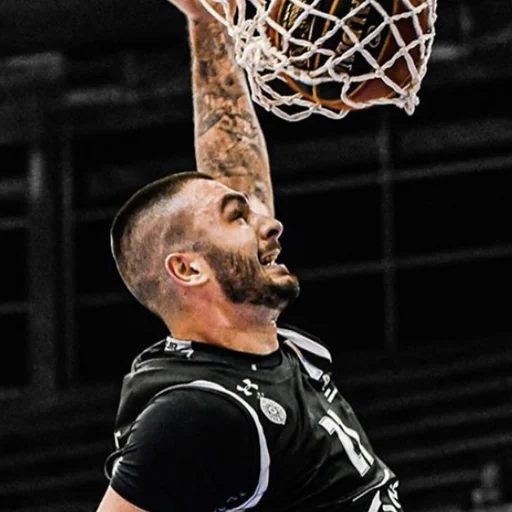
Nikola Janković
Co-founder · Former professional basketball player
Nikola Janković is a former professional basketball player — a 6'9" forward and the 2016–17 ABA League MVP — who played for Partizan, Union Olimpija and Mega, among others. Today he runs a pilates studio and gym focused on strength, mobility and overall wellbeing. He co-founded PUSHapp to make consistent, measurable training simple for everyone.