
Workouts & Programs
Pushup Workout Autoregulation for Busy Weeks
Discover practical pushup workout autoregulation for busy weeks with RPE, RiR, and readiness checks to boost strength without overreaching.


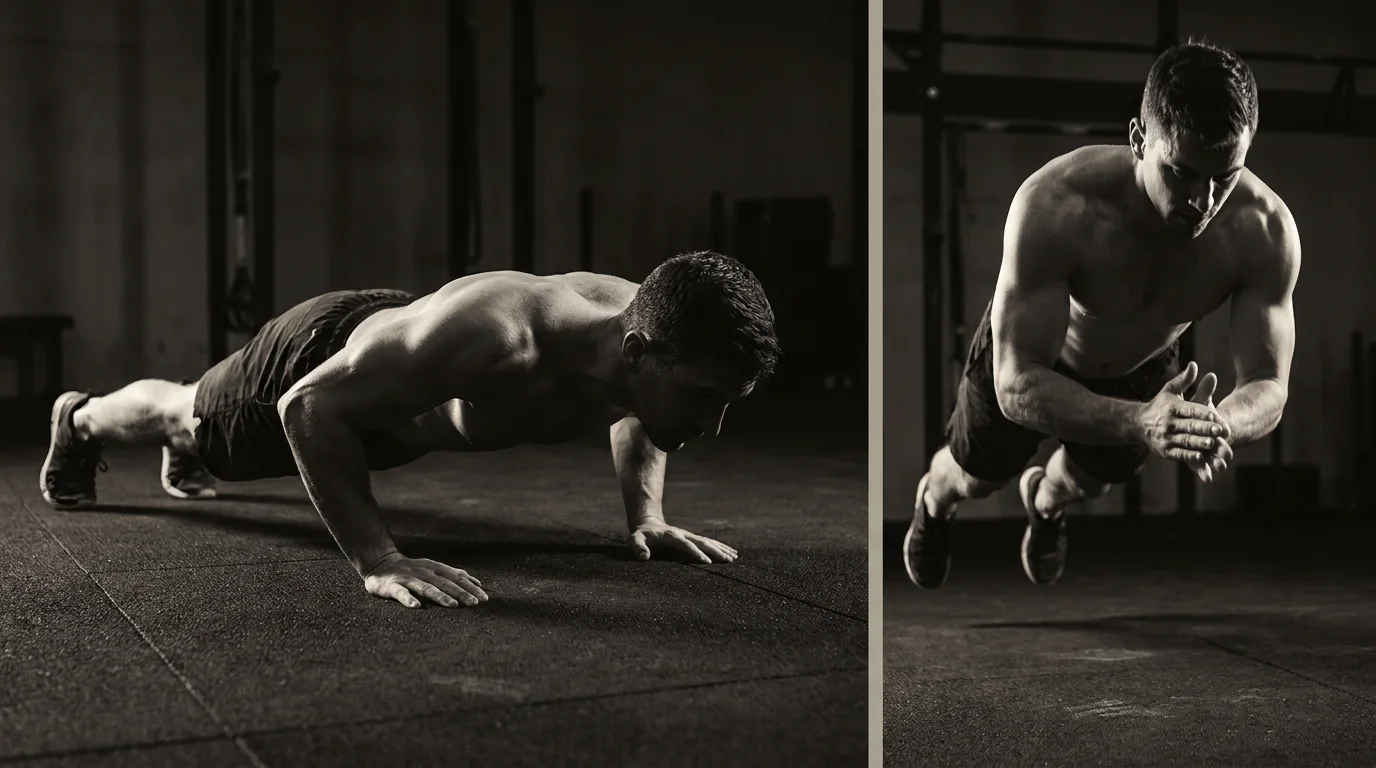
Foundations of autoregulation for bodyweight pushups
Autoregulation lets you tailor pushups to how you feel and what your week allows. For bodyweight pushups, rely on RPE and RiR to pace effort, and use velocity cues to stay sharp. You can calibrate without 1RM testing, and a quick readiness questionnaire helps flag fatigue before you train. In busy weeks, undulating periodization keeps progress steady without piling on volume.
Calibrating RPE and RiR for pushups without 1RM
- Baseline set: 6 to 8 solid reps. Note RPE after the set.
- RiR, or repetitions in reserve: if you could do 8 but stop at 6, you have 2 RiR.
- Plan: if RPE stays under 7 and reps rise, add a rep next session; if RPE rises but reps don't, hold.
Readiness questionnaires for upper-body workloads
- Quick check each day: sleep, soreness, mood, stress.
- If red flags appear, cut volume or skip to protect form.
Velocity-based cues and undulating periodization in busy weeks
- Velocity cues: if tempo slows on a set, back off a rep or two.
- Undulating periodization: mix light, moderate, and easy days; in busy weeks, two light days and one moderate day often fits well.
Practical templates for busy weeks: adaptive sets, reps, and microcycle planning
Adaptive set/rep templates for a busy week
- RiR rounds: pick an effort 1-2 reps shy of failure. In a 12 minute block, 4 rounds of 6-8 reps, rest 60 seconds. If you hit 8 reps consistently, add 1 next round; if you drop to 5-6, stay there and focus on form.
- Tempo and variations: tempo 2-0-2 for standard pushups or 3-0-2 for incline. Keep rounds near 6-12 total reps and swap incline or decline to fit energy; incline early, decline only when you feel strong.
- Rest strategy: on busy days lean on incline to maintain cadence; switch to decline when energy returns within the same window.
Pushup variations and tempo within autoregulation
- Progress from incline to standard to decline as energy allows; tempo 2-0-2 adds time under tension and control.
- RiR targets keep you in control rather than chasing a fixed number; if fatigue spikes, trim the next set by 2 reps.
Microcycle examples and progression
- Microcycle A: three days, moderate effort, RiR 1-2, 6-10 reps per set, 60-90 seconds rest.
- Microcycle B: add a tempo day, maintain rest.
- Microcycle C: shift to decline pushups for 3-4 sets of 4-6, using undulating periodization.
Monitoring, risk management, and advanced autoregulation methods for pushups
Choosing and validating readiness tools for pushups
- Use a readiness questionnaire validated for upper-body work and pair it with a quick self-check before each session.
- Ask about sleep quality, muscle soreness, pain in shoulders or wrists, fatigue, and recent training stress. If any red flags appear, scale the session.
- Alternatives to 1RM testing include push-up max reps to failure, submaximal tests, or an RPE based prescription. Track daily RPE to guide load.
Velocity-based autoregulation and velocity loss targets for pushups
- In velocity-based autoregulation you pace workouts to keep reps moving at a chosen speed. If velocity falls below your target, reduce volume or stop the set.
- Velocity loss targets help you manage fatigue within a set. Keep the drop in average rep velocity within the planned window; when it exceeds that, stop the set.
- Use a smartphone app, video analysis, or a wearable if available to estimate speed. In undulating periodization vary targets across days to fit a busy week.
Injury prevention and joint health during busy weeks
- Warm up thoroughly for shoulders and wrists; include scapular movement drills.
- Use joint friendly push-up variations if needed such as incline or knee pushups; avoid painful ranges.
- Protect joints and support injury risk management by avoiding excessive provocative loads on tired days; maintain good form; monitor for sharp pain and dial back.
Frequently asked questions
What is autoregulated resistance training and why use it?
Autoregulated resistance training means you adjust workouts to how you feel today, not to a fixed plan. It helps you stay strong during busy weeks by protecting form and finishing sessions with clean technique.
How can I autoregulate pushup workouts if I have a busy schedule?
Do a quick readiness check before training. Use a baseline of 6 to 8 solid pushups and track RPE and RiR; if RPE stays under 7 and reps rise, add a rep next session; if RPE rises but reps don't, hold. On busy days use incline to maintain cadence, tempo to control tension, and keep rest around 60 seconds.
What do RPE and RiR mean, and how do I apply them to bodyweight exercises like pushups?
RPE is your perceived effort after a set. RiR is reps in reserve, so if you could do 8 but stopped at 6 you have 2 RiR; plan to add a rep if RPE stays under 7 and reps rise, or hold if RPE rises but reps don't.
Can velocity targets or velocity loss be applied to bodyweight movements such as pushups, and how?
The article uses velocity cues to pace effort; if tempo slows on a set, back off a rep or two. It does not specify velocity loss targets for pushups, but tempo changes and undulating days help in busy weeks.
About the authors

Goran Huskić
Co-founder · Professional basketball player
Goran Huskić is a Serbian professional basketball player — a 6'11" center currently playing for Monbus Obradoiro in Spain's Primera FEB. He won the 2019–20 Basketball Champions League with San Pablo Burgos and has competed professionally across Spain, Germany, Lithuania, Serbia and the United States. He co-founded PUSHapp to bring pro-level training discipline to everyday workouts.

Nikola Janković
Co-founder · Former professional basketball player
Nikola Janković is a former professional basketball player — a 6'9" forward and the 2016–17 ABA League MVP — who played for Partizan, Union Olimpija and Mega, among others. Today he runs a pilates studio and gym focused on strength, mobility and overall wellbeing. He co-founded PUSHapp to make consistent, measurable training simple for everyone.