
Workouts & Programs
Home Pushup Workout: Complete At-Home Guide
Master a home pushup workout with beginner-to-advanced variations, form tips, and no-equipment routines for a stronger upper body.


Foundations for a Safe Home Pushup Workout
Wrist-friendly hand position and pain-free form
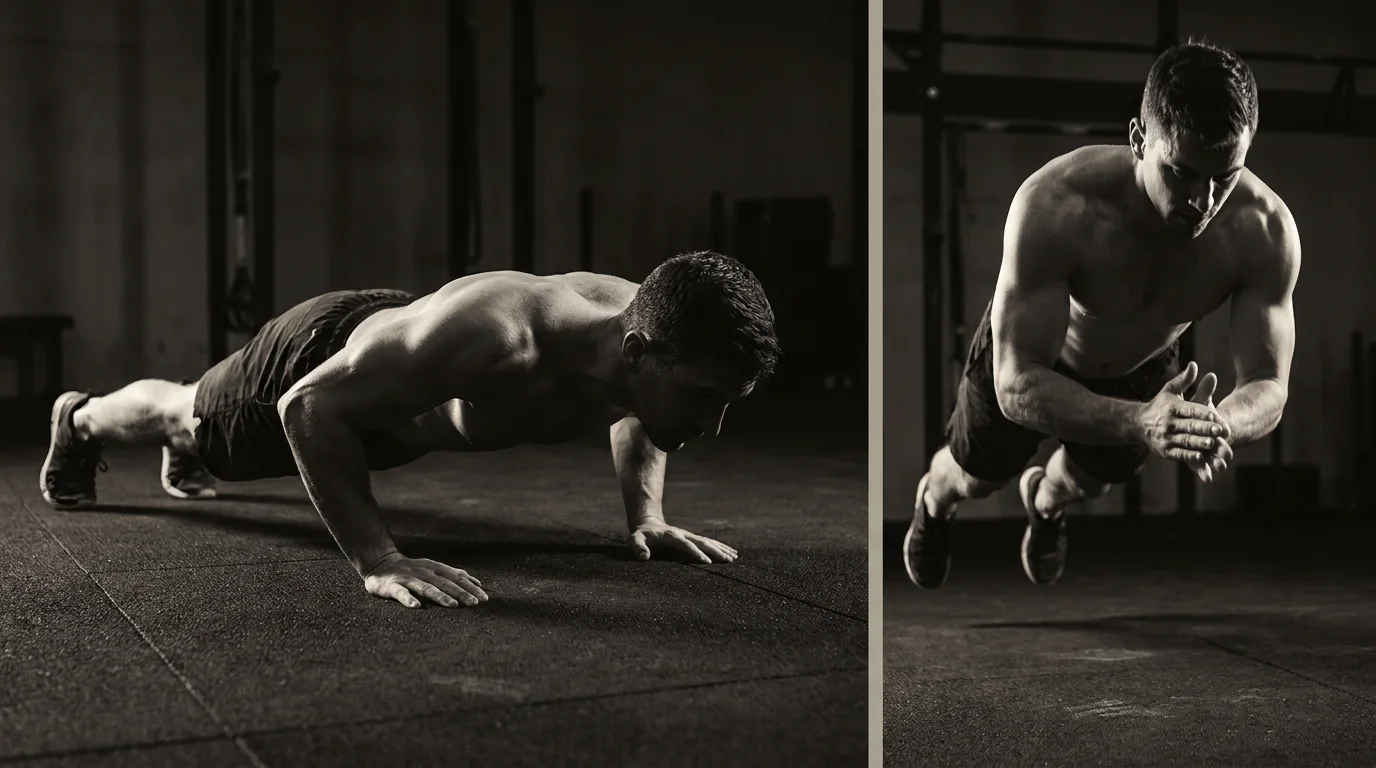
In a bodyweight workout, wrist comfort matters. Keep hands under the shoulders, fingers spread wide, and press through the base of the palms. Keep wrists neutral and forearms vertical or slightly angled. Tuck the shoulder blades down and back to start, then brace the core so the hips don’t sag. A steady, pain-free path keeps you in control during each rep.
Gradual progression: from wall to knee to incline to standard push-ups
Begin with wall push-ups to teach scapular stability and spinal alignment. Move to incline push-ups on a counter or bench, then knee push-ups to build strength, and finally standard push-ups as you gain control and confidence. This progression supports a safe, consistent path for beginner push-ups and a solid bodyweight workout.
Tempo and time-under-tension basics
Aim for a controlled tempo—lower yourself 2–3 seconds, slight pause at the bottom, then press up 2–3 seconds. Rest 30–60 seconds between sets to support form and consistency.
5–10 minute starter routine (no equipment required)
Wall push-ups: 2 sets of 8–12 reps; incline push-ups: 2 sets of 6–10 reps; knee push-ups: 2 sets of 6–8 reps. Adjust by feel, and finish with a quick shoulder/thorax reset. This keeps you moving toward a fuller home pushup workout.
Time-Efficient Pushups: 5–15 Minute Routines and Tempo-Driven Progressions
5–15 minute timer-based templates
- 5-minute template: 5 rounds, 40s work / 20s rest. Use standard push-ups, or drop to knee pushes if needed.
- 10-minute template: 8 rounds, 45s work / 15s rest. Maintain steady, controlled tempo.
- 15-minute template: 12 rounds, 40s work / 20s rest (12 minutes) plus 3 minutes of cooldown or mobility work.
Tempo progressions: using time-under-tension to build strength
- Start with tempo 2-0-2-0 (2s down, no pause, 2s up, no pause).
- Progress to 3-0-3-0 or add a 1-second pause at the bottom.
- Aim for smooth reps; time-under-tension compounds gains without extra equipment.
No-equipment days: seated or standing push-up alternatives
- Wall push-ups: 2–3 sets of 8–12 reps.
- Countertop/bench push-ups: 2–3 sets of 10–15.
- Seated edge push: 3 rounds of 8–10 reps.
Beginner-friendly quick-start routine (no equipment required)
- Round 1: 30s wall push-ups, 30s rest.
- Round 2: 30s incline push-ups (chair/ countertop), 30s rest.
- Round 3: 30s knee push-ups, 60s rest.
- Total about 4 minutes.
From Beginners to Advanced: Variations, Programming, and Troubleshooting
Choosing the right variation and progression plan
- In a home pushup workout, start with knee push-ups or incline push-ups to learn scapular stability and elbow tracking.
- Pick a plan that nudges you up 1–2 times per week, moving from knee → incline → standard while maintaining solid form.
Quantified progression: knee → incline → standard with reps/tempo targets
- Knee push-ups: 3 sets of 5–8 reps, tempo about 2 seconds down, 1 second up.
- Incline push-ups: 3 sets of 8–12 reps, same tempo.
- Standard push-ups: 3 sets of 6–12 reps, controlled descent (2 seconds down, 1 second up).
Muscle activation and scapular cues for chest, shoulders, core
- Think: chest press feel, shoulder blades lightly pinched, core braced, elbows tracking ~45 degrees from the torso.
Troubleshooting pain and form: how to fix wrist, elbow, or shoulder pain
- Wrist: use neutral grips or fists, spread load evenly; avoid collapsing wrists.
- Elbows: keep them tuck closer to the body to protect the shoulder.
- Shoulders: pause at the bottom if needed; ensure scapular stability before pressing to avoid flaring. If pain persists, drop back a variation.
Frequently asked questions
What are the best push-up variations for beginners at home?
Begin with wall push-ups to build scapular stability and spine alignment, then incline push-ups on a counter or bench to ease load, followed by knee push-ups, and finally standard push-ups as you gain control.
How do you modify a push-up to match your fitness level?
Use the progression from wall to incline to knee to standard to adjust load, and tailor reps and tempo to keep your form solid.
What is the proper form for a push-up to avoid injury?
Keep hands under the shoulders with wrists neutral, brace the core and keep hips in line, and tuck the elbows close to your body; move with a controlled tempo and scale back if you feel pain.
Can I incorporate push-ups into a quick three-move home routine?
Yes. A beginner-friendly quick-start uses wall push-ups, incline push-ups, and knee push-ups in sequence; this can be done with no equipment in about four minutes.
About the authors

Goran Huskić
Co-founder · Professional basketball player
Goran Huskić is a Serbian professional basketball player — a 6'11" center currently playing for Monbus Obradoiro in Spain's Primera FEB. He won the 2019–20 Basketball Champions League with San Pablo Burgos and has competed professionally across Spain, Germany, Lithuania, Serbia and the United States. He co-founded PUSHapp to bring pro-level training discipline to everyday workouts.

Nikola Janković
Co-founder · Former professional basketball player
Nikola Janković is a former professional basketball player — a 6'9" forward and the 2016–17 ABA League MVP — who played for Partizan, Union Olimpija and Mega, among others. Today he runs a pilates studio and gym focused on strength, mobility and overall wellbeing. He co-founded PUSHapp to make consistent, measurable training simple for everyone.